- 4.9/5.0
- 402 Questions
- Updated on: 12-Oct-2026
- Understanding Cisco Cybersecurity Operations Fundamentals (CBROPS)
- 24025 Prepared
Free Cisco 200-201 Practice Questions 2026 | Understanding Cisco Cybersecurity Operations Fundamentals (CBROPS)
An engineer received an alert affecting the degraded performance of a critical server Analysis showed a heavy CPU and memory load What is the next step the engineer should take to investigate this resource usage?
A. Run "ps -ef to understand which processes are taking a high amount of resources
B. Run "ps -u" to find out who executed additional processes that caused a high load on a server
C. Run "ps -m" to capture the existing state of daemons and map the required processes to find the gap
D. Run "ps -d" to decrease the priority state of high-load processes to avoid resource exhaustion
Explanation: When a server is experiencing high CPU and memory load, the first step is to identify the processes that are consuming the most resources. The command “ps -ef” is used to display information about all the running processes, including their IDs, memory and CPU usage, and the commands that started them. This allows the engineer to pinpoint which processes are responsible for the high load and take appropriate action, such as terminating unnecessary processes or optimizing resource usage.
During which phase of the forensic process are tools and techniques used to extract information from the collected data?
A. investigation
B. examination
C. reporting
D. collection
Explanation: During the examination phase of the forensic process, digital forensic
investigators use various tools and techniques to extract and analyze information from the
collected data. This phase involves detailed scrutiny of the data to uncover relevant
evidence and is critical for the success of the forensic investigation.
: The explanation aligns with the standard phases of digital forensics, which include
identification, preservation, examination, documentation, and presentation as outlined in
digital forensics literature and guidelines.
What is the difference between the ACK flag and the RST flag?
A. The RST flag approves the connection, and the ACK flag terminates spontaneous connections.
B. The ACK flag confirms the received segment, and the RST flag terminates the connection.
C. The RST flag approves the connection, and the ACK flag indicates that a packet needs to be resent
D. The ACK flag marks the connection as reliable, and the RST flag indicates the failure within TCP Handshake
Explanation: In TCP/IP networking, the ACK flag is used to acknowledge the receipt of a packet. It’s a way to confirm that the previous packets have been received and that the connection is proceeding as expected. The RST flag, on the other hand, is used to reset the connection. It is sent if a segment arrives which is not intended for the current connection, or if a connection request is to be denied. Essentially, the ACK flag is about maintaining the established connection, while the RST flag is about aborting connections that are not valid or are no longer needed.
What is the impact of encryption?
A. Confidentiality of the data is kept secure and permissions are validated
B. Data is accessible and available to permitted individuals
C. Data is unaltered and its integrity is preserved
D. Data is secure and unreadable without decrypting it
Explanation: Encryption ensures that data is secure and unreadable to unauthorized individuals without the proper decryption key. It is a critical aspect of maintaining data confidentiality and security, especially in the transmission of sensitive information over potentially insecure networks.
Which option describes indicators of attack?
A. spam emails on an employee workstation
B. virus detection by the AV software
C. blocked phishing attempt on a company
D. malware reinfection within a few minutes of removal
Explanation: Indicators of attack (IoAs) are signs that an attack may be in progress or imminent. Malware reinfection within a few minutes of removal (D) is a strong IoA because it suggests that the attacker has a persistent mechanism to redeploy malware, indicating an active compromise of the system.
A security analyst notices a sudden surge of incoming traffic and detects unknown packets from unknown senders After further investigation, the analyst learns that customers claim that they cannot access company servers According to NIST SP800-61, in which phase of the incident response process is the analyst?
A. post-incident activity
B. detection and analysis
C. preparation
D. containment, eradication, and recovery
Explanation: The analyst is in the detection and analysis phase of the incident response process according to NIST SP800-61. In this phase, events are detected and analyzed to determine whether they constitute incidents that require a response. It involves monitoring security events or data collection, correlation, and analysis of log entries and network flow data, among others. The goal is to identify incidents quickly so that appropriate actions can be taken.
Refer to the exhibit.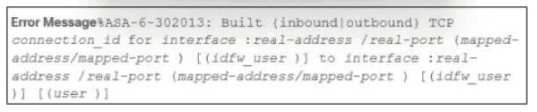
During the analysis of a suspicious scanning activity incident, an analyst discovered
multiple local TCP connection events Which technology provided these logs?
A. antivirus
B. proxy
C. IDS/IPS
D. firewall
Explanation: The logs indicating multiple local TCP connection events are typically provided by a firewall. Firewalls are responsible for monitoring and controlling incoming and outgoing network traffic based on predetermined security rules, and they generate logs that detail such events, which can be used for further analysis and incident response.
How does statistical detection differ from rule-based detection?
A. Statistical detection involves the evaluation of events, and rule-based detection requires an evaluated set of events to function.
B. Statistical detection defines legitimate data over time, and rule-based detection works on a predefined set of rules
C. Rule-based detection involves the evaluation of events, and statistical detection requires an evaluated set of events to function Rule-based detection defines
D. legitimate data over a period of time, and statistical detection works on a predefined set of rules
Explanation: Statistical detection relies on analyzing data over time to identify patterns and anomalies, without predefined rules. It uses algorithms and statistical models to determine normal behavior and identify deviations. Rule-based detection uses predefined rules or patterns to identify known threats or vulnerabilities, often based on signatures or behaviors associated with specific attacks.
Which are two denial-of-service attacks? (Choose two.)
A. TCP connections
B. ping of death
C. man-in-the-middle
D. code-red
E. UDP flooding
E. UDP flooding
Explanation:
- The ping of death is a type of attack that involves sending oversized or malformed packets using the ICMP protocol to crash, freeze, or reboot the target system1.
- UDP flooding is an attack method that sends a large number of User Datagram Protocol (UDP) packets to random ports on a remote host, causing the host to repeatedly check for the application listening at that port, and (when no application is found) reply with an ICMP Destination Unreachable packet. This process can saturate the network and the resources of the host, leading to denial of service2.
What is a Heartbleed vulnerability?
A. information disclosure
B. buffer overflow
C. denial of service
D. command injection
| Page 19 out of 41 Pages |