• 4.9/5.0
  • 1197 Questions
  • Updated on: 25-May-2026
  • Cisco Certified Network Associate
  • 211975 Prepared

Free Cisco 200-301 Practice Questions 2026 | Cisco Certified Network Associate


Topic 1: Exam Pool A


desc about topic

What is the purpose of a southbound API in a control based networking architecture?

A. Facilities communication between the controller and the applications

B. Facilities communication between the controller and the networking hardware

C.

allows application developers to interact with the network

D. integrates a controller with other autoamation and orchestration tools.

B.   Facilities communication between the controller and the networking hardware

Explanation:

https://www.ciscopress.com/articles/article.asp?p=2995354&seqNum=2#:~:text=The-S
outhbound-Interface,communicate-to-the-networking-devices.&text=The -overall-goal-is-network,from-being-only-a-protocol.
The Southbound Interface In a controller-based network architecture, the controller needs to communicate to the networking devices.

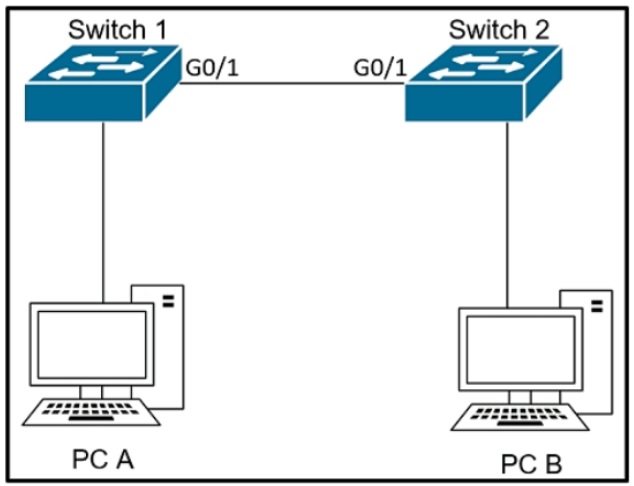
Refer to the exhibit.

The network administrator wants VLAN 67 traffic to be untagged between Switch 1 and
Switch 2 while all other VLANs are to remain tagged.
Which command accomplishes this task?

A. switchport access vlan 67

B. switchport trunk allowed vlan 67

C. switchport private-vlan association host 67

D. switchport private-vlan association host 67

D.   switchport private-vlan association host 67

Refer to the exhibit
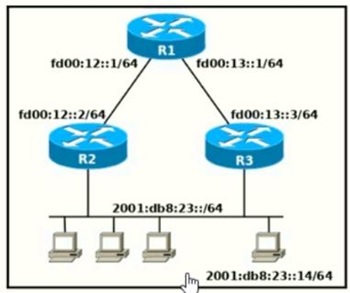
Which two commands, when configured on router R1, fulfill these requirements? (Choose two.) Packets towards the entire network 2001:db8:2::/64 must be forwarded through router R2.
Packets toward host 2001:db8:23::14 preferably must be forwarded through R3.

A. Ipv6 route 2001:db8:23::/128 fd00:12::2

B. Ipv6 route 2001:db8:23::14/128 fd00:13::3

C. Ipv6 route 2001:db8:23::14/64 fd00:12::2

D. Ipv6 route 2001:db8:23::/64 fd00:12::2

E. Ipv6 route 2001:db8:23::14/64 fd00:12::2 200

D.   Ipv6 route 2001:db8:23::/64 fd00:12::2
E.   Ipv6 route 2001:db8:23::14/64 fd00:12::2 200

What are two fundamentals of virtualization? (choose two)

A. The environment must be configured with one hypervisor that serves solely as a network manager to monitor SNMP traffic

B. It allows logical network devices to move traffic between virtual machines and the rest of the physical network

C. It allows multiple operating systems and applications to run independently on one physical server.

D. It allows a physical router to directly connect NICs from each virtual machine into the network E. It requires that some servers, virtual machines and network gear reside on the Internet

B.   It allows logical network devices to move traffic between virtual machines and the rest of the physical network
C.   It allows multiple operating systems and applications to run independently on one physical server.

How do servers connect to the network in a virtual environment?

A. wireless to an access point that is physically connected to the network

B. a cable connected to a physical switch on the network

C. a virtual switch that links to an access point that is physically connected to the network

D. a software switch on a hypervisor that is physically connected to the network

D.   a software switch on a hypervisor that is physically connected to the network

Which 802.11 management frame type is sent when a client roams between access points on the same SSID?

A. Reassociation Request

B. Probe Request

C. Authentication Request

D. Association Request

A.   Reassociation Request

What is a role of wireless controllers in an enterprise network?

A. centralize the management of access points in an enterprise network

B. support standalone or controller-based architectures

C. serve as the first line of defense in an enterprise network

D. provide secure user logins to devices on the network.

A.   centralize the management of access points in an enterprise network

Which two protocols are supported on service-port interfaces? (Choose two.)

A. RADIUS

B. TACACS+

C. SCP

D. Telnet

E. SSH

D.   Telnet
E.   SSH

Explanation:

https://www.cisco.com/c/en/us/td/docs/wireless/controller/7-5/configurationguide/ b_cg75/b_cg75_chapter_011110.html

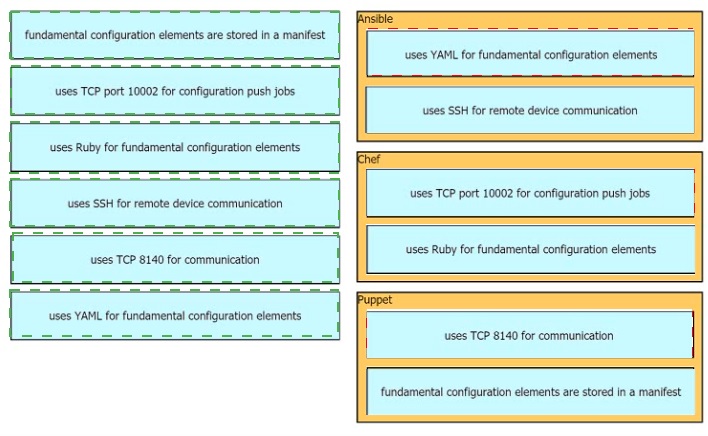
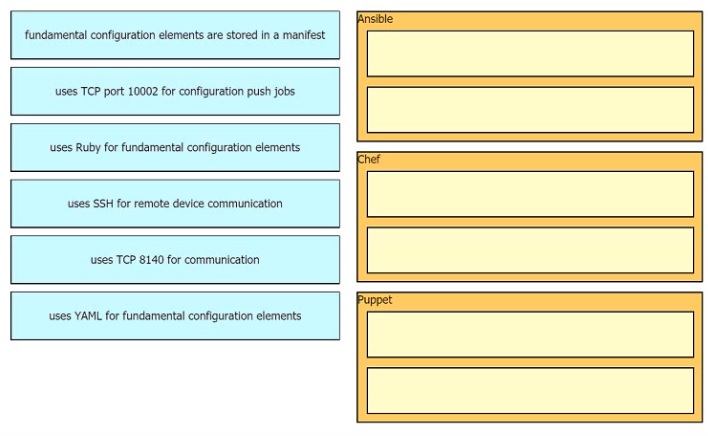
Drag drop the descriptions from the left onto the correct configuration-management technologies on the right.

How do TCP and UDP differ in the way they guarantee packet delivery?

A. TCP uses checksum, acknowledgement, and retransmissions, and UDP uses checksums only.

B. TCP uses two-dimensional parity checks, checksums, and cyclic redundancy checks and UDP uses retransmissions only.

C. TCP uses checksum, parity checks, and retransmissions, and UDP uses acknowledgements only.

D. TCP uses retransmissions, acknowledgement and parity checks and UDP uses cyclic redundancy checks only.

A.   TCP uses checksum, acknowledgement, and retransmissions, and UDP uses checksums only.

Page 23 out of 120 Pages