• 4.9/5.0
  • 1197 Questions
  • Updated on: 25-May-2026
  • Cisco Certified Network Associate
  • 211975 Prepared

Free Cisco 200-301 Practice Questions 2026 | Cisco Certified Network Associate


Topic 3: Exam Pool C

Refer to the exhibit.
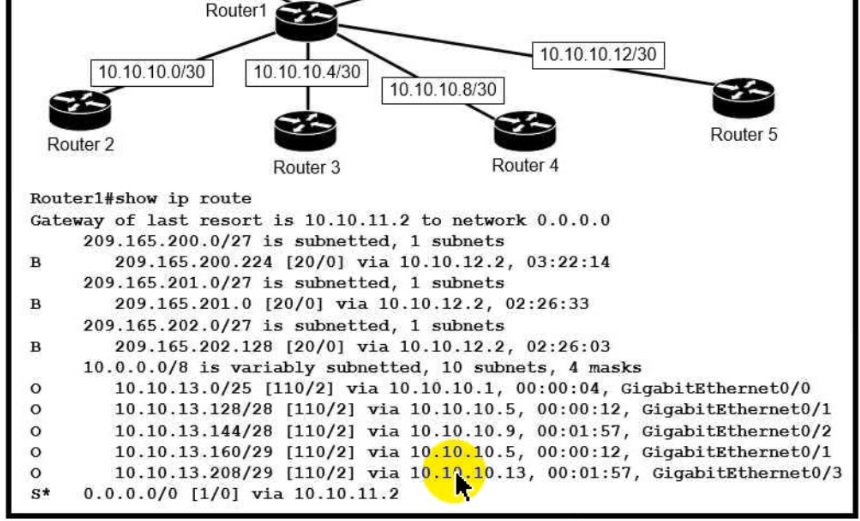
Which next-hop IP address does Routed use for packets destined to host 10 10.13.158?

A. 10.10.10.5

B. 10.10.11.2

C. 10.10.12.2

D. 10.10.10.9

A.   10.10.10.5

Which protocol is used for secure remote CLI access?

A. HTTPS

B. HTTP

C. Telnet

D. SSH

D.   SSH

Which REST method updates an object in the Cisco DNA Center Intent API?

A. CHANGE

B. UPDATE

C. POST

D. PUT

D.   PUT

Explanation:

PUT is most-often utilized for **update** capabilities, PUT-ing to a known resource URI with the request body containing the newly-updated representation of the original resource.However, PUT can also be used to create a resource in the case where the resource ID is chosen by the client instead of by the server. In other words, if the PUT is to a URI that contains the value of a non-existent resource ID. Again, the request body contains a resource representation. Many feel this is convoluted and confusing. Consequently, this method of creation should be used sparingly, if at all.Alternatively, use POST to create new resources and provide the client-defined ID in the body representation—presumably to a URI that doesn’t include the ID of the resource (see POST below).On successful update, return 200 (or 204 if not returning any content in the body) from a PUT. If using PUT for create, return HTTP status 201 on successful creation. A body in the response is optional—providing one consumes more bandwidth. It is not necessary to return a link via a Location header in the creation case since the client already set the resource ID.PUT is not a safe operation, in that it modifies (or creates) state on the server, but it is idempotent. In other words, if you create or update a resource using PUT and then make that same call again, the resource is still there and still has the same state as it did with the first call.If, for instance, calling PUT on a resource increments a counter within the resource, the call is no longer idempotent. Sometimes that happens and it may be enough to document that the call is not idempotent. However, it’s recommended to keep PUT requests idempotent. It is strongly recommended to use POST for non-idempotent requests.Examples: https://www.restapitutorial.com/lessons/httpmethods.html

Refer to the exhibit


Users on existing VLAN 100 can reach sites on the Internet. Which action must the
administrator take to establish connectivity to the Internet for users in VLAN 200?

A. Define a NAT pool on the router.

B. Configure static NAT translations for VLAN 200.

C. Configure the ip nat outside command on another interface for VLAN 200.

D. Update the NAT INSIDF RANGFS ACL

B.   Configure static NAT translations for VLAN 200.

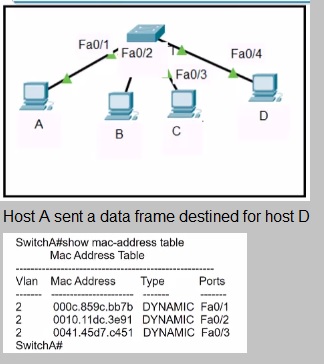
Refer to the exhibit.

What does the switch do when it receives the frame from host A?

A. It drops the frame from the switch CAM table.

B. It floods the frame out of all ports except port Fa0/1.

C. It shuts down the port Fa0/1 and places it in err-disable mode.

D. It experiences a broadcast storm

B.   It floods the frame out of all ports except port Fa0/1.

What is a zero-day exploit?

A.

It is when a new network vulnerability is discovered before a fix is available

B. It is when the perpetrator inserts itself in a conversation between two parties and captures or alters data.

C. It is when the network is saturated with malicious traffic that overloads resources and bandwidth

D. It is when an attacker inserts malicious code into a SOL server.

A.   

It is when a new network vulnerability is discovered before a fix is available


Explanation:

https://www.kaspersky.com/resource-center/definitions/zero-day-exploit

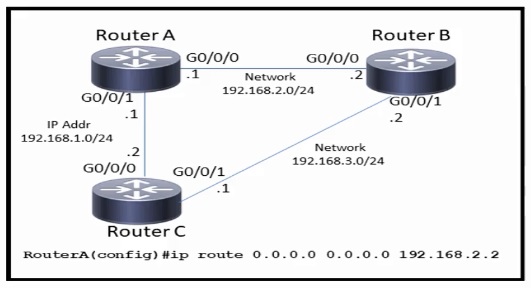
Refer to the exhibit.

Which command must be issued to enable a floating static default route on router A?

A. lp route 0.0.0.0 0.0.0.0 192.168.1.2

B. ip default-gateway 192.168.2.1

C. ip route 0.0.0.0 0.0.0.0 192.168.2.1 10

D. ip route 0.0.0.0 0.0.0.0 192.168.1.2 10

D.   ip route 0.0.0.0 0.0.0.0 192.168.1.2 10

Refer to the exhibit.
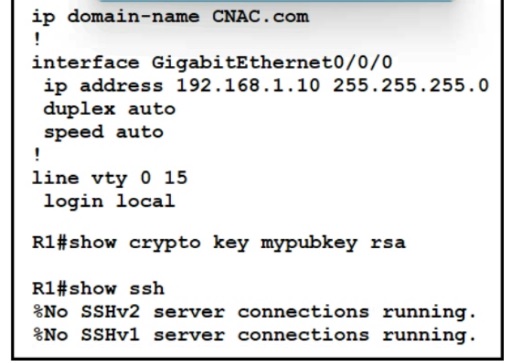
Which two commands must be added to update the configuration of router R1 so that it accepts only encrypted connections? (Choose two )

A. username CNAC secret R!41!4319115@

B. ip ssh version 2

C. line vty 0 4

D. crypto key generate rsa 1024

E. transport input ssh

D.   crypto key generate rsa 1024
E.   transport input ssh


A Cisco engineer must configure a single switch interface to meet these requirements
• accept untagged frames and place them in VLAN 20
• accept tagged frames in VLAN 30 when CDP detects a Cisco IP phone
Which command set must the engineer apply?
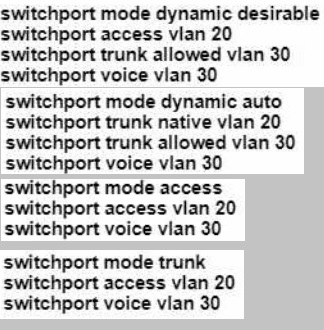
A. Option A

B. Option B

C. Option C

D. Option D

C.   Option C

Page 45 out of 120 Pages