- 4.9/5.0
- 1197 Questions
- Updated on: 25-May-2026
- Cisco Certified Network Associate
- 211975 Prepared
Free Cisco 200-301 Practice Questions 2026 | Cisco Certified Network Associate
Topic 1: Exam Pool A
desc about topic
In software-defined architecture, which place handles switching for traffic through a Cisco router?
A. Control
B. Management
C. Data
D. application
Explanation:
Data plane—Handles all the data traffic. The basic functionality of a Cisco NX-OS device is to forward packets from one interface to another. The packets that are not meant for the switch itself are called the transit packets. These packets are handled by the data plane
Which type of address is the public IP address of a NAT device?
A. outside global
B. outsdwde local
C. inside global
D. insride local
E.
outside public
F.
inside public
Explanation:
NAT use four types of addresses:
* Inside local address – The IP address assigned to a host on the inside network. The address is usually not an IP address assigned by the Internet Network Information Center (InterNIC) or service provider.This address is likely to be an RFC 1918 private address.
* Inside global address – A legitimate IP address assigned by the InterNIC or service provider that represents one or more inside local IP addresses to the outside world.
* Outside local address – The IP address of an outside host as it is known to the hosts on the inside network.
* Outside global address – The IP address assigned to a host on the outside network. The owner of the host assigns this address.
Which CRUD operation corresponds to the HTTP GET method?
A. read
B. update
C. create
D. delete
Explanation:
GET: This method retrieves the information identified by the request URI. In the context of the RESTful web services, this method is used to retrieve resources. This is the method used for read operations (the R in CRUD). https://hub.packtpub.com/crud-operations-rest
Which type of wireless encryption is used for WPA2 in preshared key mode?
A. TKIP with RC4
B. RC4
C. AES-128
D. AES-256
Explanation:
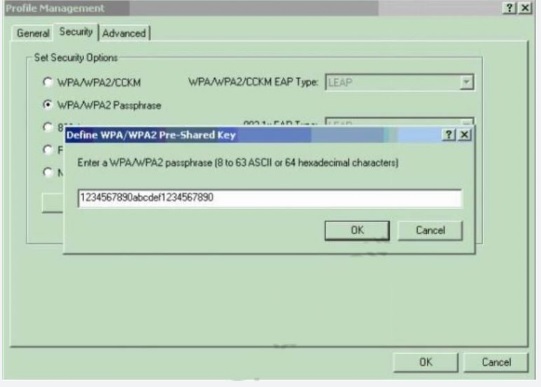
We can see in this picture we have to type 64 hexadecimal characters (256 bit) for the
WPA2 passphrase so we can deduce the encryption is AES-256, not AES-128.
What is the difference regarding reliability and communication type between TCP and UDP?
A. TCP is reliable and is a connection-oriented protocol UDP is not reliable and is a connectionless protocol
B. TCP is not reliable and is a connection-oriented protocol; UDP is reliable and is a connectionless protocol
C. TCP is not reliable and is a connectionless protocol; UDP is reliable and is a connectionoriented protocol
D. TCP is reliable and is a connectionless protocol; UDP is not reliable and is a connectionoriented protocol
A network administrator must enable DHCP services between two sites. What must be configured for the router to pass DHCPDISCOVER messages on to the server?
A. a DHCP Relay Agent
B. DHCP Binding
C. a DHCP Pool
D. DHCP Snooping
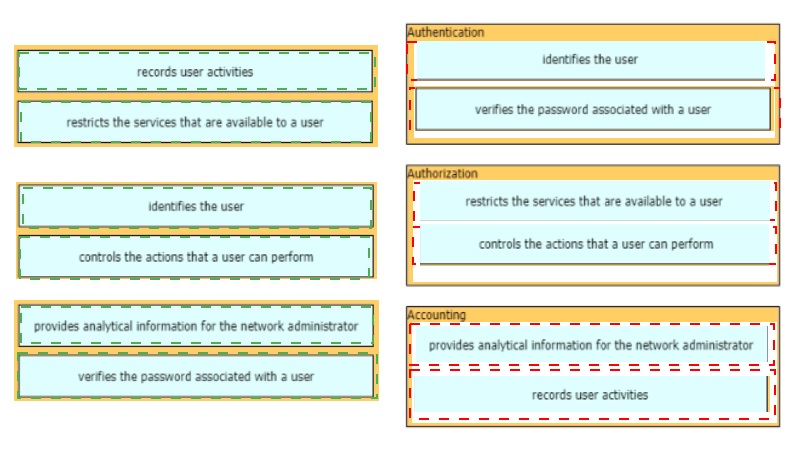
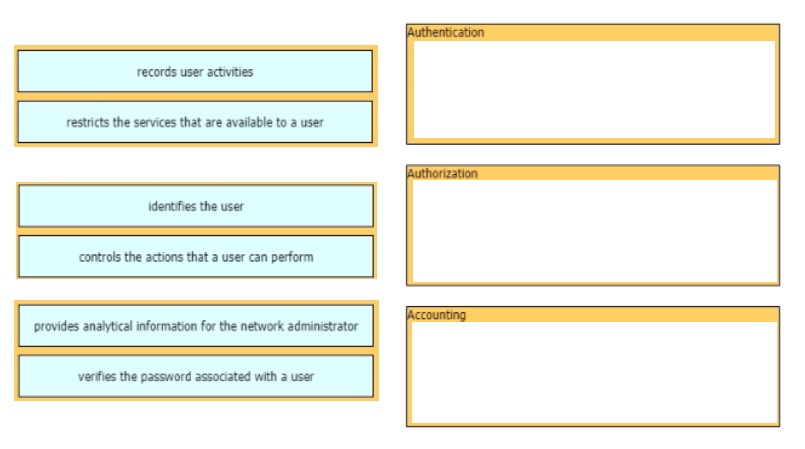
Drag and drop the AAA functions from the left onto the correct AAA services on the right
Which access layer threat-mitigation technique provides security based on identity?
A. Dynamic ARP Inspection
B. using a non-default native VLAN
C. 802.1x
D. DHCP snooping
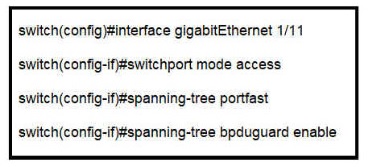
Refer to the exhibit.
What is the result if Gig1/11 receives an STP BPDU?
A. The port transitions to STP blocking
B. The port transitions to the root port
C. The port immediately transitions to STP forwarding.
D. The port goes into error-disable state
in Which way does a spine and-leaf architecture allow for scalability in a network when additional access ports are required?
A. A spine switch and a leaf switch can be added with redundant connections between them
B. A spine switch can be added with at least 40 GB uplinks
C. A leaf switch can be added with a single connection to a core spine switch.
D. A leaf switch can be added with connections to every spine switch
Explanation:
Spine-leaf architecture is typically deployed as two layers: spines (such as an aggregation layer), and leaves (such as an access layer). Spine-leaf topologies provide high-bandwidth, low-latency, nonblocking server-to-server connectivity. Leaf (aggregation) switches are what provide devices access to the fabric (the network of spine and leaf switches) and are typically deployed at the top of the rack. Generally, devices connect to the leaf switches. Devices can include servers, Layer 4-7 services (firewalls and load balancers), and WAN or Internet routers. Leaf switches do not connect to other leaf switches. In spine-and-leaf architecture, every leaf should connect to every spine in a full mesh. Spine (aggregation) switches are used to connect to all leaf switches and are typically deployed at the end or middle of the row. Spine switches do not connect to other spine switches.
| Page 8 out of 120 Pages |