- 4.9/5.0
- 126 Questions
- Updated on: 25-May-2026
- Conducting Forensic Analysis and Incident Response Using Cisco CyberOps Technologies (CBRFIR)
- 21265 Prepared
Free Cisco 300-215 Practice Questions 2026 | Conducting Forensic Analysis and Incident Response Using Cisco CyberOps Technologies (CBRFIR)
In a secure government communication network, an automated alert indicates the presence of anomalous DLL files injected into the system memory during a routine update of communication protocols. These DLL files are exhibiting beaconing behavior to a satellite IP known for signal interception risks. Concurrently, there is an uptick in encrypted traffic volumes that suggests possible data exfiltration. Which set of actions should the security engineer prioritize?
A. Invoke a classified incident response scenario, notify national defense cyber operatives, and begin containment and eradication procedures on affected systems.
B. Conduct memory forensics to analyze the suspicious DLL files, disrupt the beaconing sequence, and assess the encrypted traffic for breach indicators.
C. Activate a secure emergency communication channel, isolate the segments of the communication network, and initiate a threat hunting operation for further anomalies.
D. Sever connections to the satellite IP, execute a rollback of the recent protocol updates, and engage counter-intelligence cybersecurity measures.
An “unknown error code” is appearing on an ESXi host during authentication. An engineer checks the authentication logs but is unable to identify the issue. Analysis of the vCenter agent logs shows no connectivity errors. What is the next log file the engineer should check to continue troubleshooting this error?
A. /var/log/syslog.log
B. /var/log/vmksummary.log
C. /var/log/shell.log
D. /var/log/general/log
A security team needs to prevent a remote code execution vulnerability. The vulnerability can be exploited only by sending '${ string in the HTTP request. WAF rule is blocking '${', but system engineers detect that attackers are executing commands on the host anyway. Which action should the security team recommend?
A. Enable URL decoding on WAF.
B. Block incoming web traffic.
C. Add two WAF rules to block 'S' and '{' characters separately.
D. Deploy antimalware solution.
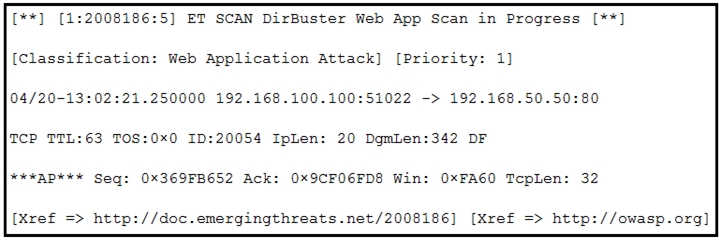
Refer to the exhibit.

According to the SNORT alert, what is the attacker performing?
A. brute-force attack against the web application user accounts
B. XSS attack against the target webserver
C. brute-force attack against directories and files on the target webserver
D. SQL injection attack against the target webserver
A scanner detected a malware-infected file on an endpoint that is attempting to beacon to an external site. An analyst has reviewed the IPS and SIEM logs but is unable to identify the file’s behavior. Which logs should be reviewed next to evaluate this file further?
A. email security appliance
B. DNS server
C. Antivirus solution
D. network device
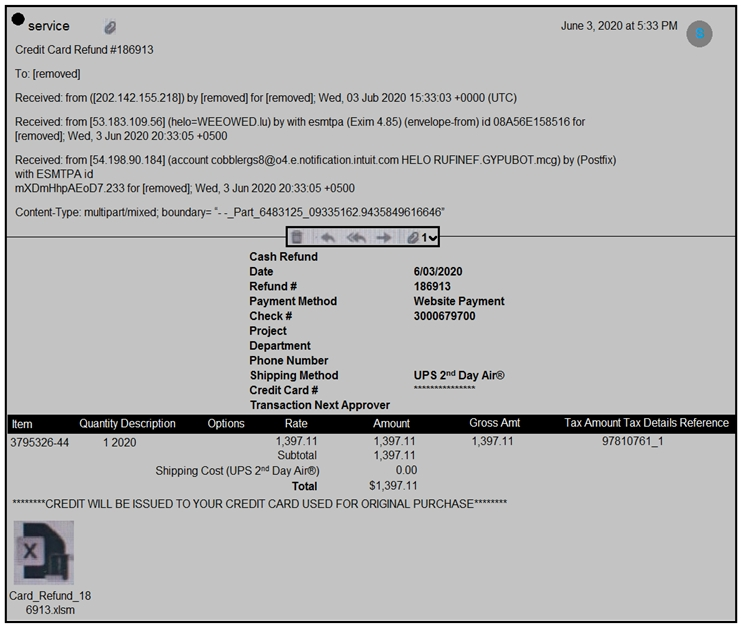
Refer to the exhibit.

Which element in this email is an indicator of attack?
A. IP Address: 202.142.155.218
B. content-Type: multipart/mixed
C. attachment: “Card-Refund”
D. subject: “Service Credit Card”
During an overnight shift, a cybersecurity team at a global trading firm detects irregular activity The network intrusion system flags an encrypted traffic spike from high-value transaction servers to an anonymous Tor exit node Simultaneously, internal surveillance tools report unusual database queries and access patterns resembling exfiltration techniques Which focused action should the team take first to analyze and address these potential security threats?
A. Initiate immediate containment protocols tor transaction servers.
B. Implement dynamic firewall rules to block suspicious outbound connections
C. Cross-reference database access logs with user activity profiles
D. Engage advanced decryption and anomaly analysis for the flagged traffic
An incident response team is recommending changes after analyzing a recent compromise
in which:
a large number of events and logs were involved;
team members were not able to identify the anomalous behavior and escalate it in
a timely manner;
several network systems were affected as a result of the latency in detection;
security engineers were able to mitigate the threat and bring systems back to a
stable state; and
the issue reoccurred shortly after and systems became unstable again because
the correct information was not gathered during the initial identification phase.
Which two recommendations should be made for improving the incident response process?
(Choose two.)
A. Formalize reporting requirements and responsibilities to update management and internal stakeholders throughout the incident-handling process effectively.
B. Improve the mitigation phase to ensure causes can be quickly identified, and systems returned to a functioning state.
C. Implement an automated operation to pull systems events/logs and bring them into an organizational context.
D. Allocate additional resources for the containment phase to stabilize systems in a timely manner and reduce an attack’s breadth.
E. Modify the incident handling playbook and checklist to ensure alignment and agreement on roles, responsibilities, and steps before an incident occurs.
Which type of record enables forensics analysts to identify fileless malware on Windows machines?
A. IIS logs
B. file event records
C. PowerShell event logs
D. network records
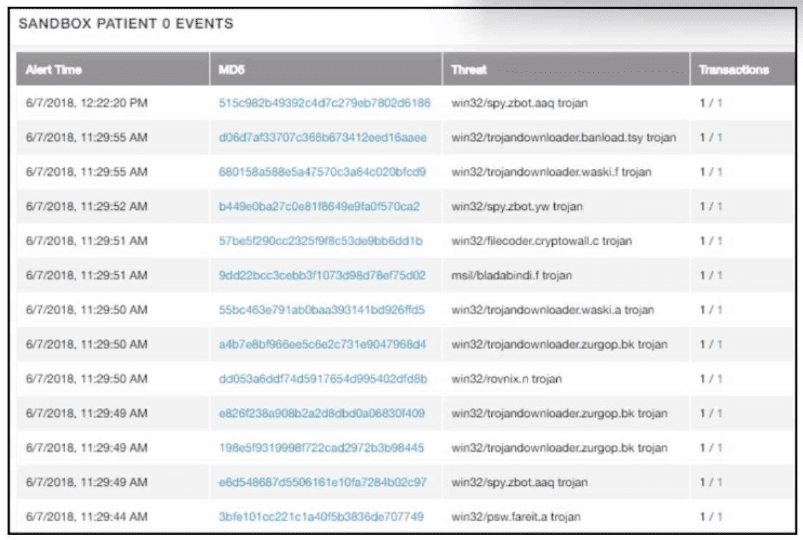
Refer to the exhibit.

multiple machines behave abnormally. A sandbox analysis reveals malware. What must
the administrator determine next?
A. if Patient 0 still demonstrates suspicious behavior
B. source code of the malicious attachment
C. if the file in Patient 0 is encrypted
D. if Patient 0 tried to connect to another workstation
| Page 3 out of 13 Pages |