- 4.9/5.0
- 318 Questions
- Updated on: 25-May-2026
- Designing Cisco Enterprise Networks (ENSLD)
- 23185 Prepared
Free Cisco 300-420 Practice Questions 2026 | Designing Cisco Enterprise Networks (ENSLD)
An enterprise customer has these requirements:
end-to-end QoS for the business-critical applications and VoIP services based on CoS marking.
flexibility to offer services such as IPv6 and multicast without any reliance on the
service provider.
support for full-mesh connectivity at Layer 2.
Which WAN connectivity option meets these requirements?
A.
VPWS
B.
MPLS VPN
C.
DMVPN
D.
VPLS
VPLS
An engineer is designing an EIGRP network for a small branch site where there is only one
Layer 3 router. The engineer wants the router to advertise the local LAN network to remote
EIGRP neighbors without sending any unnecessary multicast messages on the local LAN.
Which action should the engineer take?
A.
Use a static default route for this site instead of EIGRP
B.
Advertise the local LAN using the network command and the passive-interface feature
C.
Redistribute the local LAN network using the redistribute connected command
D.
Advertise the local LAN subnet as a stub network
Advertise the local LAN using the network command and the passive-interface feature
An architect must develop a campus network solution that includes:
logically segmented and isolated networks
ability to communicate between network segments when required
support for overlapping IP addresses
widely available technologies to avoid purchasing specialized equipment
Which solution must the architect select?
A.
VSS with IGP
B.
802.1Q with HSRP
C.
vPC with HSRP
D.
VRF-Lite with OSPF
VRF-Lite with OSPF
When designing interdomain multicast, which two protocols are deployed to achieve communication between multicast sources and receivers? (Choose two.)
A.
A. IGMPv2
B.
BIDIR-PIM
C.
MP-BGP
D.
MSDP
E.
MLD
MP-BGP
D.
MSDP
A branch office has a primary L3VPN MPLS connection back to the main office and an
IPSEC VPN tunnel that serves as backup. Which design ensures that data is sent over the
backup connection only if the primary MPLS circuit is down?
A.
Use EIGRP to establish a neighbor relationship with the main office via
B.
L3VPN MPLS and the IPSEC VPN tunnel.
C.
Use BGP with the multipath feature enabled to force traffic via the primary path when
available.
D.
Use static routes tied to an IP SLA to prefer the primary path while a floating static route
points to the backup connection.
E.
Use OSPF with a passive-interface command on the backup connection
Use static routes tied to an IP SLA to prefer the primary path while a floating static route
points to the backup connection.
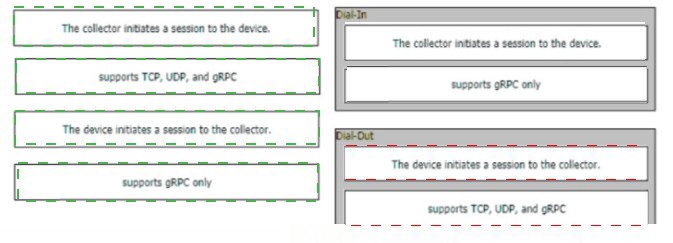
Drag and drop the characteristics from the left onto the telemetry mode they apply to on the right.

Refer to the exhibit. All routers currently reside in OSPF area 0. The network manager
recently used R1 and R2 as aggregation routers for remote branch locations and R3 and
R4 for aggregation routers for remote office locations. The network has since been
suffering from outages, which are causing frequent SPF runs. To enhance stability and
introduce areas to the OSPF network with the minimal number of ABRs possible, which two
solutions should the network manager recommend? (Choose two.)
A.
a new OSPF area for R1 and R2 connections,with R1 and R2as ABRs
B.
a new OSPF area for R3 and R4 connections,with R5 and R6as ABRs
C.
a new OSPF area for R3 and R4 connections,with R3 and R4as ABRs
D.
a new OSPF area for R1, R2, R3, and R4 connections, with R1, R2, R3, and R4 as ABRs
E.
a new OSPF area for R1 and R2 connections, with R5 and R6 as ABRs
a new OSPF area for R3 and R4 connections,with R5 and R6as ABRs
E.
a new OSPF area for R1 and R2 connections, with R5 and R6 as ABRs
An existing network solution is using BFD in echo mode. Several of the network devices
are experiencing high CPU utilization which an engineer has determined is related to the
BFD feature. Which solution should the engineer leverage to reduce the CPU load?
A.
Implement slow timers between peers with low CPU resources.
B.
Implement BED asynchronous mode between peers with low CPU resources.
C.
Enable BFD multi-hop on the devices with low CPU resources.
D.
Utilize carrier delay on all routers in the network.
Implement slow timers between peers with low CPU resources.
At which layer does Cisco Express Forwarding use adjacency tables to populate
addressing information?
A.
Layer4
B.
Layer 2
C.
Layer 1
D.
Layer 3
Layer 2
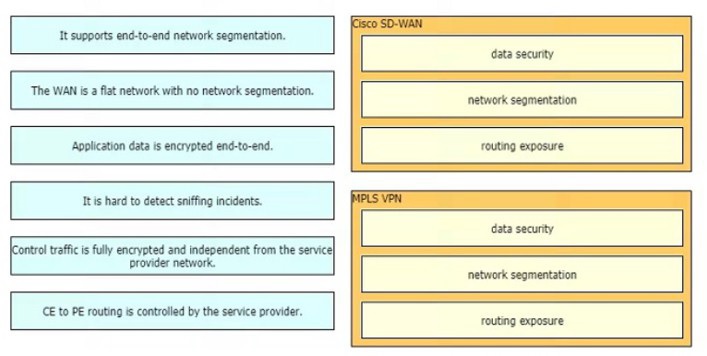
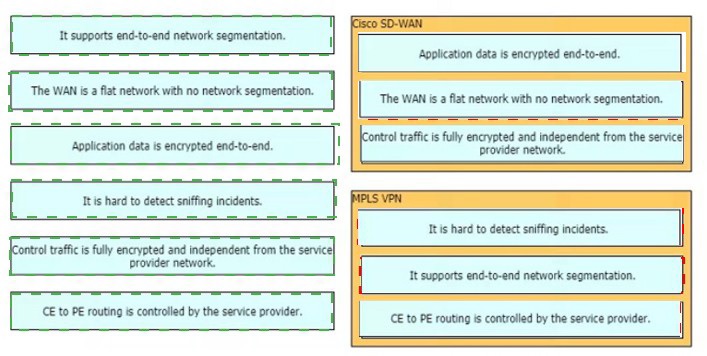
Drag and drop the description from the left onto the corresponding WAN connectivity types and categories on the right.
| Page 14 out of 32 Pages |