- 4.9/5.0
- 268 Questions
- Updated on: 12-Oct-2026
- 300-510
- 22685 Prepared
Free Cisco 300-510 Practice Questions 2026 | 300-510
Refer to the exhibit.
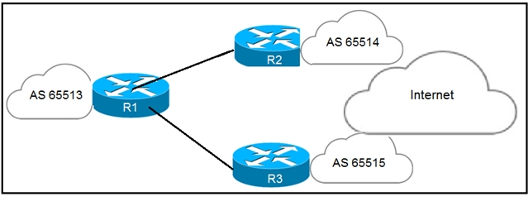
An engineer has successfully fixed BGP peering issue. R1 has an established eBGP
peering with R2 and R3. Which mechanism should the engineer apply in order to steer the
traffic correctly?
A. The MED attribute can be applied on R2 to influence R1 to use it as the primary path.
B. The local preference attribute can be applied on R3 to influence AS 65513 to use AS 65515 as the secondary path.
C. The weight attribute can be applied on R2 to influence AS 65513 to use AS 65515 as the primary path.
D. The IGP metric can be manipulated on R1 to allow traffic to be load balanced between R2 and R3.
Refer to the exhibit.
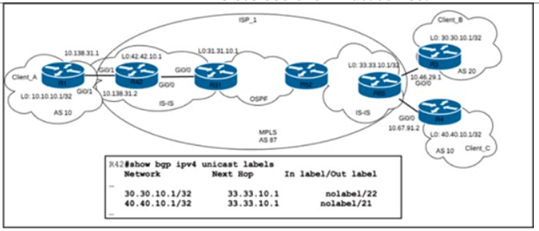
ISP_1 uses eBGP for connection to all clients LDP with OSPF and IS-IS is used in the
ISP_1 network Client_A and Client_B are in the same VRF_VoD. After oftware upgrade on
all routers on the ISP_1 network, Client_A has lost the connection to Client_C. A network
engineer must troubleshoot the connection from R1 to R4 via M. After initial checks, the
engineer confirmed that all routes are installed correctly. Which two tasks must the
engineer perform to correct the problem? (Choose two.)
A. Configure next-hop-self under the BGP configuration on R42.
B. Configure mpls label implicit-null under the global configuration on R31.
C. Configure next-hop-unchanged under the BGP configuration on R31.
D. Configure ip cef under the global configuration on R31.
E. Configure send-label under the BGP configuration on R42
E. Configure send-label under the BGP configuration on R42
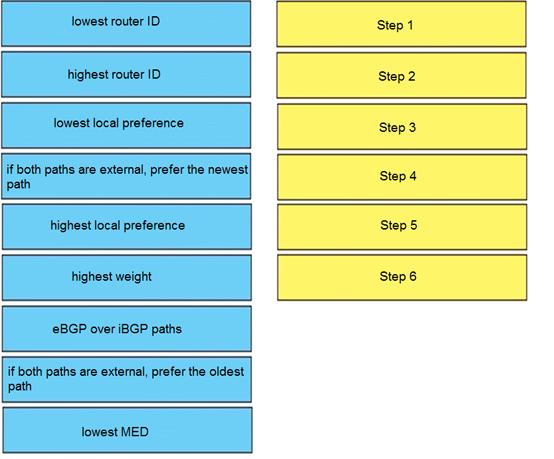
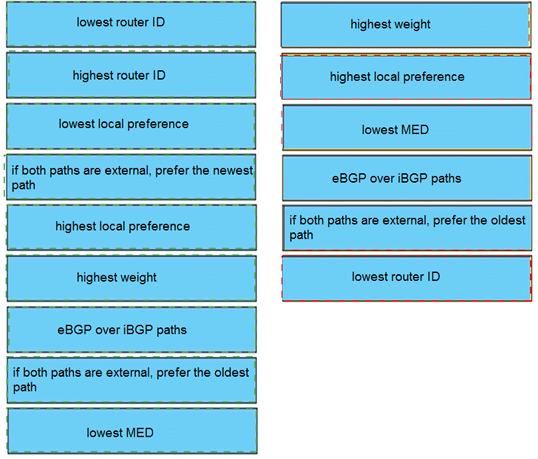
Drag and drop the attributes for the BGP route selection on the left into the correct order on
the right. Not all options are used.
Refer to the exhibit.
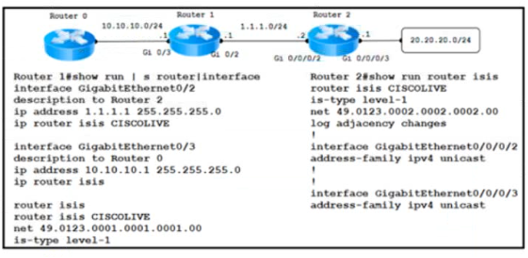
An engineer is troubleshooting a network routing issue on this IS-IS
network situated at the customer's regional hub. Router 2 that runs Cisco IOS XR Software
cannot see the network 10.1.1.0/24 on router 1. The Layer 2 encapsulations are correct.
The ARP connectivity for the Ethernet interface that runs IS-IS is working. Which action
resolves the issue?
A. On router 1, remove the CISCOLIVE keyword after the Ip router Isis command under interface GigabitEthernet0/2.
B. Under the router isis command on router 1. change is-type level-1 to is-type level-2
C. On router 1. add the CISCOLIVE keyword after the Ip router isis command under interface GigabitEthernet0/3.
D. Under the router isis command on router 2. change is-type level-1 to is-type level-2
Refer to the exhibit.
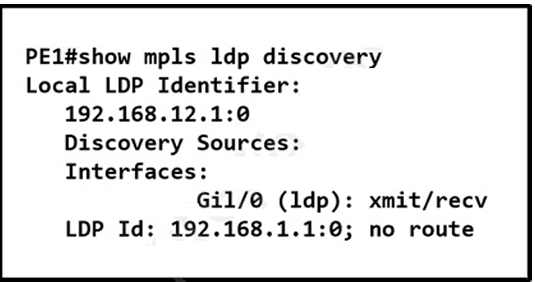
An administrator is troubleshooting network issues on a customer’s network PE1 cannot
form an LDP relationship with PE2 using LDP ID 192 168.1.1. Due to this connectivity
issue, the customer’s routes behind both PE routers cannot be exchanged. Which action
must the administrator take to correct the problem?
A. Configure PE2 to automatically select its own LDP router ID with 192.168.1.1.
B. Create a targeted LDP session on PE2 to override the missing routing table entry on PEL
C. Configure PE1 with a static route to 192 168.1.1.
D. Enable LDP session protection on the link that P1 uses as the next hop to PE2.
Refer to the exhibit.
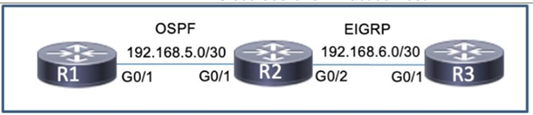
A company has been running OSPF and EIGRP on two separate portions of the network
To allow communication flow between these previously isolated parts of the business the
networking team just configured R2 to mutually redistribute routes between EIGRP and
OSPF R3 has the OSPF routes in its routing table but R1 is failing to receive EIGRP routes
for the link between R2 and R3 Which action must the team take to resolve the issue?
A. Configure EIGRP on R1
B. Configure the redistribution statement with the subnets keyword under the R2 OSPF configuration
C. Configure a virtual link between R1 and R2 to handle traffic without an assigned area
D. Configure R1 with a static route with the next hop set to R3 with the vrf keyword to avo»d the global routing table
Refer to the exhibit.
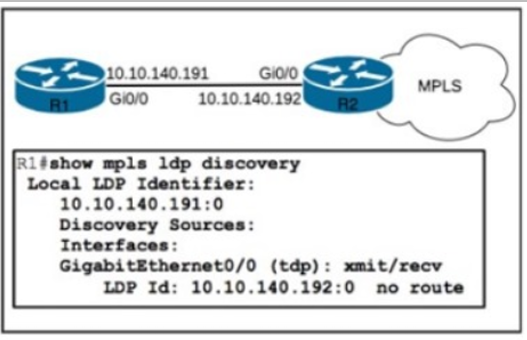
Routers R1 and R2 are RFC 5036-based MPLS-enabled core routers MPLS IP is enabled
globally on both routers OSPF with area 0 configuration is used as an interior routing
protocol between the routers After new services were enabled on the MPLS network, LDP
connectivity failed on R1 TCP/UDP port 711 is confirmed to be open Which two actions
must the engineer take to correct the problem? (Choose two.)
A. Configure network 10.10.140.192 0.0.0.0 arta 0 under the OSPF configuration on R2
B. Configure mpls label protocol Idp under the Gi0/0 interface on R
C. Configure mpls ip under the Gi0'0 interface on R1
D. Configure network 10.10.140.192 0.0.0.255 arta 0 under the OSPF configuration on R2
E. Configure labtl mpls ip protocol tdp under the Gi0 0 interface on R1
C. Configure mpls ip under the Gi0'0 interface on R1
| Page 10 out of 27 Pages |