- 4.9/5.0
- 268 Questions
- Updated on: 12-Oct-2026
- 300-510
- 22685 Prepared
Free Cisco 300-510 Practice Questions 2026 | 300-510
Refer to the exhibit.
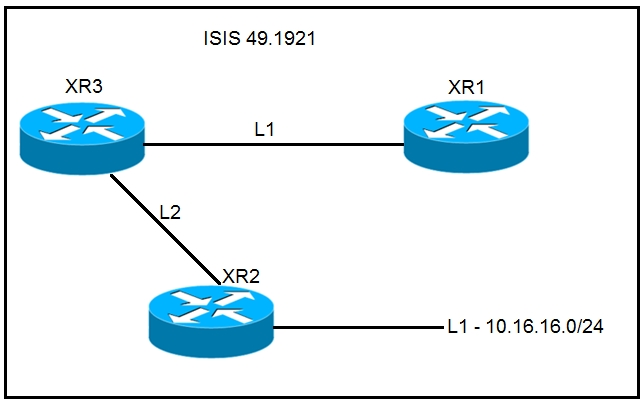
A network operator must inject a Level 1 route from XR2 (10.16.16.0/24) into the ISIS
topology. Which configuration allows the injection in a way that XR3 and XR1 have a valid
and working route for 10.16.16.0/24?.png)
A. Option A
B. Option B
C. Option C
D. Option D
Refer to the exhibit.
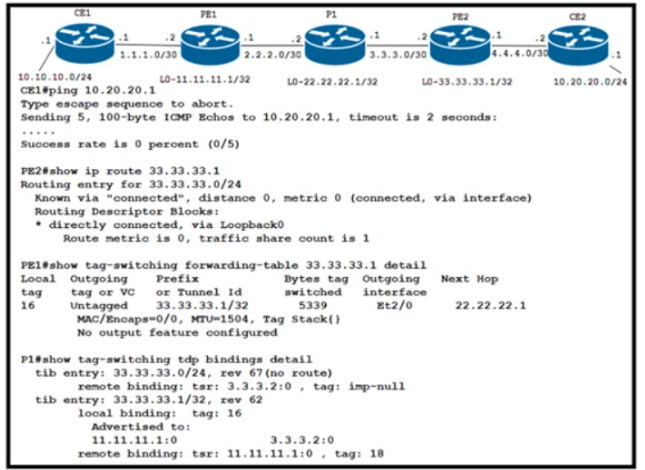
The network is situated at different locations on the customer site. The customer runs a
mission-critical application behind CE2. which is connected over a 10 link to the local
network of the customer After recent configuration changes to the P and PE routers, an
LSP failure has occurred, causing connectivity issues. CE1 is unable to which the CE2
internal IP address Which action resolves this issue?
A. Implement BGP in the core and configure an MPLS TE tunnel between PE1 and PE2
B. Configure the ip ospf network point-to-multipoint command on PE2.
C. Change the subnet mask on the PE2 loopback interface from /24 to 32
D. Configure the ip ospf network point-to-point command on PE2
Refer to the exhibit.
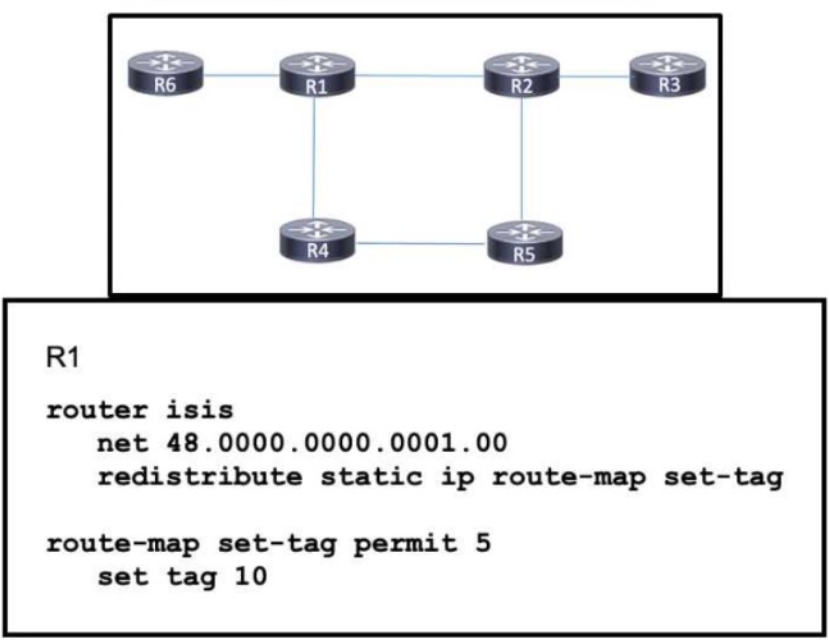
IS-IS runs in the network and all routers are in the same area R1 statically routes to
distribute traffic with R6 and the networking team has redistributed the static routes on R1
into IS-IS Hosts on R3 need access to servers connected to R6 A tag has been applied to
the routes to manipulate routes along the path but routers running IS-IS are still unable to
reach the redistributed routes Which action must the team take to resolve the issue?
A. Configure the routers as Level 1/Level 2 routers
B. Configure R3 with a default route that uses R2 as the next hop
C. Configure the IS-IS routers with metric-style wide
D. Configure the route map with an additional route-map set-tag permit 10 sequence
Refer to the exhibit.
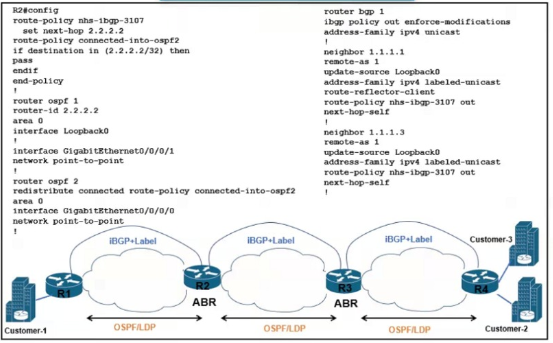
There is a connectivity issue between Customer-1 and Customer-2 File servers between
the customers cannot send critical data R3 routes are missing from the routing table on the Customer-1 router All interlaces on Customer-1 are up Which configuration must be
applied to router R2 to correct the problem?
.png)
A. Option A
B. Option B
C. Option C
D. Option D
Refer to the exhibit.
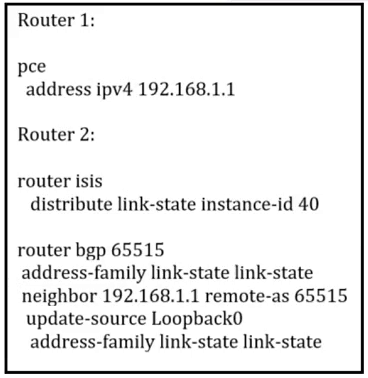
What is the relationship between Router 1 and Router 2?
A. Router 1 centrally learns the topology of the network to aid in SR-TE path selection, and Router 2 is a node that feeds Router 1 topology information.
B. Router 1 and Router 2 are participating in SR-TE tunnels and are both head-end routers.
C. Router 1 and Router 2 centrally learn the topology of the network to aid in SR-TE path selection for peers.
D. Router 2 is the head-end router in an SR-TE tunnel, and it is learning topology of the network from the PCE enabled on Router 1.
Refer to the exhibit.

AJI four routers on the network reside in the same data center The four routers are running
IS-IS between them in Level 1 mode within an IPv4 network After a network engineer
installed several new servers connected to R4, users connected via R1 reported they could
not connect to applications on the servers The engineer has determined that R4 is
receiving routes from R3 but it is failing to receive routes from R1 Which action must the
engineer take to resolve the issue?
A. Configure R3 only lo be a Level 1'Level 2 router.
B. Configure R2 and R3 to be Level 1/Level 2 routers
C. Configure R2 only to be a Level 2 router
D. Configure R1 and R4 to be Level 2 routers
| Page 2 out of 27 Pages |