- 4.9/5.0
- 268 Questions
- Updated on: 12-Oct-2026
- 300-510
- 22685 Prepared
Free Cisco 300-510 Practice Questions 2026 | 300-510
Refer to the exhibit.
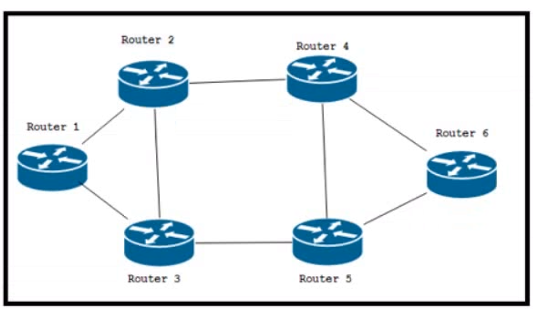
Router 1. Router 2. and Router 3 are co-located in an onsite data center of an office, but
Router 4. Router 5. and Router 6 are installed in another data center 'eral miles away A
network engineer is troubleshooting an RSVP-TE issue on the network On most of the
devices, the engineer can move all LSPs away from a selected interface and take it down
for maintenance without interrupting traffic. However, when an interface on Router 3 is
taken down, traffic on the network is disrupted What must the engineer enable to resolve
the issue on Router 3?
A. FRR
B. NSR
C. soft-preemption feature
D. soft-disperse feature
Refer to the exhibit.
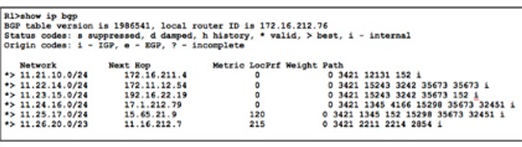
Company A established BGP sessions with several ISPs. A network
engineer at the company must filter out all traffic except for routes that transit AS 152. The engineer configured the filtering policy “permit _152S_(_[0.9])” on R1, but after applying the
configuration, the engineer notices that other routes are still visible. Which action resolves
the issue?
.png)
A. Option A
B. Option B
C. Option C
D. Option D
Refer to the exhibit.
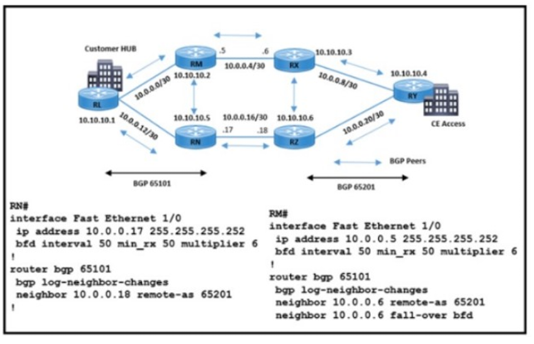
EBGP peering is up between BGP AS 65101 and BGP AS 65201 The service provider
expects traffic convergence within 300ms between the two autonomous systems but the
network operations team sees that route and traffic convergence is too slow Which two
actions improve the convergence time? (Choose two.)
A. Change the bfd multiplier value to 3 on routers RN and RM
B. Configure fall-over bfd under the BGP instance for BGP neighbors on RN
C. Configure bfd interval 50 min_rx 100 multiplier 6 on the connected interfaces on RN and RM
D. Configure bfd interval 50 min_rx 50 multiplier 6 on the connected interfaces on RL and RY
E. Change the bfd interval value to 100ms on routers RN and RM
E. Change the bfd interval value to 100ms on routers RN and RM
Refer to the exhibit.
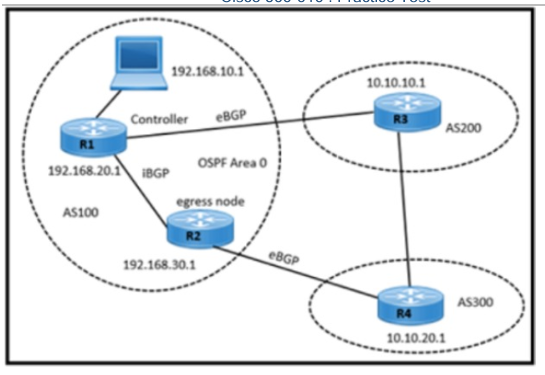
A network engineer must enable segment routing between the three autonomous systems
with these requirements:
·OSPF link-state data for area 0 routers must be distributed to the controller via BGP LS.
·EPE must be enabled on the egress node in AS 100.
·Routers must advertise peer node SIDs to the controller R1 via BGP LS.
Which configuration must the engineer apply?.png)
A. Option A
B. Option B
C. Option C
D. Option D
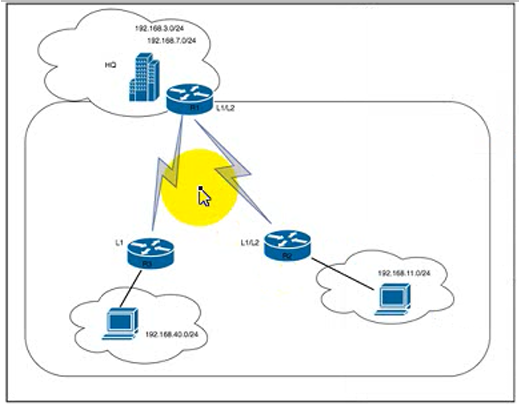
Refer to the exhibit The branch office in area 10 is connected to HQ via Frame Relay
uplinks with bandwidth constraints After a recent implementation of QoS on the R2 and R3
networks the system has been logging %SYS-2-MALLOCFAIL: Memory allocation of
65536 bytes failed from 0x224E321, alignment 0 messages To reduce traffic load and
memory utilization on R2 and R3 the network engineer configured R1 to announce only
one user subnet per location by issuing the summary address 192.168.0.0 255.255.248.0
command en R1 However, the engineer noticed that router R2 still has two routes and a
summary address from HQ and R3 also has two routes from HQ Which two actions must
the engineer take on R1 to fix the issue so that only one route is announced’ (Choose two.)
A. Configure the subnet range with the network command under the IS-IS process.
B. Configure RI as a Level 1 device.
C. Redistribute both routes into the ISIS process.
D. Configure a summary route for Level 1-Level 2 devices.
E. Configure a summary route for Level 1 devices.
E. Configure a summary route for Level 1 devices.
Refer to the exhibit.
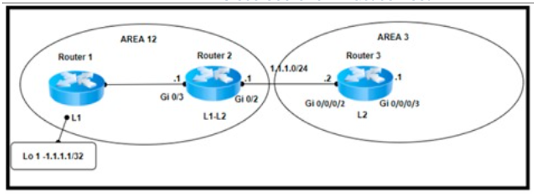
A network engineer configured three new PE routers to expand the
network. The new routers run in the IS-IS routing protocol and reside in the data center in
the same exchange as the existing routers. However, the network is now experiencing
suboptimal routing. The Layer 2 configuration and VLANs are configured correctly to
provide segregation between networks, but the Level 1 routes are not being converted to
Level 2 routes. Which action resolves the issue?
A. On Router 1, redistribute the routes into IGP.
B. On Router 1, summarize internal routes between areas.
C. On Router 2, redistribute the routes into IGP.
D. On Router 2. summarize internal routes between areas.
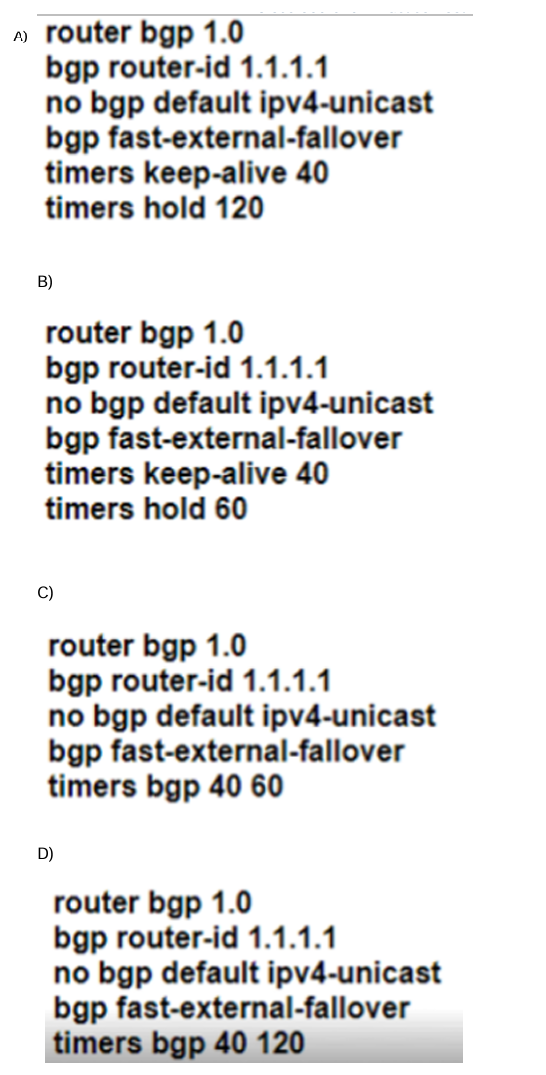
A network administrator working for a private service provider with an employee ID 4784 41
907 wants to configure timers for the BGP process on their Cisco IOS XE router Which
configuration follows guideline timer recommendations and is a valid BGP timer
deployment?
A. Option A
B. Option B
C. Option C
D. Option D
Refer to the exhibit.
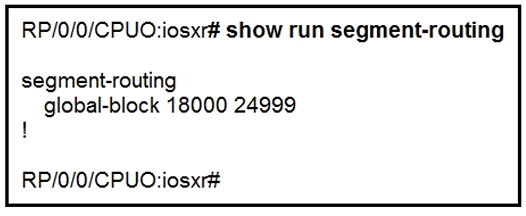
A network engineer implemented this segment routing configuration. Which statement
about the output is true?
A. This range conflicts with the segment routing local block range.
B. The device must be reloaded for these ranges to be allocated and used.
C. The default segment routing global block range is being used on this device.
D. A nondefault segment routing global block range is being used on this device.
| Page 9 out of 27 Pages |