- 4.9/5.0
- 246 Questions
- Updated on: 12-Oct-2026
- Implementing Cisco Application Centric Infrastructure (300-620 DCACI)
- 22465 Prepared
Free Cisco 300-620 Practice Questions 2026 | Implementing Cisco Application Centric Infrastructure (300-620 DCACI)
Refer to the exhibit
Which two objects are created as a result of the configuration? (Choose two.)
A. application profile
B. attachable AEP
C. bridge domain
D. endpoint group
E. VRF
E. VRF
Explanation:
The exhibit shows a configuration for an External Bridged Network (L2Out) connection. According to Cisco documentation, when creating a Layer 2 external connection, the configuration requires the creation of a VRF and a Bridge Domain to define the Layer 3 context and the Layer 2 domain that will be extended outside the fabric . The bridge domain is associated with the L2Out, and the VRF provides the routing context.
Correct Option:
C. bridge domain:
The bridge domain is a required object for L2Out configuration. It defines the Layer 2 domain that is being extended to the external network. The L2Out is associated with a specific bridge domain, allowing endpoints in that BD to communicate with external devices .
E. VRF:
The VRF (Virtual Routing and Forwarding) instance is also created as part of this configuration. The bridge domain references the VRF to provide the Layer 3 context for the tenant network. The VRF defines the routing domain for the endpoints in the bridge domain .
Incorrect Option:
A. application profile:
While an application profile is a common construct in ACI, it is not a direct result of creating an L2Out connection. Application profiles are used to group EPGs and define contracts, but the L2Out configuration itself does not create an application profile.
B. attachable AEP:
An Attachable Entity Profile (AEP) is used for access policies to define which VLANs and policies are applied to physical ports. While an AEP may be referenced or created for the physical connectivity of the L2Out, it is not a direct object created by the L2Out configuration itself .
D. endpoint group:
While an External EPG (l2extInstP) is created as part of the L2Out configuration, the option "endpoint group" typically refers to a standard application EPG. The L2Out creates an External Network object (External EPG), not a standard EPG. The question asks for objects created as a result of the configuration, and the core objects are the VRF and Bridge Domain.
Reference:
Cisco APIC REST API Configuration Guide — "Tenant External Bridged Networks": The configuration requires creating a VRF and a bridge domain. The bridge domain element subnets reference the corresponding Layer 3 context (VRF)
Refer to the exhibit.
An engineer is integrating a VMware vCenter with Cisco ACI VMM domain configuration. ACI creates port-group names with the format of “Tenant | Application | EPG”. Which configuration option is used to generate port groups with names formatted as “Tenant=Application=EPG”?
A. enable tag collection
B. security domains
C. delimiter
D. virtual switch name
Explanation:
In the Cisco ACI VMM domain configuration, the Delimiter field allows you to define the character that separates the Tenant, Application, and EPG names when port groups are created on the VMware vSphere Distributed Switch. The default delimiter is a pipe character (|), so port groups are named Tenant | Application | EPG. If you change the delimiter to an equals sign (=), the port group names become Tenant=Application=EPG.
Correct Option:
C. delimiter:
This is the configuration option used to change the separator between the tenant, application profile, and EPG names in the port group naming format. Setting the delimiter to = produces the required Tenant=Application=EPG format.
Incorrect Option:
A. enable tag collection:
This option enables the collection of tags from the VM controller for use in uSeg EPGs and attribute-based policies. It does not affect port group naming.
B. security domains:
Security domains are used for RBAC (Role-Based Access Control) to restrict user access to specific tenants or objects. They do not influence port group naming.
D. virtual switch name:
The virtual switch name is the name of the VDS (VMware vSphere Distributed Switch) that is created or referenced in the VMM domain. It does not determine the port group naming format.
Reference:
Cisco APIC Virtualization Guide — "VMM Domain Delimiter": The delimiter is used to separate the tenant, application, and EPG names in the port group name. The default delimiter is |. It can be changed to other characters such as =.
Refer to the exhibit.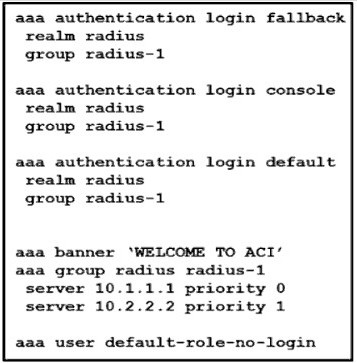
Which action should be taken to ensure authentication if the RADIUS servers are unavailable?
A. Adjust the priority of server 10.1.1.1 to 1.
B. Set the fallback login to local.
C. Assign the user to the default role.
D. Set the default login realm to LDAP
Explanation:
The exhibit shows a Cisco ACI AAA configuration with a fallback login configured to radius realm. When both RADIUS servers are unavailable, the fallback mechanism will attempt to authenticate against the RADIUS servers again, which will fail. To ensure authentication during a RADIUS outage, the fallback login must be changed to local so that the APIC falls back to its local user database.
Correct Option:
B. Set the fallback login to local:
The current configuration has aaa authentication login fallback realm radius. This means if the primary RADIUS authentication fails, the system tries the fallback method, which is also RADIUS. Changing the fallback realm to local ensures that when RADIUS servers are unreachable, the APIC authenticates users against its local database instead.
Incorrect Option:
A. Adjust the priority of server 10.1.1.1 to 1:
Changing server priority does not help when both servers are unavailable. Priority only determines the order in which servers are tried when they are reachable.
C. Assign the user to the default role:
The aaa user default-role-no-login command sets the default role for users who do not have an assigned role, and it prevents login. This does not provide fallback authentication when RADIUS is unavailable.
D. Set the default login realm to LDAP:
Changing the realm to LDAP would require an LDAP server to be configured and available. It does not solve the problem of RADIUS server unavailability for local fallback.
Reference:
Cisco APIC Security Configuration Guide — "AAA Fallback": The fallback login realm can be set to local, radius, or tacacs. When set to local, the APIC uses its local user database if the primary authentication method fails.
Refer to the exhibit.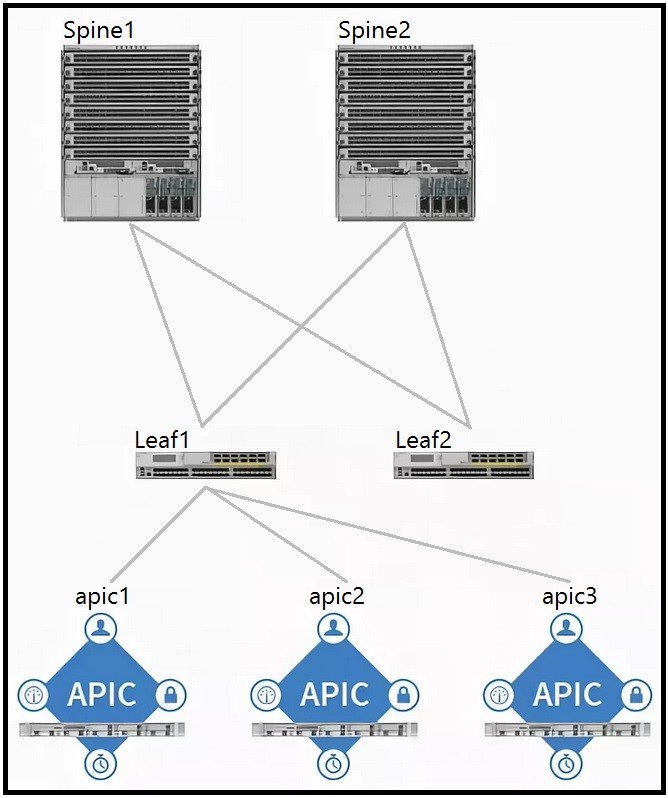
Which two components should be configured as route reflectors in the ACI fabric? (Choose
two.)
A. Spine1
B. apic1
C. Spine2
D. Leaf1
E. Leaf2
F. apic2
C. Spine2
Explanation:
In a Cisco ACI fabric, spine switches are configured as BGP Route Reflectors to propagate MP-BGP EVPN routes between leaf switches. The leaf switches act as BGP clients and establish iBGP sessions with the spines. The APIC controllers are not part of the BGP route reflection architecture. Therefore, the two spine switches shown in the exhibit are the correct components to be configured as route reflectors.
Correct Option:
A. Spine1:
Spine switches serve as BGP route reflectors in the ACI fabric. They receive EVPN routes from leaf switches and reflect them to other leaf switches, enabling endpoint reachability information to be distributed across the fabric.
C. Spine2:
Like Spine1, Spine2 also acts as a BGP route reflector. ACI fabrics typically use two or more spines for redundancy, and all spines are configured as route reflectors to ensure high availability.
Incorrect Option:
B. apic1:
APIC controllers are management and policy controllers. They do not participate in the BGP EVPN control plane as route reflectors.
D. Leaf1:
Leaf switches are BGP clients that establish sessions with spine route reflectors. They do not act as route reflectors.
E. Leaf2:
Same as Leaf1, leaf switches are clients, not route reflectors.
F. apic2:
APIC controllers are not part of the BGP route reflection architecture.
Reference:
Cisco ACI Fundamentals — "Spine switches act as BGP route reflectors to distribute EVPN routes between leaf switches."
Refer to the exhibit
An engineer configures the Cisco ACI fabric for VMM integration with ESXi servers that are to be connected to the ACI leaves. The server team requires the network switches to initiate the LACP negotiation as opposed to the servers. The LAG group consists of two 10 Gigabit Ethernet links. The server learn also wants to evenly distribute traffic across all available links. Which two enhanced LAG policies meet these requirements? (Choose two.)
A. LACP Mode: LACP Standby
B. LB Mode: Destination IP Address and TCP/UDP Port
C. LB Mode: Source and Destination MAC Address
D. LB Mode: Source IP Address and TCP/UDP Port
E. LACP Mode: LACP Active
E. LACP Mode: LACP Active
Explanation
The server team has two specific requirements: the network switches must initiate LACP negotiation, and traffic must be evenly distributed across both 10 Gigabit Ethernet links. The LACP Mode determines which side initiates negotiation, while the Load Balancing (LB) Mode determines how traffic is distributed across the links in the LAG group.
Correct Option
C. LB Mode:
Source and Destination MAC Address: This load balancing method uses a hash of the source and destination MAC addresses to distribute traffic across the links. It is a common choice for server connectivity because it provides an even distribution of traffic flows across all available links in the LAG, satisfying the requirement for even traffic distribution.
E. LACP Mode:
LACP Active: In LACP Active mode, the ACI leaf switch initiates the LACP negotiation by sending LACPDUs. This directly meets the requirement that the network switches (not the servers) initiate LACP negotiation. In LACP Passive mode, the switch would wait for the server to initiate negotiation.
Incorrect Option
A. LACP Mode:
LACP Standby: LACP Standby is not a valid LACP mode in Cisco ACI. The available modes are Active and Passive. Standby mode is not supported for LACP on ACI leaf switches.
B. LB Mode:
Destination IP Address and TCP/UDP Port: This load balancing method uses destination IP and TCP/UDP port information. It is less effective for traffic distribution when a single client communicates with a single server, as all traffic would use the same link. It does not provide the even distribution required.
D. LB Mode:
Source IP Address and TCP/UDP Port: This method uses source IP and TCP/UDP port information. Similar to option B, it can result in uneven distribution when traffic originates from a single source, and it does not guarantee even distribution across all links.
Reference
Cisco APIC Virtualization Guide — Enhanced Lag Policy: LACP Active mode initiates LACP negotiation from the ACI side. Load Balancing modes such as Source and Destination MAC Address provide even distribution of traffic across the LAG member links.
| Page 3 out of 25 Pages |