- 4.9/5.0
- 240 Questions
- Updated on: 12-Oct-2026
- Implementing Cisco Advanced Call Control and Mobility Services (CLACCM)
- 22405 Prepared
Free Cisco 300-815 Practice Questions 2026 | Implementing Cisco Advanced Call Control and Mobility Services (CLACCM)
Refer to the exhibit.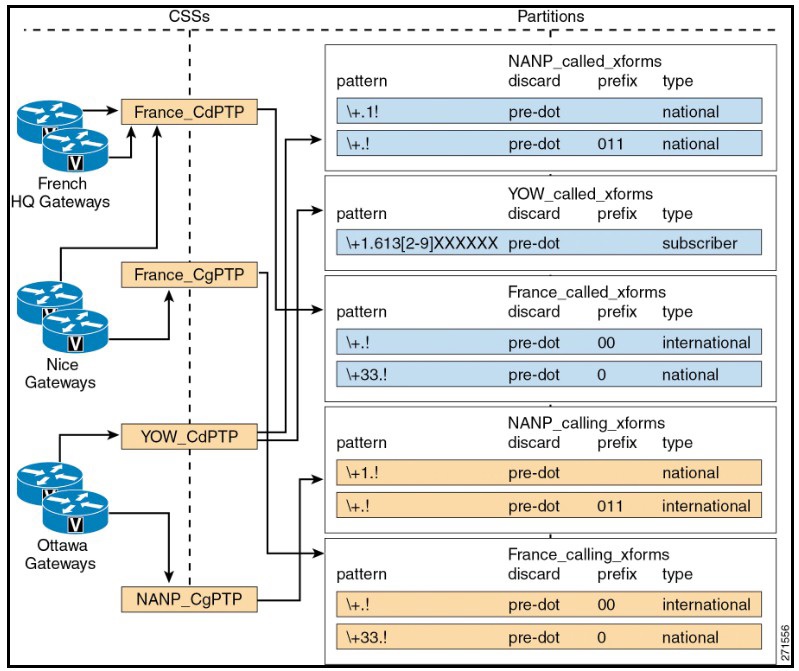
Within the North American Numbering Plan, gateways located in Ottawa, Canada and
marked as “YOW” are assigned to the Calling Party Transformation CSS NANP_CgPTP,
which contains partition NANP_calling_xforms. What is the calling-party number and the
numbering type if the calling user +1613-555-1234 dials the number?
A.
calling number 613-555-1234 and numbering type “subscriber”
B.
calling number 011-1-613-555-1234 and numbering type “subscriber”
C.
calling number 011613-555-1234 and numbering type “international”
D.
calling number 613-555-1234 and numbering type “national”
calling number 613-555-1234 and numbering type “national”
Refer to the exhibit.
An engineer is troubleshooting a call-establishment problem between Cisco Unified Border Element and Cisco UCM. Which command set corrects the issue?
A.
SIP binding in SIP configuration mode
voice service voip sip bind control source-interface GigabitEthernetO/0/0 bind media source-interface GigabitEthernetO/0/0
B.
SIP binding In SIP configuration mode:
voice service volp
sip
bind control source-Interface GlgabltEthernetO/0/1 bind media source-Interface
GlgabltEthernetO/0/1
C.
SIP binding In dial-peer configuration mode:
dial-peer voice 300 voip
voice-class sip bind control source-interface GigabitEthernetO/0/1 voice-class sip bind
media source-interface GigabitEthernetO/0/1
D.
SIP binding in dial-peer configuration mode:
dial-peer voice 100 volp
voice-class sip bind control source-interface GigabitEthernetO/0/0
voice-class sip bind media source-interface GigabitEthernetO/0/0
SIP binding in dial-peer configuration mode:
dial-peer voice 100 volp
voice-class sip bind control source-interface GigabitEthernetO/0/0
voice-class sip bind media source-interface GigabitEthernetO/0/0
Refer to the exhibit.
In an active SIP call between phone user A and phone user B, phone A initiates a call transfer to phone user C. Which two scenarios are correct? (Choose two.)
A.
Phone_A sends a SIP-REFER message to the Cisco Unified Communications Manager
with Phone_C information in the Refer-To section.
B.
Phone_B sends a SIP-REFER message to the Cisco Unified CM with Phone_C
information in the Refer-To section.
C.
As soon as Phone_A presses the Transfer button for the first time, Phone_B hears the
MOH and the MOH audio is chosen from Phone_B User Hold MOH Audio Source settings.
D.
As soon as Phone_A presses the Transfer button for the first time, Phone_B hears the
music on hold and the MOH audio is chosen from Phone_A Network Hold MOH Audio
Source settings.
E.
As soon as Phone_A presses the Transfer button for the first time, Phone_B hears the
MOH and the MOH audio is chosen from Phone_A User Hold MOH Audio Source settings.
Phone_A sends a SIP-REFER message to the Cisco Unified Communications Manager
with Phone_C information in the Refer-To section.
D.
As soon as Phone_A presses the Transfer button for the first time, Phone_B hears the
music on hold and the MOH audio is chosen from Phone_A Network Hold MOH Audio
Source settings.
| Page 6 out of 24 Pages |