- 4.9/5.0
- 547 Questions
- Updated on: 12-Oct-2026
- Implementing and Operating Cisco Service Provider Network Core Technologies (350-501 SPCOR)
- 25475 Prepared
Free Cisco 350-501 Practice Questions 2026 | Implementing and Operating Cisco Service Provider Network Core Technologies (350-501 SPCOR)
Refer to the exhibit:
What is the URL used for with REST API?
A. It is used to contact a URL filter to determine the efficacy of a web address
B. It is used to send a TACACS+ authentication request to a server
C. It is used to send a message to the APIC to perform an operation on a managed object or class operator
D. It is used to initiate an FTP session to save a running configuration of a device
Explanation
The exhibit shows a URL of the form https://192.168.1.100/api/mo/uni/tn-ciscotest.xml. The /api/mo/uni/ path is specific to the Cisco APIC (Application Policy Infrastructure Controller) REST API, where mo stands for managed object and uni is the policy universe root. The URL targets the tn-ciscotest managed object, which represents a tenant named ciscotest in the ACI fabric. Sending an HTTP request to this URL allows the client to perform operations such as create, read, update, or delete on that managed object. Therefore, this URL is used to send a message to the APIC to perform an operation on a managed object or class operator. This makes option C the correct answer.
Why the Other Options Are Incorrect:
A. It is used to contact a URL filter to determine the efficacy of a web address – The URL is a REST API endpoint for the APIC, not a URL filter or web-reputation service. The path structure clearly indicates ACI managed object access.
B. It is used to send a TACACS+ authentication request to a server – TACACS+ uses TCP port 49 and does not use the /api/mo/uni/ REST path. This URL is unrelated to TACACS+ authentication.
D. It is used to initiate an FTP session to save a running configuration of a device – The URL uses HTTPS, not FTP, and it targets the APIC REST API, not a file transfer mechanism for saving configurations.
Reference:
Cisco APIC REST API Configuration Guide – Managed Objects and the /api/mo/uni/ Path; Cisco ACI Fundamentals; Cisco 350-501 SPCOR Official Cert Guide, Automation and Assurance section.
Refer to the exhibit: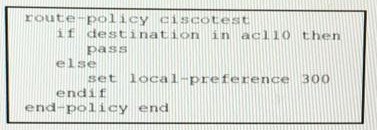
A network engineer is implementing a BGP routing policy.
Which effect of this configuration is true?
A. All traffic that matches acl10 is allowed without any change to its local-preference
B. All traffic that matches acl10 is dropped without any change to its local-preference
C. If traffic matches acl10, it is allowed and its local-preference is set to 300
D. All traffic is assigned a local-preference of 30O regardless of its destination
Explanation
The exhibit shows a route-policy named "ciscotest" with the logic: if the destination matches acl10, then pass; otherwise, set local-preference 300. In Cisco IOS XR route-policy syntax, the pass statement means the route is accepted and no further actions in that policy are applied to it. The else branch applies to routes that do not match acl10, and those routes have their local-preference set to 300. Therefore, traffic matching acl10 is allowed (passed) without any change to its local-preference, while traffic that does not match acl10 gets local-preference 300. This makes option A the correct answer.
Why the Other Options Are Incorrect
B. All traffic that matches acl10 is dropped without any change to its local-preference
The pass statement does not drop traffic; it accepts it. Dropping would require a drop statement, which is not present.
C. If traffic matches acl10, it is allowed and its local-preference is set to 300
The pass statement exits the policy immediately, so the set local-preference 300 in the else branch is not applied to matching traffic. Only non-matching traffic gets local-preference 300.
D. All traffic is assigned a local-preference of 300 regardless of its destination
Traffic that matches acl10 is passed without the local-preference change, so not all traffic receives local-preference 300.
Reference
Cisco IOS XR Routing Configuration Guide – Implementing Routing Policy: Route-Policy Statements and Actions;
RFC 4271 – A Border Gateway Protocol 4 (BGP-4);
Cisco 350-501 SPCOR Official Cert Guide, BGP and Routing Policy sections.
Refer to the exhibit.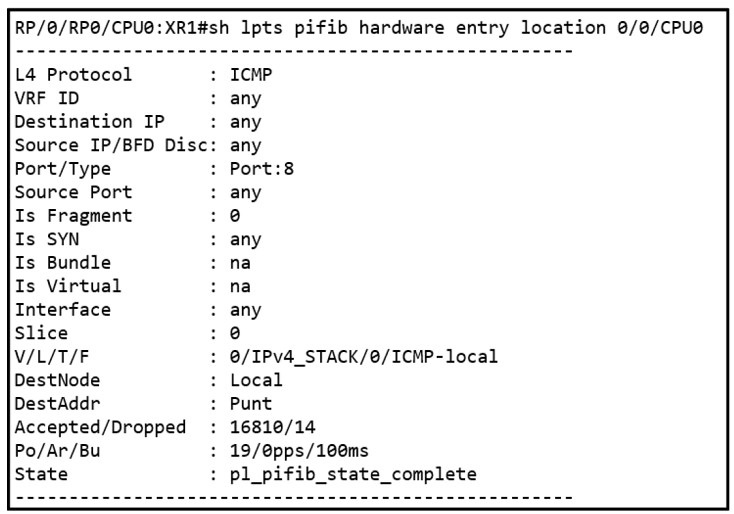
While troubleshooting the network, a network operator with an employee id: 3812:12:993 is
trying to ping XR1. Which result should the operator expect when trying to ping to an XR1
local address?
A. ICMP traffic works at a policed rate of 19 bytes per second every 100 ms
B. All ICMP traffic responds successfully.
C. All ICMP traffic is dropped.
D. ICMP traffic works at a policed rate of 19 packets every 100 ms.
Explanation
The exhibit shows the LPTS (Local Packet Transport Services) PIFIB hardware entry for ICMP traffic on XR1. The Port/Type field shows Port:8, which corresponds to ICMP. The DestAddr is Punt, meaning ICMP traffic destined to a local address on XR1 is punted to the control plane for processing. The Po/Ar/Bu field shows 19/0pps/100ms, which indicates that ICMP traffic is policed at a rate of 19 packets per second per 100 ms. The State is pl_pifib_state_complete, meaning the entry is fully programmed and operational. Therefore, when pinging an XR1 local address, ICMP traffic works but is policed at a rate of 19 packets every 100 ms. This makes option D the correct answer.
Why the Other Options Are Incorrect
A. ICMP traffic works at a policed rate of 19 bytes per second every 100 ms
The Po/Ar/Bu field shows 19 pps, not 19 bytes per second. The unit is packets per second, not bytes.
B. All ICMP traffic responds successfully
The entry shows a policed rate of 19 pps, meaning that traffic exceeding this rate will be dropped. Not all ICMP traffic responds successfully if the rate is exceeded.
C. All ICMP traffic is dropped
The DestAddr is Punt, meaning traffic is accepted and sent to the control plane, not dropped. The Accepted/Dropped counters (16810/14) show that most traffic is accepted, with only a small number dropped due to policing.
Reference
Cisco IOS XR LPTS (Local Packet Transport Services) Configuration Guide – LPTS PIFIB Entries and Control-Plane Policing;
Cisco 350-501 SPCOR Official Cert Guide, Network Assurance and Security sections.
Refer to the exhibit.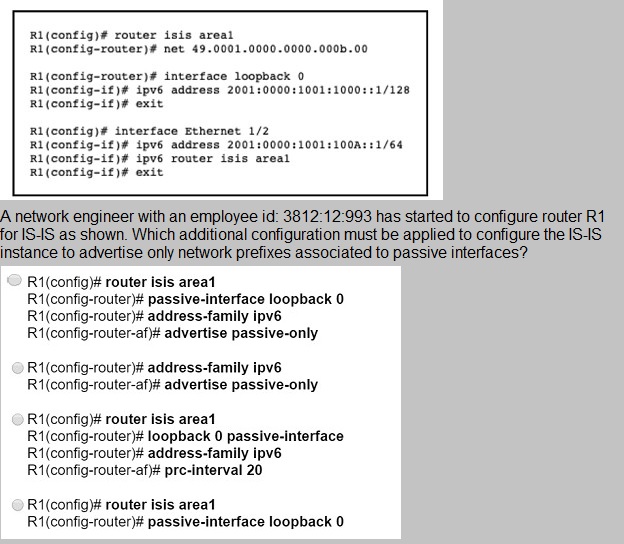
A. Option A
B. Option B
C. Option C
D. Option D
Explanation
The exhibit shows R1 configured with router isis area1, a loopback 0 with IPv6 address, and Ethernet 1/2 with IPv6 address and ipv6 router isis area1. The requirement is to advertise only network prefixes associated with passive interfaces. To accomplish this, the engineer must configure passive-interface on the interfaces that should be advertised but not form adjacencies, and then use the advertise passive-only command under the IPv6 address family to advertise only those passive interface prefixes. Option A correctly configures passive-interface loopback 0 under the IS-IS process, then enters address-family ipv6 and configures advertise passive-only. This ensures that only the loopback prefix (the passive interface) is advertised, while the Ethernet interface does not have its prefix advertised. This makes option A the correct answer.
Why the Other Options Are Incorrect
B. Option B
It configures address-family ipv6 with advertise passive-only but does not configure any passive interface. Without a passive interface defined, no prefixes are advertised, so this does not satisfy the requirement.
C. Option C
It includes passive-interface loopback 0 but uses the incorrect syntax loopback 0 passive-interface and includes prc-interval 20, which is unrelated to the requirement. The syntax is wrong, so this configuration would not work as intended.
D. Option D
It configures passive-interface loopback 0 but does not include the advertise passive-only command under the IPv6 address family. Without that command, IS-IS would advertise prefixes from all interfaces, not just passive ones.
Reference
Cisco IOS XR Routing Configuration Guide – Implementing IS-IS: Passive Interfaces and Advertise Passive-Only;
RFC 5308 – Routing IPv6 with IS-IS;
Cisco 350-501 SPCOR Official Cert Guide, IS-IS chapter.
Refer to the exhibit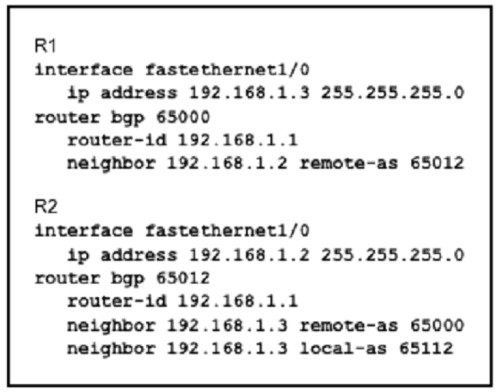
Assume all other configurations are correct and the network is otherwise operating
normally. Which conclusion can you draw about the neighbor relationship between routers
R1 and R2?
A. The neighbor relationship will be up only if the two devices have activated the correct neighbor relationships under the IPv4 address family
B. The neighbor relationship is down because R1 believes R2 is in AS 65012.
C. The neighbor relationship is up
D. The neighbor relationship is down because the loco I-as value for R2 is missing in the R1 neighbor statement
Explanation
R1 is configured with neighbor 192.168.1.2 remote-as 65012, and R2 is configured with neighbor 192.168.1.3 remote-as 65000 plus neighbor 192.168.1.3 local-as 65112. The local-as 65112 on R2 tells R2 to present itself as AS 65112 to R1 during BGP peering. However, R1 expects the peer to be in AS 65012, not AS 65112. Because the AS number R1 expects (65012) does not match the AS number R2 presents (65112), the BGP session will not establish. R1 will reject R2's OPEN message due to the AS mismatch. This makes option B the correct answer.
Why the Other Options Are Incorrect
A. The neighbor relationship will be up only if the two devices have activated the correct neighbor relationships under the IPv4 address family
While address family activation is required for prefix exchange, the primary reason the session fails here is the AS number mismatch caused by the local-as configuration, not address family activation.
C. The neighbor relationship is up
The relationship is not up because R1 expects AS 65012 while R2 presents AS 65112. The AS numbers do not match, so the session fails.
D. The neighbor relationship is down because the local-as value for R2 is missing in the R1 neighbor statement
The local-as keyword is configured on R2, which is correct. The problem is that R2's local-as 65112 does not match the remote-as 65012 configured on R1. R1 does not need a local-as statement for R2; it needs its remote-as to match what R2 presents.
Reference
Cisco IOS XR Routing Configuration Guide – Implementing BGP: Neighbor local-as and remote-as;
RFC 4271 – A Border Gateway Protocol 4 (BGP-4);
Cisco 350-501 SPCOR Official Cert Guide, BGP chapter.
| Page 10 out of 55 Pages |