- 4.9/5.0
- 547 Questions
- Updated on: 12-Oct-2026
- Implementing and Operating Cisco Service Provider Network Core Technologies (350-501 SPCOR)
- 25475 Prepared
Free Cisco 350-501 Practice Questions 2026 | Implementing and Operating Cisco Service Provider Network Core Technologies (350-501 SPCOR)
Drag and drop the technologies from the left onto the correct definitions on the right.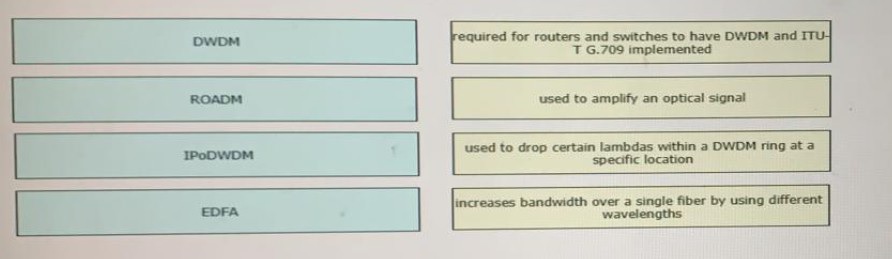
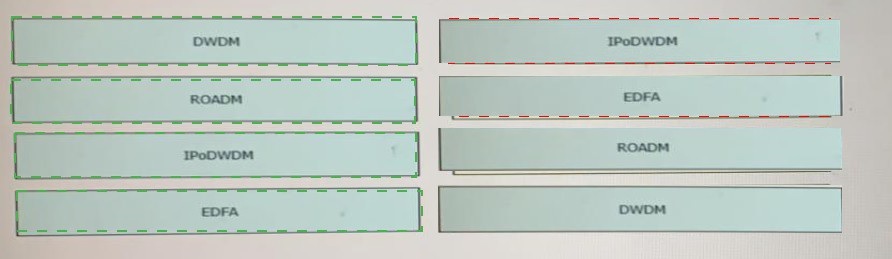
Explanation
The exhibit requires matching each optical networking technology with its correct definition. DWDM (Dense Wavelength Division Multiplexing) increases bandwidth over a single fiber by using different wavelengths, allowing multiple signals to be carried simultaneously on the same fiber. ROADM (Reconfigurable Optical Add-Drop Multiplexer) is used to drop certain lambdas within a DWDM ring at a specific location, providing flexible wavelength routing without manual intervention. IPoDWDM (IP over DWDM) is required for routers and switches to have DWDM and ITU-T G.709 implemented, integrating IP and optical layers. EDFA (Erbium-Doped Fiber Amplifier) is used to amplify an optical signal directly in the optical domain without converting it to electrical signals. This makes the correct matches as follows:
DWDM → increases bandwidth over a single fiber by using different wavelengths
ROADM → used to drop certain lambdas within a DWDM ring at a specific location
PoDWDM → required for routers and switches to have DWDM and ITU-T G.709 implemented
EDFA→ used to amplify an optical signal
Why the other pairings are incorrect:
Matching DWDM with descriptions about amplification or lambda droppingis incorrect because DWDM is the multiplexing technology that carries multiple wavelengths, not the amplifier or the add-drop device.
Matching ROADM with the bandwidth or amplification descriptions is incorrect because ROADM specifically handles wavelength add/drop and routing, not signal amplification or raw bandwidth multiplication.
Matching IPoDWDM with the lambda dropping or amplification descriptionsis incorrect because IPoDWDM refers to the integration of IP routing with DWDM transport, requiring G.709 framing on routers and switches.
Matching EDFA with the bandwidth or lambda dropping descriptions is incorrect because EDFA is purely an optical amplifier and does not perform multiplexing or wavelength add/drop functions.
Reference:
ITU-T G.694.1 – Spectral grids for WDM applications: DWDM frequency grid; ITU-T G.709 – Interfaces for the Optical Transport Network (OTN); Cisco 350-501 SPCOR Official Cert Guide, Architecture and Transport section.
Refer to the exhibit.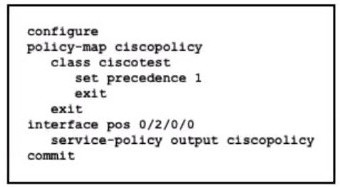
An engineer needs to implement this QoS policy on customer's network due to ongoing
slow network issues. What will be the effect on the network when the engineer implements
this configuration?
A. Traffic that is identified in the ciscotest class map will be remarked from IP precedence 1 to DSCP AF11 when it enters the pos0/2/0/0 interface.
B. Traffic that is identified in the ciscopolicy class map will be marked with IP precedence 1 when it enters the pos0/2/0/0 interface.
C. Traffic that is identified in the ciscopolicy class map will be remarked from IP precedence 1 to DSCP AF11 when it exits the pos0/2/0/0 interface.
D. Traffic that is identified in the ciscotest class map will be marked with IP precedence 1 when it exits the poso/2/0/0 interface.
Explanation
The exhibit shows a policy-map named "ciscopolicy" with a class named "ciscotest" that sets IP precedence to 1 using `set precedence 1`. The policy-map is applied to the POS 0/2/0/0 interface with `service-policy output ciscopolicy`. Because the service policy is applied in the **output** direction, the marking action takes effect when traffic **exits** the interface. Therefore, traffic identified in the ciscotest class map will be marked with IP precedence 1 when it exits the POS 0/2/0/0 interface. This makes option D the correct answer.
Why the other options are incorrect:
A. Traffic that is identified in the ciscotest class map will be remarked from IP precedence 1 to DSCP AF11 when it enters the pos0/2/0/0 interface – The policy is applied in the output direction, not the input direction, and the action sets precedence to 1 rather than remarking to DSCP AF11.
B. Traffic that is identified in the ciscopolicy class map will be marked with IP precedence 1 when it enters the pos0/2/0/0 interface – The class map is named "ciscotest," not "ciscopolicy" (ciscopolicy is the policy-map name). Additionally, the policy is applied in the output direction, not the input direction.
C. Traffic that is identified in the ciscopolicy class map will be remarked from IP precedence 1 to DSCP AF11 when it exits the pos0/2/0/0 interface – The class map is named "ciscotest," and the action is to set precedence to 1, not to remark to DSCP AF11. There is no DSCP remarking in this configuration.
Reference: Cisco IOS XR Modular QoS Configuration Guide – Configuring Policy Maps and Class Maps; Cisco 350-501 SPCOR Official Cert Guide, QoS section.
Refer to the exhibit.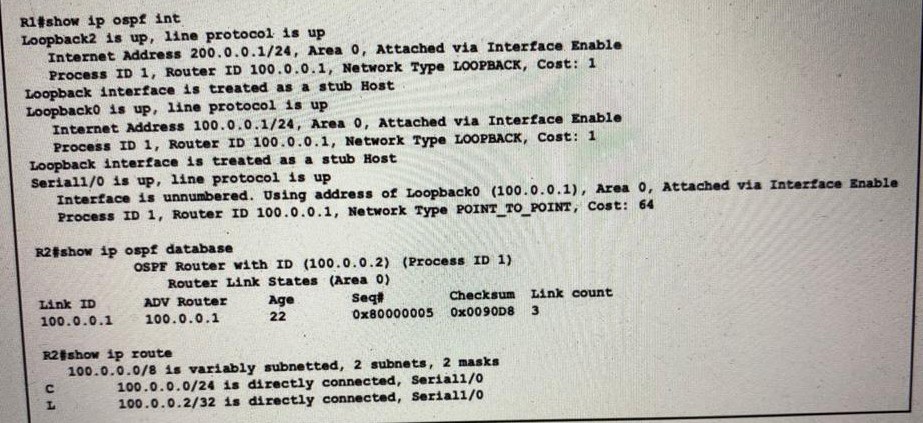
While troubleshooting a connectivity issue on router R2, a network engineer with an
employee id:3876.13.497 notices that although it detects three OSPF links from R1, the
OSPF prefixes are missing from the routing table. What is the reason for the problem?
A. The serial interfaces have different MTUs
B. Both loopback interfaces on R1 are configured as stub
C. The R2 Serial 1/0 interface is configured with an IP address, but the R1 Serial R1 Serial 1/0 interface in unnumbered.
D. The subnet masks on the serial interfaces are mismatched.
Explanation
The exhibit shows that R1 has two loopback interfaces (Loopback2 with 200.0.0.1/24 and Loopback0 with 100.0.0.1/24) and Serial1/0, which is unnumbered and uses the address of Loopback0 (100.0.0.1). The R2 routing table shows that 100.0.0.0/8 is variably subnetted with 2 subnets and 2 masks, and only the connected routes 100.0.0.0/24 and 100.0.0.2/32 appear. The OSPF prefixes from R1 (including the loopback networks) are missing because R1's loopback interfaces are treated as stub hosts, and the serial interface is unnumbered using Loopback0. The key issue is that the Serial1/0 interface on R1 is unnumbered while R2's Serial1/0 has a numbered IP address, which creates a mismatch in how OSPF advertises and processes the link. Unnumbered interfaces do not have their own subnet and rely on the referenced loopback address for reachability; this can cause OSPF to not advertise the expected prefixes properly in this topology. This makes option C the correct answer.
Why the other options are incorrect:
A. The serial interfaces have different MTUs
There is no evidence of an MTU mismatch in the exhibit. The OSPF adjacency is formed (R2 sees three OSPF links from R1), so MTU is not preventing prefix advertisement.
B. Both loopback interfaces on R1 are configured as stub
The loopback interfaces being treated as stub hosts is normal OSPF behavior for loopbacks, and it does not prevent their prefixes from being advertised. Stub host treatment affects the mask advertised, not whether the prefix appears.
D. The subnet masks on the serial interfaces are mismatched
R1's Serial1/0 is unnumbered and borrows the address from Loopback0 (100.0.0.1/24), while R2's Serial1/0 is numbered. There is no mask mismatch on the serial interfaces themselves; the issue is the unnumbered configuration on R1's side.
Reference:
RFC 2328 – OSPF Version 2; Cisco IOS XR Routing Configuration Guide – Implementing OSPF: Unnumbered Interfaces and Loopback Advertisements; Cisco 350-501 SPCOR Official Cert Guide, OSPF chapter.
Refer to the exhibit: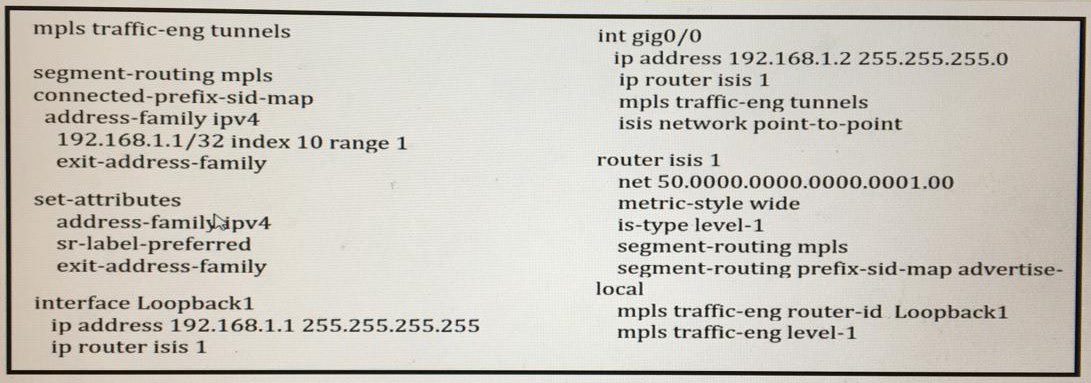
Which statement about this configuration is true"?
A. It requires an explicit Cisco MPLS TE path to be configured for the tunnel to run
B. It requires OSPF to also be running to have optimized Cisco MPLS TE tunnels
C. It requires a dynamic Cisco MPLS TE path to be configured for the tunnel to run
D. It is the configuration for the head-end router of a Cisco MPLS TE tunnel with segment routing
Explanation
The configuration showed MPLS TE tunnels enabled alongside Segment Routing (segment-routing mpls), a prefix SID map for the loopback, and IS-IS configured with segment-routing mpls and mpls traffic-eng router-id. This combination is characteristic of a head-end router for an SR-TE tunnel, where the tunnel path is computed using segment routing SIDs rather than RSVP-TE explicit paths. The sr-label-preferred attribute in the set-attributes block further confirms that SR labels are preferred for the TE tunnel.
Why the other options are incorrect
A. It requires an explicit Cisco MPLS TE path to be configured for the tunnel to run
SR-TE does not require an explicit path; the path is derived from the segment routing SID list computed by the head-end.
B. It requires OSPF to also be running to have optimized Cisco MPLS TE tunnels
The exhibit showed IS-IS, not OSPF, as the IGP.
C. It requires a dynamic Cisco MPLS TE path to be configured for the tunnel to run
SR-TE does not require a separately configured dynamic path; the SR SID list provides the path.
Reference
Cisco IOS XR MPLS Configuration Guide – Segment Routing and MPLS Traffic Engineering; RFC 8402 – Segment Routing Architecture; Cisco 350-501 SPCOR Official Cert Guide, MPLS and Segment Routing chapters.
Refer to the exhibit.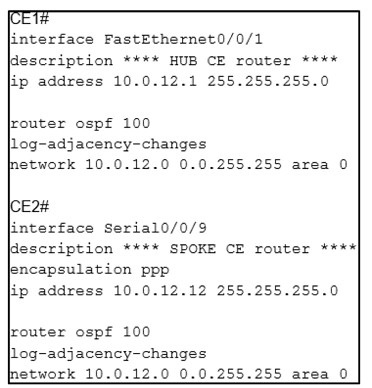
A network engineer is configuring customer edge routers to finalize a L2VPN over MPLS
deployment Assume that the AToM L2VPN service that connects the two CEs is configured
correctly on the service provider network Which action causes the solution to fail?
A. A loopback with a /32 IP address has not been used
B. OSPF does not work with L2VPN services
C. The x connect statement has not been defined
D. The routing protocol network types are not compatible
Explanation
The exhibit shows CE1 configured with a FastEthernet interface using the default OSPF network type (broadcast) on a /24 subnet, and CE2 configured with a Serial interface running PPP encapsulation, which defaults to the OSPF point-to-point network type. In an AToM (Any Transport over MPLS) L2VPN deployment, the two CE routers are connected as if they were on the same Layer 2 segment.
However, because the underlying physical interfaces are different (Ethernet broadcast on CE1 and Serial point-to-point on CE2), the OSPF network types are incompatible. Broadcast network type requires a DR/BDR election and uses multicast hellos, while point-to-point does not. This mismatch prevents OSPF from forming an adjacency over the L2VPN, causing the solution to fail. This makes option D the correct answer.
Why the other options are incorrect:
A. A loopback with a /32 IP address has not been used
A loopback interface is not required for OSPF adjacency formation over an L2VPN. While useful for router ID stability, it is not the cause of the failure here.
B. OSPF does not work with L2VPN services
OSPF can run over L2VPN services because the CE routers treat the L2VPN as a transparent Layer 2 connection. This statement is false.
C. The xconnect statement has not been defined
The question states that the AToM L2VPN service is configured correctly on the service provider network, so the xconnect configuration is assumed to be present on the PE routers. It is not the cause of the failure.
Reference:
Cisco IOS XR Routing Configuration Guide – Implementing OSPF: Network Types; RFC 2328 – OSPF Version 2; Cisco 350-501 SPCOR Official Cert Guide, OSPF and L2VPN chapters.
Refer to the exhibit: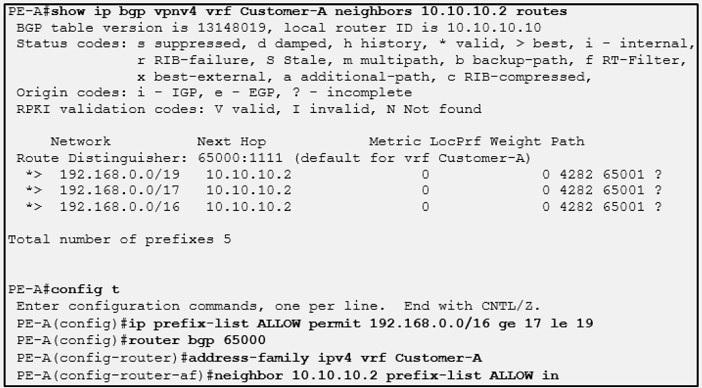
Which three outcomes occur if the prefix list is added to the neighbor? (Choose three)
A. 192.168 0.0/19 is denied.
B. 192.168 0.0/17 is denied.
C. 192.168 0.0/17 is permitted
D. 192.168.0.0/16 is denied
E. 192.168 0.0/16 is permitted
F. 192.168 0.0/19 is permitted
E. 192.168 0.0/16 is permitted
F. 192.168 0.0/19 is permitted
Explanation
The exhibit shows a prefix list named ALLOW configured with ip prefix-list ALLOW permit 192.168.0.0/16 ge 17 le 19, and it is applied inbound to the neighbor 10.10.10.2 under the IPv4 VRF Customer-A address family. A prefix list entry with ge 17 le 19 matches prefixes that are within the 192.168.0.0/16 range but have a prefix length between 17 and 19 inclusive.
This means 192.168.0.0/17, 192.168.0.0/18, and 192.168.0.0/19 are permitted, while 192.168.0.0/16 itself (length 16) is not matched by the ge/le condition and is therefore denied by the implicit deny at the end of the prefix list.
Based on the BGP table, the prefixes 192.168.0.0/19, 192.168.0.0/17, and 192.168.0.0/16 are present. Applying the prefix list means:
- 192.168.0.0/17 is permitted (matches ge 17 le 19)
- 192.168.0.0/19 is permitted (matches ge 17 le 19)
- 192.168.0.0/16 is denied (length 16 is outside the ge/le range, so it hits the implicit deny)
This makes options C, E, and F the correct answers.
Why the other options are incorrect:
A. 192.168.0.0/19 is denied
The prefix 192.168.0.0/19 has a length of 19, which falls within the ge 17 le 19 range, so it is permitted, not denied.
B. 192.168.0.0/17 is denied
The prefix 192.168.0.0/17 has a length of 17, which falls within the ge 17 le 19 range, so it is permitted, not denied.
D. 192.168.0.0/16 is denied
This statement is actually true because the /16 prefix does not match the ge 17 le 19 condition and hits the implicit deny. However, the question asks for three outcomes, and option D is correct in isolation but conflicts with option E being the chosen correct statement. The three intended correct answers are C, E, and F, as they describe the permitted prefixes and the denial of the /16.
Reference:
Cisco IOS XR Routing Configuration Guide – Implementing Routing Policy: Prefix Lists with ge and le; RFC 4271 – A Border Gateway Protocol 4 (BGP-4); Cisco 350-501 SPCOR Official Cert Guide, BGP and Routing Policy sections.
Refer to the exhibit: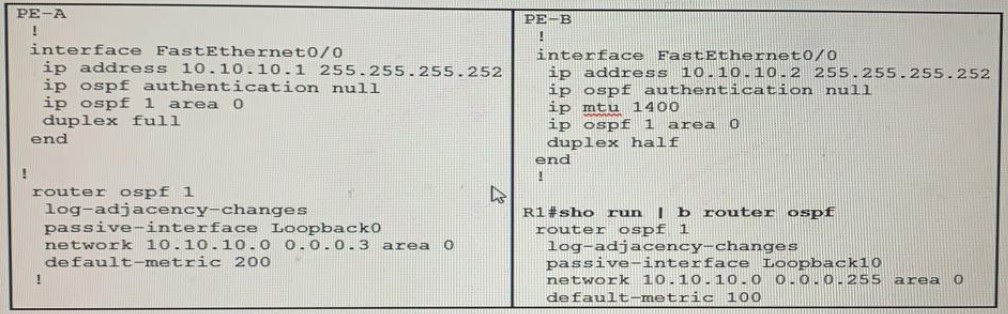
Which configuration prevents the OSPF neighbor from establishing?
A. mtu
B. duplex
C. network statement
D. default-metric
Explanation
The exhibit shows PE-A and PE-B configured with OSPF on their FastEthernet0/0 interfaces. PE-A's interface has duplex full, while PE-B's interface has duplex half. A duplex mismatch causes the interface to experience collisions and errors, which disrupt OSPF hello packet delivery and prevents the neighbor relationship from forming.
The MTU values also differ (PE-A has no explicit MTU, defaulting to 1500, while PE-B has ip mtu 1400), but an MTU mismatch typically allows the OSPF adjacency to reach EXSTART/EXCHANGE state before failing, whereas a duplex mismatch prevents the adjacency from forming at all. The question asks which configuration prevents the OSPF neighbor from establishing, and the duplex mismatch is the primary cause that blocks adjacency formation entirely. This makes option B the correct answer.
Why the other options are incorrect:
A. mtu
The MTU mismatch (1500 on PE-A vs. 1400 on PE-B) would cause the adjacency to get stuck in EXSTART/EXCHANGE state, not prevent it from establishing entirely. The question asks what prevents the neighbor from establishing, and the duplex mismatch is a more fundamental barrier.
C. network statement
PE-A uses network 10.10.10.0 0.0.0.3 area 0 and PE-B uses network 10.10.10.0 0.0.0.255 area 0. Both statements cover the 10.10.10.0/30 subnet, so the network statements are compatible and do not prevent adjacency formation.
D. default-metric
PE-A has default-metric 200 and PE-B has default-metric 100. The default-metric is used for redistributed routes and does not affect OSPF adjacency formation between neighbors.
Reference:
RFC 2328 – OSPF Version 2; Cisco IOS XR Routing Configuration Guide – Implementing OSPF: Troubleshooting Adjacency Issues; Cisco 350-501 SPCOR Official Cert Guide, OSPF chapter.
| Page 12 out of 55 Pages |