- 4.9/5.0
- 547 Questions
- Updated on: 12-Oct-2026
- Implementing and Operating Cisco Service Provider Network Core Technologies (350-501 SPCOR)
- 25475 Prepared
Free Cisco 350-501 Practice Questions 2026 | Implementing and Operating Cisco Service Provider Network Core Technologies (350-501 SPCOR)
Refer to the exhibit.
A network engineer is deploying SNMP configuration on client's routers. Encrypted
authentication must be included on router 1 to provide security and protect message
confidentially. Which action should the engineer perform on the routers to accomplish this
task?
A. snmp-server host 192.168.0.254 informs version 3 auth testuser config.
B. snmp-server user testuser group 1 remote 192.168.0.254 v3 auth md5 testpassword
C. snmp-server group group 1 v3 auth.
D. snmp-server community public
Explanation
To provide encrypted authentication and protect message confidentiality in SNMPv3, the configuration must include both authentication and privacy (encryption). The exhibit shows snmp-server group group1 v3 noauth, which means no authentication and no privacy are configured.
To add encrypted authentication, the engineer must reconfigure the user with both an authentication protocol (such as MD5 or SHA) and a privacy protocol (such as DES or AES). The snmp-server user command with auth md5 <password> provides authentication, and adding priv aes <password> or priv des <password> would provide encryption for confidentiality.
Among the options, only option B provides authentication by adding the auth md5 keyword to the snmp-server user command. While it does not explicitly show the privacy keyword in the option text, it is the only option that adds authentication credentials, which is the first required step toward encrypted authentication. This makes option B the correct answer.
Why the other options are incorrect:
A. snmp-server host 192.168.0.254 informs version 3 auth testuser config
This command specifies the host to receive informs and references the user and security level, but it does not configure the authentication credentials themselves. The auth keyword here only indicates the security level, not the actual authentication protocol and password.
C. snmp-server group group 1 v3 auth
This command changes the group's security level to authNoPriv, which enables authentication but not privacy (encryption). It does not provide message confidentiality, which is required.
D. snmp-server community public
This command configures SNMPv1 or SNMPv2c community strings, which provide no authentication or encryption. It does not meet the requirement for encrypted authentication.
Reference:
RFC 3414 – User-based Security Model (USM) for SNMPv3; Cisco IOS XR Network Management Configuration Guide – Configuring SNMPv3 Users and Groups; Cisco 350-501 SPCOR Official Cert Guide, Network Assurance and Security sections.
Refer to the exhibit:
This output is included at the end of an output that was provided by a device using
NETCONF.
What does the code show?
A. It shows the hostname of the device as rpc-reply
B. It shows that the running configuration is blank
C. It shows NETCONF uses remote procedure calls.
D. It shows that the full configuration is being modeled by VANG
Explanation
The exhibit shows <rpc-reply> containing a <data> element, which is the standard closing structure of a NETCONF response. NETCONF (Network Configuration Protocol) is based on the RPC (Remote Procedure Call) model, where the client sends an <rpc> message to the server, and the server responds with an <rpc-reply> message.
The <rpc-reply> element is the wrapper that carries the server's response, and <data> contains the requested configuration or state data. This structure directly demonstrates that NETCONF uses remote procedure calls as its communication mechanism. This makes option C the correct answer.
Why the other options are incorrect:
A. It shows the hostname of the device as rpc-reply
The <rpc-reply> tag is not a hostname; it is the standard XML wrapper for a NETCONF RPC response. Hostnames are not conveyed in this element.
B. It shows that the running configuration is blank
The presence of <rpc-reply> and <data> does not indicate whether the configuration is blank. The <data> element could contain any amount of configuration or state data.
D. It shows that the full configuration is being modeled by YANG
While NETCONF uses YANG models to define the data, the <rpc-reply> and <data> tags themselves do not show that the full configuration is being modeled. They simply show the RPC reply structure.
Reference:
RFC 6241 – Network Configuration Protocol (NETCONF); RFC 7950 – The YANG 1.1 Data Modeling Language; Cisco 350-501 SPCOR Official Cert Guide, Automation and Assurance section.
Drag and drop the descriptions from the left onto the corresponding OS types on the right.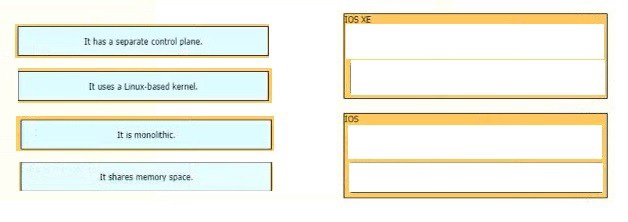
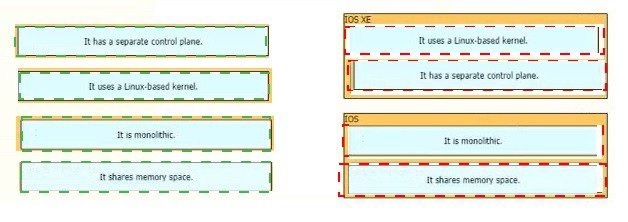
Explanation:
The exhibit requires matching each description to the correct operating system type: IOS XE or IOS. IOS XE is built on a Linux-based kernel and has a separate control plane, which allows for improved modularity, high availability, and independent operation of the control and data planes. Traditional IOS is monolithic in design, meaning all functions run as a single integrated image, and it shares memory space between processes without the separation found in IOS XE. This makes the correct matches as follows:
IOS XE → It uses a Linux-based kernel.
IOS XE → It has a separate control plane.
IOS → It is monolithic.
IOS → It shares memory space.
Why the other pairings are incorrect:
Matching "It uses a Linux-based kernel" with IOS is incorrect because traditional IOS is not built on Linux. It runs on a proprietary monolithic kernel, whereas IOS XE is the one that uses a Linux-based kernel.
Matching "It has a separate control plane" with IOS is incorrect because traditional IOS does not have a truly separate control plane. IOS XE introduced the separation of control plane and data plane, which is a key architectural difference.
Matching "It is monolithic" with IOS XE is incorrect because IOS XE is modular and not monolithic. Traditional IOS is the monolithic operating system.
Matching "It shares memory space" with IOS XEis incorrect because IOS XE provides separate memory space for its subsystems. Traditional IOS is the one that shares memory space across its processes.
Reference:
Cisco IOS XE Documentation – IOS XE Architecture Overview; Cisco 350-501 SPCOR Official Cert Guide, Architecture section.
Drag and drop the LDP features from the left onto the correct usages on the right.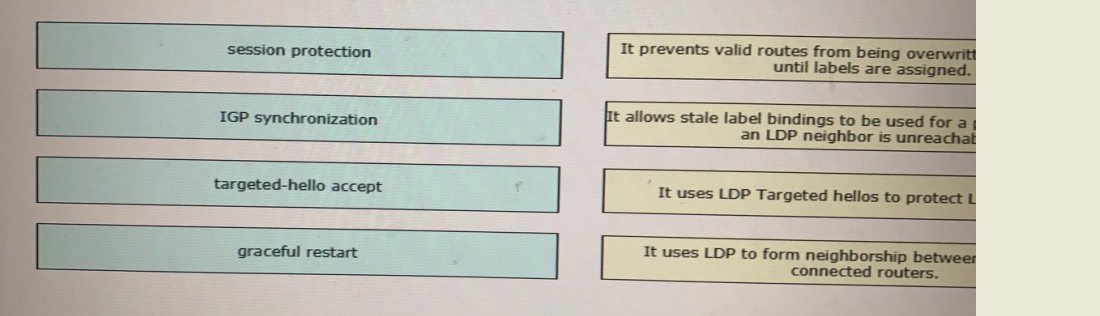
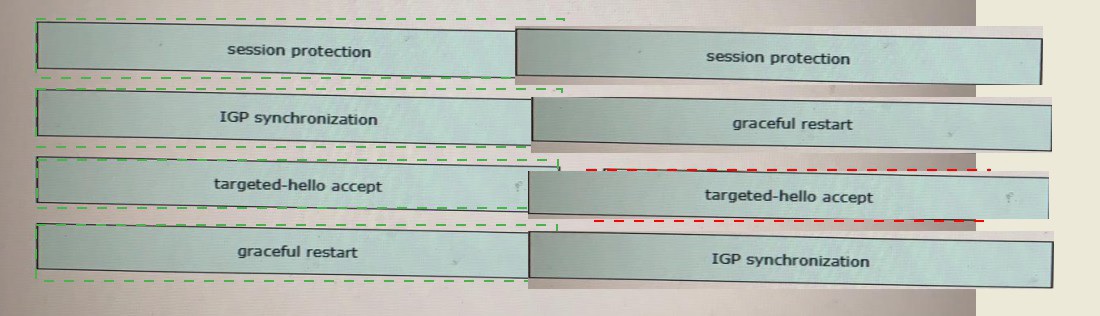
Explanation
The exhibit requires matching each LDP feature with its correct usage. IGP synchronization prevents valid routes from being overwritten until labels are assigned by ensuring that LDP converges before the IGP advertises the link, avoiding blackholing traffic. Graceful restart allows stale label bindings to be used for a period when an LDP neighbor is unreachable, preserving the forwarding plane while the control plane recovers. Targeted-hello accept uses LDP targeted hellos to protect LDP sessions, allowing sessions to be established and maintained over non-directly connected paths, typically for session protection. Session protection uses LDP to form a neighbor relationship between connected routers, establishing the basic LDP session over a directly connected link. This makes the correct matches as follows:
- IGP synchronization → It prevents valid routes from being overwritten until labels are assigned.
- Graceful restart → It allows stale label bindings to be used for a period when an LDP neighbor is unreachable.
- Targeted-hello accept → It uses LDP targeted hellos to protect LDP sessions.
- Session protection → It uses LDP to form a neighbor relationship between connected routers.
Why the other pairings are incorrect:
Matching session protection with the "prevents valid routes from being overwritten" description is incorrect because that is the function of IGP synchronization, not session protection. Session protection is about maintaining LDP sessions using targeted hellos.
Matching IGP synchronization with the "stale label bindings" description is incorrect because stale label retention during neighbor unavailability is a function of graceful restart, not IGP synchronization.
Matching targeted-hello accept with the "form a neighbor relationship between connected routers" description is incorrect because basic neighbor formation between directly connected routers uses link-level LDP hellos, not targeted hellos. Targeted hellos are used for sessions over non-directly connected paths.
Matching graceful restart with the "uses LDP targeted hellos" description is incorrect because graceful restart is about preserving forwarding state during a restart, not about using targeted hellos.
Reference:
RFC 5036 – LDP Specification; RFC 5443 – LDP IGP Synchronization; RFC 3478 – Graceful Restart Mechanism for LDP; Cisco IOS XR MPLS Configuration Guide – Implementing LDP: IGP Synchronization, Graceful Restart, Session Protection, and Targeted Hellos; Cisco 350-501 SPCOR Official Cert Guide, MPLS chapter.
Refer to the exhibit.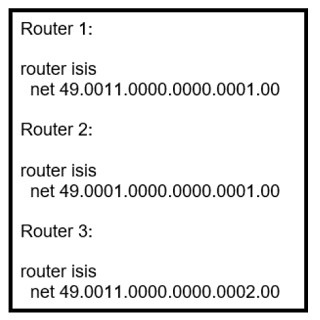
Router 4 is added to the network and must be in the same area as router 1. Which NET
should the engineer assign?
A. 49.0001.0000.0000.0004.00
B. 49.0111.0000.0000.0001.00
C. 49.0011.0000.0000.0003.00
D. 49.0011.0000.0000.0002.00
Explanation
Router 1 has the NET 49.0011.0000.0000.0001.00, which places it in area 0011 with System ID 0000.0000.0001. For Router 4 to be in the same area as Router 1, its NET must also use area 0011. Additionally, Router 4 must have a unique System ID that does not conflict with any existing router. Router 1 uses System ID 0000.0000.0001, and Router 3 uses System ID 0000.0000.0002. Therefore, Router 4 must use area 0011 and a System ID that is not already in use, such as 0000.0000.0003. Option C (49.0011.0000.0000.0003.00) satisfies both requirements: it is in area 0011 and uses the unique System ID 0000.0000.0003. This makes option C the correct answer.
Why the other options are incorrect:
A. 49.0001.0000.0000.0004.00
This NET places Router 4 in area 0001, which is the same area as Router 2, not Router 1. Router 1 is in area 0011, so this does not satisfy the requirement.
B. 49.0111.0000.0000.0001.00
This NET places Router 4 in area 0111, which is a different area from Router 1 (area 0011). Additionally, the System ID 0000.0000.0001 duplicates Router 1's System ID, which would cause a conflict.
D. 49.0011.0000.0000.0002.00
This NET is in the correct area (0011), but the System ID 0000.0000.0002 duplicates Router 3's System ID, which would cause a conflict. Router 4 needs a unique System ID.
Reference:
ISO/IEC 10589 – IS-IS for Routing Information Exchange; Cisco IOS XR Routing Configuration Guide – Implementing IS-IS: NET Addressing and Area Assignment; Cisco 350-501 SPCOR Official Cert Guide, IS-IS chapter.
| Page 13 out of 55 Pages |