- 4.9/5.0
- 547 Questions
- Updated on: 12-Oct-2026
- Implementing and Operating Cisco Service Provider Network Core Technologies (350-501 SPCOR)
- 25475 Prepared
Free Cisco 350-501 Practice Questions 2026 | Implementing and Operating Cisco Service Provider Network Core Technologies (350-501 SPCOR)
Refer to the exhibit:
Which command is used to complete this configuration for QoS class-based marking?
A. PE-A(config-pmap-c)#set dscp ef
B. PE-A(config-pmap-c)#fair-queue
C. PE-A(config-pmap-c)#random-detect
D. PE-A(config -pmap-c)#priority
Explanation
The exhibit shows a class-map named VOIP that matches IP precedence 5, and a policy-map named MARK-TRAFFIC that references the VOIP class. The task is to complete the configuration for QoS class-based marking. Class-based marking uses the set command to assign a new marking value to the matched traffic. To mark VoIP traffic with the standard DSCP value for voice, the correct command is set dscp ef (Expedited Forwarding). This makes option A the correct answer.
Why the other options are incorrect:
B. PE-A(config-pmap-c)#fair-queue
Fair queueing is a congestion management (queuing) feature that provides fair bandwidth allocation among flows. It is not a marking command and does not complete a class-based marking configuration.
C. PE-A(config-pmap-c)#random-detect
Random Early Detection (RED) is a congestion avoidance mechanism that drops packets before a queue fills up. It is not a marking action.
D. PE-A(config-pmap-c)#priority
The priority command configures a low-latency queue (LLQ) for the class, providing priority treatment. It is a queuing/scheduling action, not a marking action, and the question specifically asks about class-based marking.
Reference:
Cisco IOS XR Modular QoS Configuration Guide – Configuring Class-Based Marking; RFC 2474 – Definition of the Differentiated Services Field (DS Field) in the IPv4 and IPv6 Headers; Cisco 350-501 SPCOR Official Cert Guide, QoS section.
Refer to the exhibit: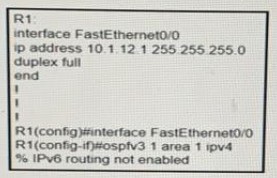
A network engineer is implementing an OSPF configuration Based on the output, which
statement is true?
A. In the ospfv3 1 area 1 ipv4 command, area 0 must be configured instead of area 1.
B. OSPFv3 does not run for IPv4 on FastEthemet0/0 until IPv6 routing is enabled on the router and IPv6 is enabled on interface Fastfc.thernet0/0
C. OSPFv3 cannot be configured for IPv4; OSPFv3 works only for IPv6.
D. IPv6 routing not enabled" is just an informational message and OSPFv3 runs for IPv4 on interface FastEthernet0/0 anyway
Explanation
The exhibit shows the engineer attempting to configure ospfv3 1 area 1 ipv4 on interface FastEthernet0/0, and the router returns the error % IPv6 routing not enabled. Although OSPFv3 has been extended to support IPv4 address families (using the ipv4 keyword in the address family configuration), Cisco IOS XR requires IPv6 routing to be enabled globally on the router before OSPFv3 can be activated on any interface, even for IPv4 address family support. Additionally, IPv6 must be enabled on the interface itself. Until ipv6 unicast-routing is configured globally and IPv6 is enabled on the interface, OSPFv3 will not run for IPv4 on FastEthernet0/0. This makes option B the correct answer.
Why the other options are incorrect:
A. In the ospfv3 1 area 1 ipv4 command, area 0 must be configured instead of area 1
There is no requirement that the area must be area 0. OSPFv3 areas can be any valid area number, and area 1 is acceptable. The error message is about IPv6 routing not being enabled, not about the area number.
C. OSPFv3 cannot be configured for IPv4; OSPFv3 works only for IPv6
This is incorrect. OSPFv3 has been extended with address family support (RFC 5838) to support IPv4 and IPv6. The ipv4 keyword in the command confirms that OSPFv3 can be used for IPv4.
D. "IPv6 routing not enabled" is just an informational message and OSPFv3 runs for IPv4 on interface FastEthernet0/0 anyway
The message is an error, not just informational. OSPFv3 will not run until IPv6 routing is enabled, so this statement is false.
Reference:
RFC 5838 – Support of Address Families in OSPFv3; Cisco IOS XR Routing Configuration Guide – Implementing OSPFv3: IPv4 Address Family Support; Cisco 350-501 SPCOR Official Cert Guide, OSPF chapter.
Drag and drop the functionalities from the left onto the target fields on the right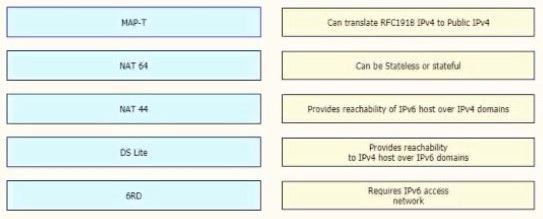
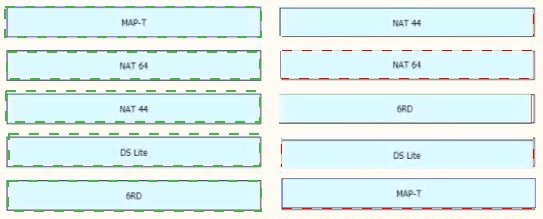
Explanation:
The exhibit requires matching each IPv6 transition technology with its correct functionality. NAT44 translates RFC1918 IPv4 addresses to public IPv4 addresses, which is the classic NAT function for IPv4-to-IPv4 translation. NAT64 provides reachability of IPv6 hosts over IPv4 domains by translating between IPv6 and IPv4, and it can operate in either stateless or stateful mode. 6RD (IPv6 Rapid Deployment) provides reachability to IPv4 hosts over IPv6 domains by encapsulating IPv4 traffic within IPv6. DS Lite (Dual-Stack Lite) requires an IPv6 access network to tunnel IPv4 traffic over the IPv6 infrastructure using IPv4-in-IPv6 tunneling. MAP-T (Mapping of Address and Port with Translation) is a stateless translation mechanism, but it is not one of the descriptions listed in the options; the remaining description matches NAT44. This makes the correct matches as follows:
NAT44 → Can translate RFC1918 IPv4 to Public IPv4
NAT64 → Can be Stateless or stateful
6RD → Provides reachability of IPv4 host over IPv6 domains
DS Lite → Requires IPv6 access network
MAP-T → Provides reachability of IPv6 host over IPv4 domains
Why the other pairings are incorrect:
Matching MAP-T with the "Can translate RFC1918 IPv4 to Public IPv4" description is incorrect because that describes NAT44, not MAP-T. MAP-T is a stateless IPv4-to-IPv6 mapping and translation mechanism.
Matching NAT64 with the "Provides reachability of IPv6 host over IPv4 domains" description is incorrect because that describes the opposite direction. NAT64 allows IPv6-only hosts to reach IPv4 servers, which is reachability of IPv4 resources from IPv6 hosts, not IPv6 hosts over IPv4 domains.
Matching DS Lite with the "Provides reachability of IPv4 host over IPv6 domains" description is incorrect because that describes 6RD. DS Lite requires an IPv6 access network and uses IPv4-in-IPv6 tunneling with carrier-grade NAT.
Matching 6RD with the "Requires IPv6 access network" description is incorrect because 6RD provides IPv6 connectivity over an existing IPv4 access network, not the other way around. DS Lite is the technology that requires an IPv6 access network.
Reference:
RFC 2663 – IP Network Address Translator (NAT) Terminology and Considerations; RFC 6146 – Stateful NAT64; RFC 5569 – IPv6 Rapid Deployment on IPv4 Infrastructures (6rd); RFC 6333 – Dual-Stack Lite Broadband Deployments Following IPv4 Exhaustion; RFC 7599 – Mapping of Address and Port using Translation (MAP-T); Cisco 350-501 SPCOR Official Cert Guide, Architecture and Services section.
Refer to the exhibit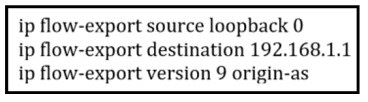
Export statistics received do not include the BGP next hop.
Which statement about the NetFlow export statistics is true?
A. Only the origin AS of the source router will be included in the export statistics.
B. Only the origin AS of the source router will be included in the export statistics.
C. The origin AS and the peer-as will be included in the export statistics.
D. To include the BGP next hop in the export statistics, those keywords must be included with the version 9 entry.
Explanation
The exhibit shows ip flow-export version 9 origin-as, which configures NetFlow version 9 export with the origin-as keyword. This keyword includes the origin AS information in the exported flow records, but it does not include the BGP next hop. To include the BGP next hop in the NetFlow export, the appropriate keyword (such as bgp-nexthop) must be explicitly added to the version 9 export configuration. NetFlow version 9 uses templates, and the specific fields to be exported must be defined; if the BGP next-hop keyword is not included, that field will not appear in the export statistics. This makes option D the correct answer.
Why the other options are incorrect:
A. Only the origin AS of the source router will be included in the export statistics
The configuration includes origin-as, which provides origin AS information, but this statement is not about the BGP next hop and does not address the issue described in the question.
B. Loopback 0 must be participating in BGP for it to be included in the export statistics
Loopback 0 is configured as the source of the NetFlow export, not as a BGP next-hop field. Whether Loopback 0 participates in BGP is irrelevant to including the BGP next hop in flow records.
C. The origin AS and the peer-as will be included in the export statistics
The configuration includes only origin-as, not peer-as. Therefore, the peer AS is not included in the export statistics, and this statement is false.
Reference:
Cisco IOS NetFlow Configuration Guide – NetFlow Version 9 Field Types and BGP Next-Hop Export; RFC 3954 – Cisco Systems NetFlow Services Export Version 9; Cisco 350-501 SPCOR Official Cert Guide, Network Assurance section.
ASN 65001 is peering with ASN 65002 to exchange IPv6 BGP routes. All routes that
originate in ASN 65001 have a standard community value of 65001:100, and ASN 65002 is
allowed to advertise only 2001 :db8:aaaa::/48. An engineer needs to update the ASN
65001 route-filtering configuration to meet these conditions:
* Looped routes into ASN 65001 and routes that have traversed 10 or more ASNs must be
denied.
* Routes accepted into ASN 65001 must be assigned a community value of 65001:200.
Which configuration must the engineer apply to the ASN 65001 border router?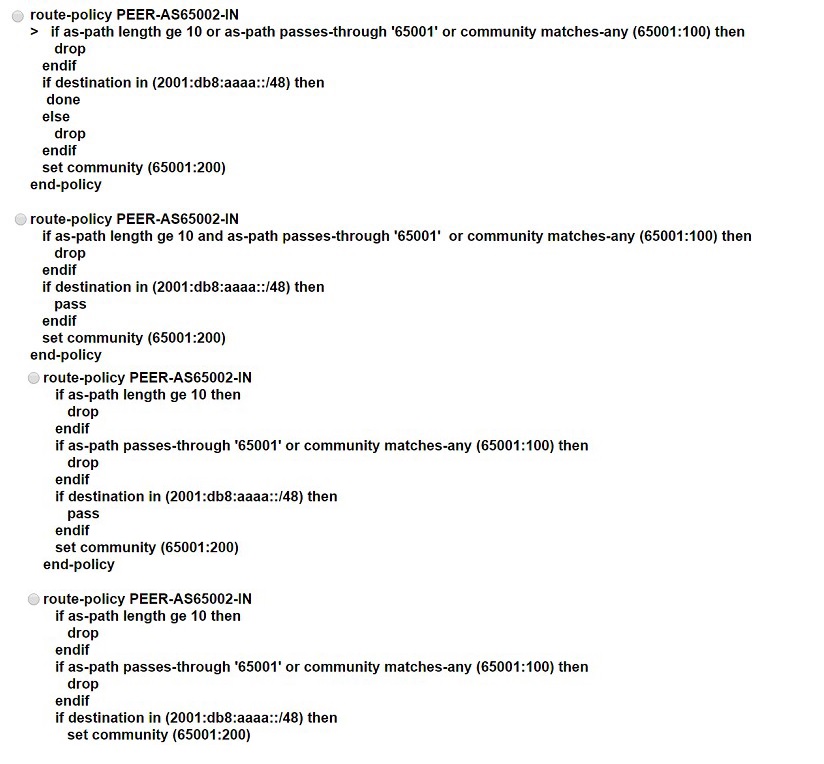
A. Option A
B. Option B
C. Option C
D. Option D
E.
Option E
Explanation
The requirements are: deny routes that are looped into ASN 65001 (contain 65001 in the AS_PATH) or have traversed 10 or more ASNs, deny routes that do not match the allowed prefix 2001:db8:aaaa::/48, and assign community 65001:200 to accepted routes. The correct route-policy must evaluate both denial conditions in a single `if` statement using `or`, then check the destination prefix, and finally set the community.
Option A does this correctly: it denies routes where the AS_PATH length is 10 or more **or** the path passes through 65001 **or** the community matches 65001:100, then checks the destination `2001:db8:aaaa::/48`, passes (done) if it matches, drops otherwise, and sets community 65001:200. This makes option A the correct answer.
Why the other options are incorrect:
B. Option B
It uses `pass` instead of `done` for the matching prefix, which means the policy continues to evaluate and may apply unintended actions. It also places the prefix check after the denial, but the logic flow is not the standard IOS XR pattern for accepting only a specific prefix and then setting a community. The `pass` statement exits with an accept but does not guarantee the subsequent `set community` is applied in the same way as `done`.
C. Option C
It splits the denial conditions into two separate `if` blocks. While logically similar, it does not combine the loop and AS-path-length checks with `or` as required. More importantly, the community denial condition is separated, which changes the semantics and does not match the intended single combined denial.
D. Option D
It is missing the `endif` and `end-policy` structure in the correct order, and the logic is incomplete. The prefix check sets the community but does not properly handle the pass/drop decision for non-matching prefixes.
E. Option E
There is no Option E shown in the exhibit; the exhibit only contains four options (A through D). If a fifth option existed, it would need to match the exact logic of Option A.
Reference:
Cisco IOS XR Routing Configuration Guide – Implementing Routing Policy: Route-Policy Statements and Actions; RFC 4271 – A Border Gateway Protocol 4 (BGP-4); RFC 1997 – BGP Communities Attribute; Cisco 350-501 SPCOR Official Cert Guide, BGP and Routing Policy sections.
Refer to the exhibit: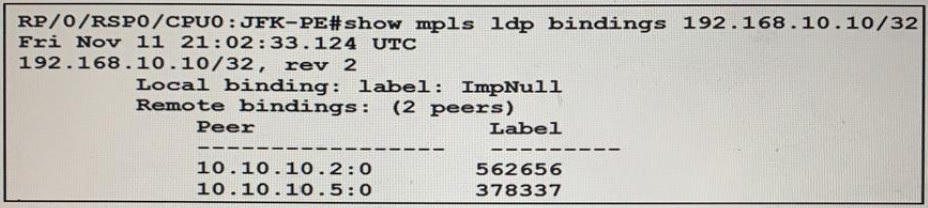
After implementing a new design for the network, a technician reviews the pictured CLI
output as part of the MOP.
Which two statements describe what the technician can ascertain from the ImpNull output?
(Choose two.)
A. Label 0 is used for the prefix displayed but will not be part of the MPLS label stack for packets destined for 192 168.10.10.
B. Ultimate Hop Popping is in use for the prefix displayed.
C. Label 0 is used for the prefix displayed and will be part of the MPLS label stack for packets destined for 192.168.10.10
D. Penultimate Hop Popping is in use for the prefix displayed
E. Label 3 is in use for the prefix displayed and will be part of the MPLS label stack for packets destined for 192.168.10.10
D. Penultimate Hop Popping is in use for the prefix displayed
Explanation
The exhibit shows `show mpls ldp bindings 192.168.10.10/32` with a Local binding of `label: ImpNull`. The Implicit Null (ImpNull) label, which has the value of 0, is advertised by a router to its upstream LDP peer to indicate that the upstream router should perform Penultimate Hop Popping (PHP). This means the penultimate (second-to-last) router in the LSP will pop the MPLS label before forwarding the packet to the ultimate hop (the egress router for the prefix). Since the label is popped by the penultimate router, the Implicit Null label itself is not part of the MPLS label stack carried in the packet when it reaches the egress router. This makes options A and D the correct answers.
Why the other options are incorrect:
B. Ultimate Hop Popping is in use for the prefix displayed
Ultimate Hop Popping (UHP) is the opposite of PHP. In UHP, the egress router pops the label itself, and the Implicit Null label would not be advertised. The presence of ImpNull indicates PHP, not UHP.
C. Label 0 is used for the prefix displayed and will be part of the MPLS label stack for packets destined for 192.168.10.10
The Implicit Null label (label 0) is signaled to the upstream peer but is not pushed onto the label stack. The upstream router pops the label instead of swapping it to label 0, so label 0 does not appear in the label stack of the forwarded packet.
E. Label 3 is in use for the prefix displayed and will be part of the MPLS label stack for packets destined for 192.168.10.10
Label 3 is the Explicit Null label used for certain QoS signaling scenarios, but it is not shown in the exhibit. The exhibit shows ImpNull (label 0), not label 3.
Reference:
RFC 3031 – Multiprotocol Label Switching Architecture (Implicit Null and PHP); RFC 5036 – LDP Specification; Cisco IOS XR MPLS Configuration Guide – Implementing LDP: Label Advertisement and PHP; Cisco 350-501 SPCOR Official Cert Guide, MPLS chapter.
Refer to the exhibit.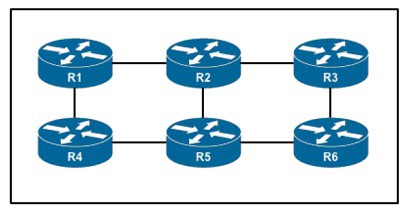
An engineer is configuring an administrative domain in the given multi-vendor environment
with PIM-SM. Which feature must the engineer implement so that devices will dynamically
learn the RP?
A. Auto-RP
B. BIDIR-PIM
C. SSM
D. BSR
Explanation
In a multi-vendor PIM-SM environment, the engineer must implement BSR (Bootstrap Router) so that devices can dynamically learn the Rendezvous Point (RP). BSR is a standards-based mechanism defined in RFC 5059, where candidate RPs send their candidacy to the Bootstrap Router, and the BSR floods RP-to-group mapping information to all PIM routers in the domain via bootstrap messages. Because BSR is an open standard, it is the correct choice for a multi-vendor environment, unlike Cisco-proprietary Auto-RP. This makes option D the correct answer.
Why the other options are incorrect:
A. Auto-RP
Auto-RP is a Cisco-proprietary mechanism for dynamic RP learning. It works well in all-Cisco environments but is not suitable for a multi-vendor environment because non-Cisco devices do not support it.
B. BIDIR-PIM
Bidirectional PIM is a PIM mode used for many-to-many communication. While it uses an RP, it does not provide a dynamic RP learning mechanism by itself; it still relies on static RP configuration or BSR/Auto-RP.
C. SSM
Source-Specific Multicast does not use an RP at all. Receivers join a specific source and group directly using IGMPv3, so there is no RP to learn dynamically.
Reference:
RFC 5059 – Bootstrap Router (BSR) Mechanism for PIM; Cisco IOS XR Multicast Configuration Guide – Configuring BSR; Cisco 350-501 SPCOR Official Cert Guide, Multicast chapter.
| Page 14 out of 55 Pages |