- 4.9/5.0
- 547 Questions
- Updated on: 12-Oct-2026
- Implementing and Operating Cisco Service Provider Network Core Technologies (350-501 SPCOR)
- 25475 Prepared
Free Cisco 350-501 Practice Questions 2026 | Implementing and Operating Cisco Service Provider Network Core Technologies (350-501 SPCOR)
You are writing an RPL script to accept routes only from certain autonomous systems
Consider this code.
If you apply this code to BGP filters, which effect does the code have on your router?
A. denies routes from AS 7070
B. allows routes from AS 7077
C. denies routes from AS 7007
D. allows routes from AS 770
Explanation
The correct answer is B. allows routes from AS 7077.
Exhibit mein RPL (Routing Policy Language) code dekhein:
text
svgsvg
Is code ka matlab hai: agar AS path `.*77$` regex se match kare, to route ko pass (allow) karo.
Regex `.*77$` ko break down karein:
- `.*` → koi bhi characters (zero ya zyada)
- `77` → literal "77" characters
- `$` → string ka end
Matlab ye regex un AS paths se match karega jo "77" par khatam hote hain. Is liye AS 7077 ka AS path "7077" hai jo "77" par end hota hai — is liye ye route allow hoga.
Why the Other Options Are Incorrect
A. denies routes from AS 7070. – AS 7070 "70" par end hota hai, "77" par nahi. Is liye ye regex se match nahi karega aur is code ka effect deny nahi hoga (default behavior alag ho sakta hai, lekin ye code specifically deny nahi karta).
C. denies routes from AS 7007. – AS 7007 "07" par end hota hai, "77" par nahi. Is liye ye regex se match nahi karega.
D. allows routes from AS 770. – AS 770 "770" par end hota hai, "77" par nahi. Regex `.*77$` ko "770" match nahi karega kyunki `$` ke baad kuch nahi aana chahiye. Is liye ye allow nahi hoga.
Reference
- Cisco Press: Implementing and Operating Cisco Service Provider Network Core Technologies (SPCOR) 350-501 Official Cert Guide – Chapter on RPL (Routing Policy Language) and AS-Path Regular Expressions.
Refer To the exhibit: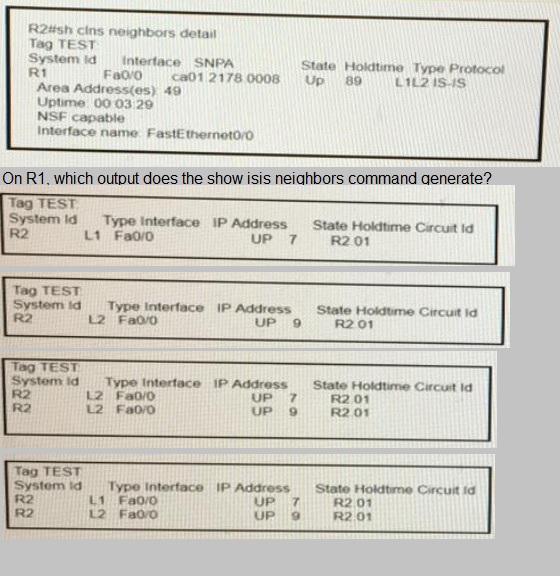
A. Option A
B. Option B
C. Option C
D. Option D
Explanation
The correct answer is D. Option D.
Exhibit mein R2 par `show clns neighbors detail` ka output diya gaya hai, jo R1 ke baare mein ye information deta hai:
- System Id: R1
- Interface: Fa0/0
- State: Up
- Holdtime: 89
- Type: L1L2 IS-IS (matlab R1 Level 1 aur Level 2 dono adjacencies form kar raha hai)
Ab `show isis neighbors` command R1 par run karne se output mein R2 ke saath dono levels (L1 aur L2) ki adjacencies dikhni chahiye. Exhibit mein R2 ne R1 ke saath L1L2 adjacency establish ki hai, is liye R1 par bhi R2 ke saath L1 aur L2 dono neighbors dikhne chahiye.
Option D mein:
- R2, Type L1, Interface Fa0/0, State UP, Holdtime 7, Circuit Id R2.01
- R2, Type L2, Interface Fa0/0, State UP, Holdtime 9, Circuit Id R2.01
Yani R1 par R2 ke saath dono Level 1 aur Level 2 adjacencies UP hain — jo R2 ke output (L1L2 IS-IS) se match karta hai.
Why the Other Options Are Incorrect
A. Option A – Sirf L1 adjacency dikha raha hai, lekin R2 ka output L1L2 IS-IS dikha raha hai. Is liye ye incomplete hai.
B. Option B – Sirf L2 adjacency dikha raha hai (Holdtime 9), L1 missing hai. Ye bhi incomplete hai.
C. Option C – Dono L2 adjacencies dikha raha hai (L2/L2), jo galat hai. R2 ka output L1L2 hai, is liye R1 par bhi L1 aur L2 dono hone chahiye, L2/L2 nahi.
Reference
- Cisco Press: Implementing and Operating Cisco Service Provider Network Core Technologies (SPCOR) 350-501 Official Cert Guide – Chapter on IS-IS Neighbor Verification and Adjacency Levels.
Drag and drop the functions from the left onto the correct Path Computation Element
Protocol roles on the right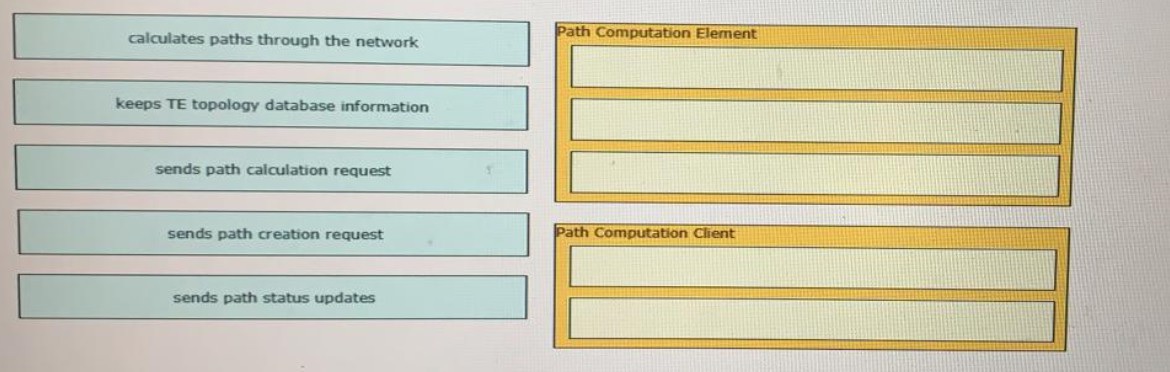
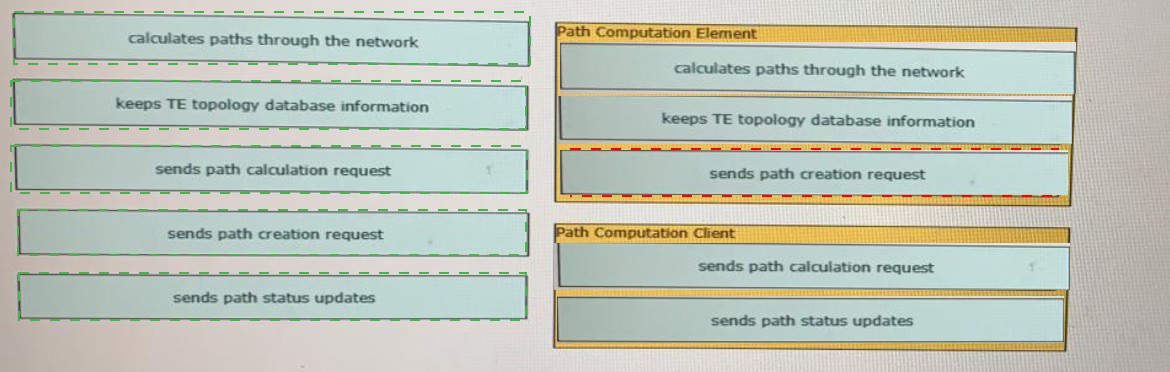
Explanation
PCE (Path Computation Element) ek network component hai jo path computation karta hai — yani MPLS TE tunnels ke liye optimal paths calculate karta hai. Ye TE topology database maintain karta hai (TED — Traffic Engineering Database), jismein network ki bandwidth, links, aur constraints ki information hoti hai. Path calculate karne ke baad PCE path creation request bhejta hai (PCInitiate message ke through) taake LSP establish ho sake. Is liye PCE ke roles hain:
- calculates paths through the network → Path computation karna
- keeps TE topology database information → TED maintain karna
- sends path creation request → PCInitiate message bhejna
PCC (Path Computation Client) ek router ya network element hai jo PCE se path computation request karta hai. Jab PCC ko kisi TE LSP ke liye path chahiye hoti hai, to woh PCReq (Path Computation Request) message PCE ko bhejta hai. Agar path computation fail ho jaye ya LSP ki state change ho, to PCC path status updates (PCRpt — Path Computation Report) bhejta hai. Is liye PCC ke roles hain:
- sends path calculation request → PCReq message bhejna
- sends path status updates → PCRpt message bhejna
Reference
- Cisco Press: Implementing and Operating Cisco Service Provider Network Core Technologies (SPCOR) 350-501 Official Cert Guide – Chapter on MPLS TE and Path Computation Element Protocol (PCEP).
Refer to the exhibit:
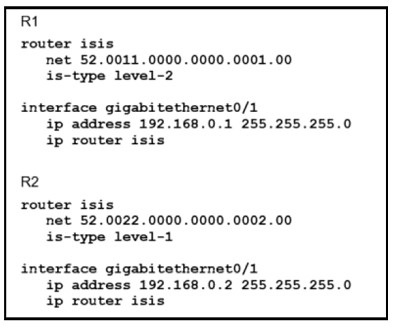
Which statement about the status of the neighbor relationship between R1 and R2 is true?
A. The neighbor relationship is down because the two routers are configured with different area types
B. The neighbor relationship is down because the two routers are in the same subnet.
C. The neighbor relationship is up because R2 is level 1 and level 2 router.
D. The neighbor relationship is down because R2 is operating as a Level 1 router and the two routers are in different area
Explanation
The correct answer is D. The neighbor relationship is down because R2 is operating as a Level 1 router and the two routers are in different areas.
Exhibit ko analyze karein:
R1:
- `net 52.0011.0000.0000.0001.00` → Area ID 52.0011
- `is-type level-2` → R1 sirf Level 2 router hai
R2:
- `net 52.0022.0000.0000.0002.00` → Area ID 52.0022
- `is-type level-1` → R2 sirf Level 1 router hai
IS-IS mein:
- Level 1 adjacency sirf tab banti hai jab dono routers same area mein hon
- Level 2 adjacency areas ke beech hoti hai
Yahan R1 area 52.0011 mein hai aur R2 area 52.0022 mein hai. R2 Level 1 only hai, matlab woh sirf apne area ke andar L1 adjacency bana sakta hai. R1 Level 2 only hai, matlab woh L2 adjacency bana sakta hai. Lekin R2 L2 support nahi karta, aur areas different hain. Is liye koi bhi adjacency form nahi hogi — neighbor relationship down rahegi.
Why the Other Options Are Incorrect
A. The neighbor relationship is down because the two routers are configured with different area types. – Ye statement technically sahi direction mein hai lekin "area types" ka zikr galat hai. IS-IS mein area type nahi hota (Stub, NSSA OSPF ke concepts hain); IS-IS mein area ID hoti hai. Option D zyada precise hai.
B. The neighbor relationship is down because the two routers are in the same subnet. – Dono routers same subnet (192.168.0.0/24) mein hain, jo adjacency ke liye zaroori hai. Ye down hone ka kaaran nahi, balki sahi configuration hai.
C. The neighbor relationship is up because R2 is level 1 and level 2 router. – R2 sirf level-1 hai, level-1-2 nahi. Is liye ye statement galat hai, aur adjacency up nahi hogi.
Reference
- Cisco Press: Implementing and Operating Cisco Service Provider Network Core Technologies (SPCOR) 350-501 Official Cert Guide – Chapter on IS-IS Area Types and Adjacency Levels.
Refer to the exhibit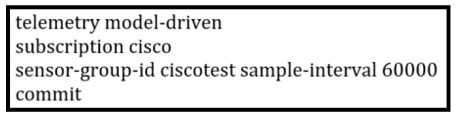
This configuration is being applied on an IOS XR router.
Which statement about this configuration is true?
A. It is used to set up configuration to poll network data
B. It is used to enable gRPC
C. It is used to create a streaming subscription with a 60-second interval
D. It is used to create a streaming subscription with a 600-second interval
Explanation
The correct answer is C. It is used to create a streaming subscription with a 60-second interval.
Exhibit ki configuration dekhein:
text
telemetry model-driven
subscription cisco
sensor-group-id ciscotest sample-interval 60000
commit
svgsvg
Ye IOS XR par Model-Driven Telemetry (MDT) ki configuration hai:
- `telemetry model-driven` → Telemetry ko model-driven mode mein enable karta hai
- `subscription cisco` → Ek subscription create karta hai jiska naam "cisco" hai
- `sensor-group-id ciscotest sample-interval 60000` → Sensor group "ciscotest" ke liye sample interval 60000 milliseconds set karta hai
- `commit` → Configuration ko apply karta hai
60000 milliseconds = 60 seconds. Is liye ye configuration ek streaming subscription create kar rahi hai jismein data har 60 second ke interval par stream hoga.
Why the Other Options Are Incorrect
A. It is used to set up configuration to poll network data. – Ye polling nahi hai; MDT push-based streaming hai. Router khud data stream karta hai, collector poll nahi karta.
B. It is used to enable gRPC. – gRPC enable karne ke liye `grpc` command alag hoti hai (e.g., `grpc port 57344`). Is configuration mein gRPC enable nahi ho raha, sirf telemetry subscription ban rahi hai.
D. It is used to create a streaming subscription with a 600-second interval. – Interval 60000 ms = 60 seconds hai, 600 seconds nahi. 600 seconds ke liye 600000 ms likha hota.
Reference
- Cisco Press: Implementing and Operating Cisco Service Provider Network Core Technologies (SPCOR) 350-501 Official Cert Guide – Chapter on Model-Driven Telemetry Configuration on IOS XR.
Refer to the exhibit.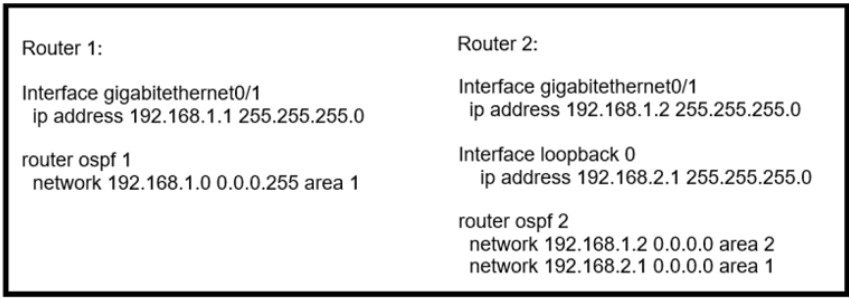
Router 1 is missing the route for the router 2 loopback 0. What should the engineer change
to fix the problem?
A. the area numbers on Router 1 and Router 2 to be similar
B. the wildcard mask network statement in OSPF of Router 2
C. Router 1 to be an ABR
D. the hello timers on Router 1 and Router 2 to be different
Explanation
The correct answer is A. the area numbers on Router 1 and Router 2 to be similar.
Exhibit ko analyze karein:
Router 1:
- OSPF process 1 mein `network 192.168.1.0 0.0.0.255 area 1` configure hai
- Interface Gi0/1 (192.168.1.1) Area 1 mein hai
Router 2:
- OSPF process 2 mein `network 192.168.1.2 0.0.0.0 area 2` configure hai
- Interface Gi0/1 (192.168.1.2) Area 2 mein hai
- `network 192.168.2.1 0.0.0.0 area 1` → Loopback0 (192.168.2.1) Area 1 mein hai
Problem ye hai ke Router 1 ka Gi0/1 Area 1 mein hai aur Router 2 ka Gi0/1 Area 2 mein hai. OSPF mein adjacency form karne ke liye dono ends ka area number same hona zaroori hai. Kyunki areas different hain, Router 1 aur Router 2 ke beech OSPF adjacency form nahi hogi, aur Router 1 ko Router 2 ka loopback route nahi milega.
Solution: Router 1 aur Router 2 ke Gi0/1 interface ka area number same karna hoga (ya Area 1 ya Area 2, dono par same).
Why the Other Options Are Incorrect
B. the wildcard mask network statement in OSPF of Router 2. – Router 2 ke network statements ke wildcard masks (`0.0.0.0`) sahi hain — ye single host match karte hain. Ye issue ka kaaran nahi hai.
C. Router 1 to be an ABR. – Router 1 ko ABR banane ki zaroorat nahi. Problem area mismatch hai, ABR role ka isse koi taalluq nahi. Pehle area match karna zaroori hai.
D. the hello timers on Router 1 and Router 2 to be different. – Hello timers same hone chahiye adjacency form karne ke liye, different nahi. Saath hi ye issue ka root cause area mismatch hai, hello timers nahi.
Reference
- Cisco Press: Implementing and Operating Cisco Service Provider Network Core Technologies (SPCOR) 350-501 Official Cert Guide – Chapter on OSPF Area Configuration and Adjacency Requirements.
Refer to the exhibit: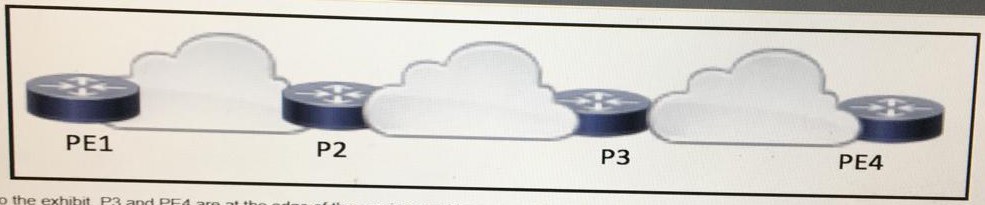
P3 and PE4 are at the edge of the service provider core and serve as ABR routers
Aggregation areas are on either side of the core.
Which statement about the architecture is true?
A. If each area is running its own IGP. the ABR routers must redistribute the IGP routing table into BGP
B. To support seamless MPLS. TDP must be used as the label protocol
C. If each area is running its own IGP. BGP must provide an end-to-end MPLS LSP
D. To support seamless MPLS, the BGP route reflector feature must be disabled
Explanation
The correct answer is A. If each area is running its own IGP, the ABR routers must redistribute the IGP routing table into BGP.
Ye Seamless MPLS architecture ka scenario hai, jismein service provider core alag alag IGP areas/domains mein divided hota hai. P3 aur PE4 ABR (Area Border Router) hain jo aggregation areas aur core ke beech boundary par baithte hain.
Jab har area apna alag IGP chala raha ho (e.g., OSPF Area 1, IS-IS Level 1, etc.), to ABR routers ko apne area ke IGP routes ko BGP mein redistribute karna padta hai taake routes doosre areas tak pahunch sakein. BGP hi inter-domain routing provide karta hai jo alag IGP domains ko connect karta hai. Isi liye Seamless MPLS mein BGP ko end-to-end transport ke liye use kiya jata hai — IGP sirf apne area ke andar chalta hai, aur BGP areas ke beech bridge ka kaam karta hai.
Why the Other Options Are Incorrect
B. To support seamless MPLS, TDP must be used as the label protocol. – Seamless MPLS mein LDP ya RSVP-TE use hota hai, TDP (Tag Distribution Protocol) nahi. TDP Cisco ka purana proprietary protocol hai jo ab obsolete hai. Saath hi "must" ka matlab hai ke TDP zaroori hai, jo galat hai.
C. If each area is running its own IGP, BGP must provide an end-to-end MPLS LSP. – BGP end-to-end MPLS LSP provide nahi karta; BGP labeled-unicast (RFC 3107) ke through inter-domain label distribution karta hai, lekin LSP ka concept IGP/LDP/RSVP-TE ke through banta hai. BGP labels ko carry karta hai, LSP establish nahi karta.
D. To support seamless MPLS, the BGP route reflector feature must be disabled. – BGP route reflectors zaroori hain Seamless MPLS mein iBGP full-mesh scaling ke liye. Inhe disable karna galat hai; ye architecture ko break kar dega.
Reference
- Cisco Press: Implementing and Operating Cisco Service Provider Network Core Technologies (SPCOR) 350-501 Official Cert Guide – Chapter on Seamless MPLS Architecture and Inter-Domain Routing.
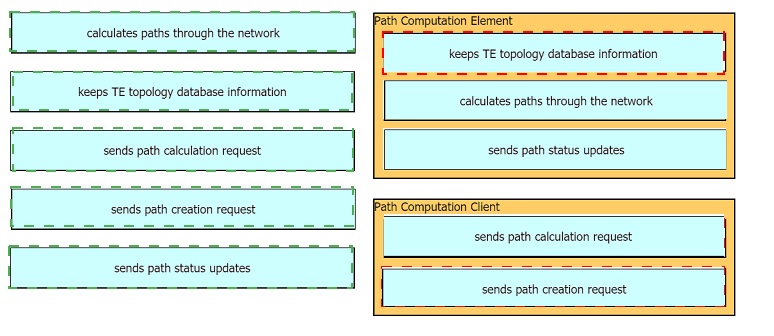
Drag and drop the functions from the left onto the Path Computation Element Protocol roles
on the right.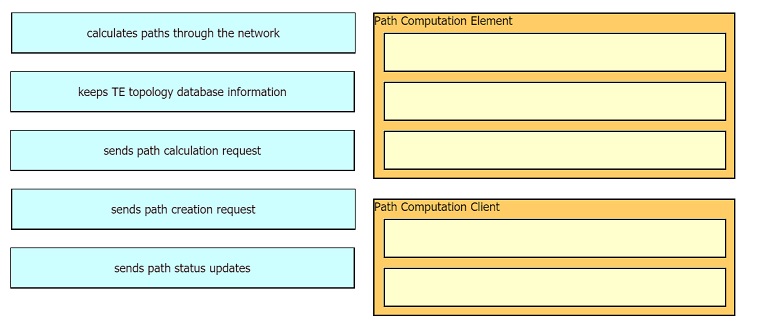
Explanation:
PCE (Path Computation Element) ek network component hai jo MPLS TE tunnels ke liye paths calculate karta hai. Ye TE topology database (TED) maintain karta hai jismein bandwidth, links, aur constraints ki information hoti hai. Path calculate karne ke baad PCE PCInitiate message ke through path creation request bhejta hai taake LSP establish ho sake.
PCC (Path Computation Client) ek router ya network element hai jo PCE se path computation request (PCReq) karta hai. Jab LSP ki state change hoti hai ya path fail hota hai, to PCC path status updates (PCRpt) bhejta hai PCE ko.
Reference:
Cisco Press: Implementing and Operating Cisco Service Provider Network Core Technologies (SPCOR) 350-501 Official Cert Guide – Chapter on MPLS TE and Path Computation Element Protocol (PCEP).
Cisco Documentation: "Path Computation Element Protocol (PCEP) Configuration Guide" – Cisco IOS XR MPLS TE Configuration Guide.
| Page 2 out of 55 Pages |