- 4.9/5.0
- 547 Questions
- Updated on: 12-Oct-2026
- Implementing and Operating Cisco Service Provider Network Core Technologies (350-501 SPCOR)
- 25475 Prepared
Free Cisco 350-501 Practice Questions 2026 | Implementing and Operating Cisco Service Provider Network Core Technologies (350-501 SPCOR)
A network engineer must implement SNMPv2 with these parameters
Enable SNMP community string C1sc0 with read-only permissions.
Enable interface index persistence. Restrict the SNMP community to only the monitoring server with IP address 198.18 19 100/32.
Provide view-only access to ospflfEntry and ospfNbrEntry.
Which configuration must the engineer apply?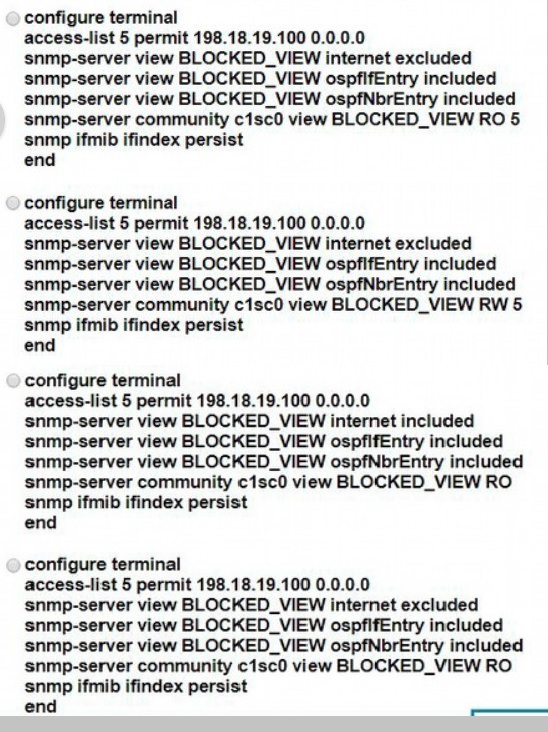
A. Option A
B. Option B
C. Option C
D. Option D
Explanation
The requirements are: SNMP community string `c1sc0` with read-only permissions, interface index persistence enabled, community restricted to the monitoring server `198.18.19.100/32`, and view-only access to `ospfIfEntry` and `ospfNbrEntry`. Option A correctly implements all of these: `access-list 5 permit 198.18.19.100 0.0.0.0` restricts access to the monitoring server, `snmp-server view BLOCKED_VIEW internet excluded` blocks general access while `ospfIfEntry` and `ospfNbrEntry` are included for view-only access, `snmp-server community c1sc0 view BLOCKED_VIEW RO 5` applies read-only permissions with ACL 5, and `snmp ifmib ifindex persist` enables interface index persistence. This makes option A the correct answer.
Why the other options are incorrect:
B. Option B
The community string is configured with `RW` (read-write) instead of `RO` (read-only), which violates the requirement for read-only permissions.
C. Option C
The view is configured with `internet included` instead of `internet excluded`. This would allow access to the entire internet MIB tree rather than restricting access to only the OSPF entries, violating the view-only requirement.
D. Option D
The configuration is incomplete: it is missing the `snmp-server community` statement that applies the community string and ACL, and it is also missing the `snmp ifmib ifindex persist` command for interface index persistence.
Reference:
Cisco IOS XR Network Management Configuration Guide – Configuring SNMPv2 Communities, Views, and ACLs; RFC 3411–3418 – SNMPv3 Framework (applies to SNMPv2c community and view concepts); Cisco 350-501 SPCOR Official Cert Guide, Network Assurance section.
Refer to the exhibit A network engineer is in the process of implementing IS-IS Area 1 and Area 2 on this network to segregate traffic between different segments of the network The hosts in the two new areas must maintain the ability to communicate with one another In both directions. Which additional change must be applied?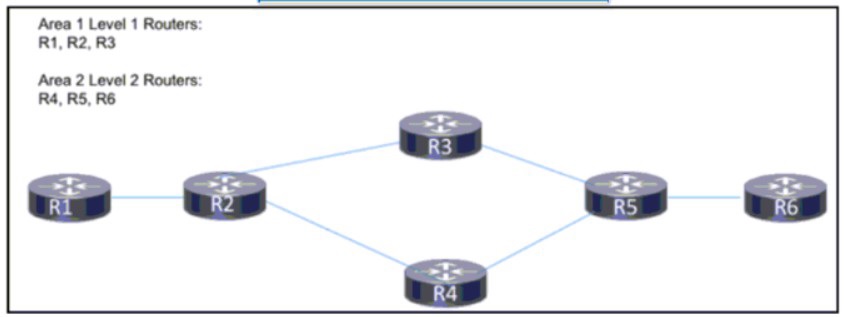
A. Reconfigure either R3 or R4 as a Level 1/Level 2 router.
B. Reconfigure routers R1, R2 R5. and R6 as Level 1/Level 2 routers.
C. Reconfigure routers R2 and R5 as Level 1/Level 2 routers.
D. Reconfigure routers R4, R5 and R6 as Level 1 routers
Explanation
The exhibit shows Area 1 with Level 1 routers (R1, R2, R3) and Area 2 with Level 2 routers (R4, R5, R6). For hosts in Area 1 and Area 2 to communicate in both directions, there must be at least one Level 1/Level 2 router that acts as an Area Border Router (ABR), connecting the Level 1 area to the Level 2 backbone. Currently, R3 is a Level 1 router in Area 1, and R4 is a Level 2 router in Area 2. To enable inter-area communication, either R3 or R4 must be reconfigured as a Level 1/Level 2 router. This allows the router to maintain Level 1 adjacencies within its area and Level 2 adjacencies with the backbone, thereby redistributing routes between Area 1 and Area 2. This makes option A the correct answer.
Why the other options are incorrect:
B. Reconfigure routers R1, R2, R5, and R6 as Level 1/Level 2 routers
Configuring all routers as Level 1/Level 2 is unnecessary and would increase complexity without providing additional benefit. Only one ABR is needed to connect the areas.
C. Reconfigure routers R2 and R5 as Level 1/Level 2 routers
R2 is in Area 1 and R5 is in Area 2. Configuring both as Level 1/Level 2 would create ABRs, but it is not required and would add unnecessary overhead. A single ABR (either R3 or R4) is sufficient.
D. Reconfigure routers R4, R5, and R6 as Level 1 routers
This would eliminate the Level 2 backbone entirely, preventing communication between the areas and breaking the IS-IS hierarchy.
Reference:
ISO/IEC 10589 – IS-IS for Routing Information Exchange; Cisco IOS XR Routing Configuration Guide – Implementing IS-IS: Level 1/Level 2 Routers and Area Boundaries; Cisco 350-501 SPCOR Official Cert Guide, IS-IS chapter.
Refer to Exhibit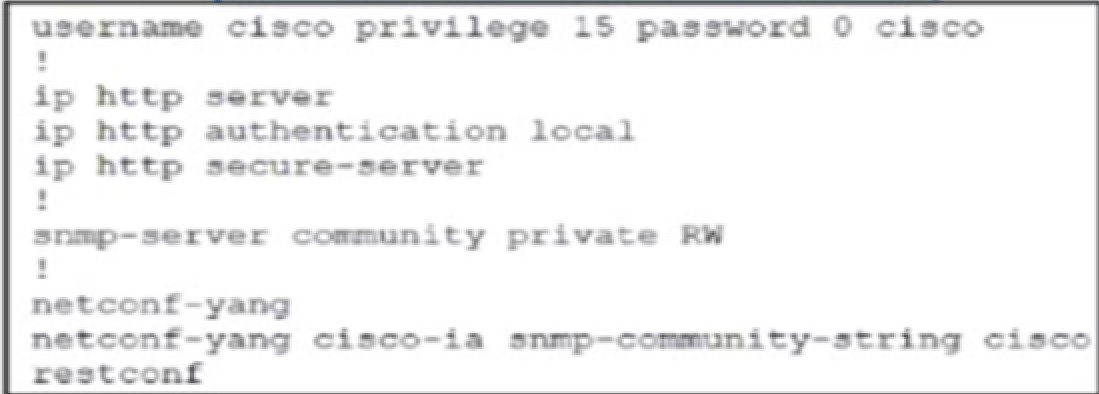
A network engineer is trying to retrieve SNMP MIBs with RESTCONF on the Cisco switch but fails. End-to-end routing is in place. Which configuration must the engineer implement on the switch to complete?
A. netconf-yang cisco-ia snamp-community -string Public
B. snmp-server community cosco RW
C. snmp-server community public RO
D. netconf-yang cisco-Ia snmp-community-string Private
Explanation
The exhibit shows a Cisco switch configured with RESTCONF and `netconf-yang cisco-ia snmp-community-string cisco`. The engineer is trying to retrieve SNMP MIBs via RESTCONF but is failing. The `netconf-yang cisco-ia snmp-community-string` command tells the Cisco IOS XE RESTCONF/NETCONF agent which SNMP community string to use when translating RESTCONF requests into SNMP MIB operations. In the exhibit, this community string is set to `cisco`, but the actual SNMP community configured on the device is `private RW` (as shown by `snmp-server community private RW`). For RESTCONF to successfully retrieve SNMP MIB data, the community string configured under `netconf-yang cisco-ia snmp-community-string` must match the SNMP community string configured with `snmp-server community`. Option D (`netconf-yang cisco-ia snmp-community-string Private`) aligns the RESTCONF SNMP community string with the configured SNMP community `private`, allowing RESTCONF to query SNMP MIBs successfully. This makes option D the correct answer.
Why the other options are incorrect:
A. `netconf-yang cisco-ia snmp-community-string Public`
This sets the community string to `Public`, which does not match the configured SNMP community `private`. It would still fail.
B. `snmp-server community cisco RW`
This changes the SNMP community to `cisco`, but it does not align the RESTCONF SNMP community string with the existing SNMP community. It also changes the read-write community unnecessarily.
C. `snmp-server community public RO`
This configures a new read-only community `public`, but the RESTCONF SNMP community string is still `cisco`, so it would not match. It does not resolve the mismatch.
Reference:
Cisco IOS XE RESTCONF API Configuration Guide – Configuring RESTCONF and SNMP Community Strings; RFC 8040 – RESTCONF Protocol; Cisco 350-501 SPCOR Official Cert Guide, Automation and Assurance section.
Refer to the exhibit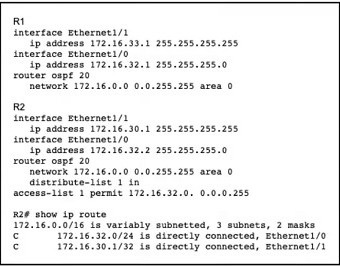
network engineer notices that router R2 is failing to install network 172.16.33.1/32 in the routing table. Which configuration must the engineer apply to R2 to fix the problem?
A.
R2(config)# access-Iist 1 permit 172.16.33.0 255.0.0.0
B.
R2(config)# access-list 1 permit 172,16,33.0 255,255,255,0
C.
R2(config)# access-list 1 permit 172.16.33.0 0.0.0.255
D.
R2(config)# access-list 1 permit 172,16,33.0 255.255,0,0
R2(config)# access-list 1 permit 172.16.33.0 0.0.0.255
Explanation
The exhibit shows R2 with `distribute-list 1 in` under OSPF, and `access-list 1 permit 172.16.32.0 0.0.0.255`. This access list only permits routes from the `172.16.32.0/24` subnet. R1 has an interface with the address `172.16.33.1/32`, which is in the `172.16.33.0/24` subnet. Because the access list does not permit `172.16.33.0/24`, the route `172.16.33.1/32` is being filtered out and not installed in R2's routing table. To fix the problem, the engineer must add a permit entry for the `172.16.33.0/24` subnet. The correct wildcard mask for a `/24` subnet is `0.0.0.255`, and the correct syntax is `access-list 1 permit 172.16.33.0 0.0.0.255`. This makes option C the correct answer.
Why the other options are incorrect:
A. `access-list 1 permit 172.16.33.0 255.0.0.0`
This uses an incorrect wildcard mask (`255.0.0.0`), which would match a much larger range of addresses and is not the correct mask for a `/24` subnet.
B. `access-list 1 permit 172.16.33.0 255.255.255.0`
This uses a subnet mask (`255.255.255.0`) instead of a wildcard mask. Cisco access lists require wildcard masks, not subnet masks.
D. `access-list 1 permit 172.16.33.0 255.255.0.0`
This uses an incorrect wildcard mask (`255.255.0.0`) and would not correctly match the `172.16.33.0/24` subnet.
Reference:
Cisco IOS XR Routing Configuration Guide – Implementing OSPF: Distribute Lists and Access Lists; RFC 2328 – OSPF Version 2; Cisco 350-501 SPCOR Official Cert Guide, OSPF chapter.
An engineer is implementing MPLS to monitor within the MPLS domain. Which must the engineer perform to prevent packets from being forwarded beyond the service provider domain when the LSP is down?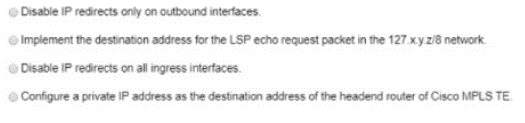
A. Option A
B. Option B
C. Option C
D. Option D
Explanation
When an MPLS LSP is down, MPLS OAM (LSP ping) echo request packets must be prevented from being forwarded beyond the service provider domain, which could leak information or cause unintended behavior. This is achieved by implementing the destination address for the LSP echo request packet in the `127.x.y.z/8` network (the loopback range). By using a destination address from the `127.0.0.0/8` range, the echo request packet is guaranteed to be dropped by any router outside the MPLS domain if it escapes the LSP, because `127.0.0.0/8` is reserved for loopback and is not routable on the public Internet. This prevents the packets from being forwarded beyond the service provider domain. This makes option B the correct answer.
Why the other options are incorrect:
A. Disable IP redirects only on outbound interfaces
Disabling IP redirects is a security best practice but does not specifically prevent MPLS OAM packets from leaving the service provider domain when an LSP is down.
C. Disable IP redirects on all ingress interfaces
Similar to option A, this is a general security measure and does not address the specific requirement of preventing LSP echo request packets from being forwarded beyond the domain.
D. Configure a private IP address as the destination address of the headend router of Cisco MPLS TE
Configuring a private IP address on the headend router does not prevent MPLS OAM packets from being forwarded beyond the domain. The standard mechanism is to use the `127.x.y.z/8` range for LSP echo request destination addresses.
Reference:
RFC 4379 – Detecting Multi-Protocol Label Switched (MPLS) Data Plane Failures; Cisco IOS XR MPLS Configuration Guide – MPLS LSP Ping and Traceroute; Cisco 350-501 SPCOR Official Cert Guide, MPLS and Network Assurance sections.
| Page 21 out of 55 Pages |