- 4.9/5.0
- 547 Questions
- Updated on: 12-Oct-2026
- Implementing and Operating Cisco Service Provider Network Core Technologies (350-501 SPCOR)
- 25475 Prepared
Free Cisco 350-501 Practice Questions 2026 | Implementing and Operating Cisco Service Provider Network Core Technologies (350-501 SPCOR)
Refer to the exhibit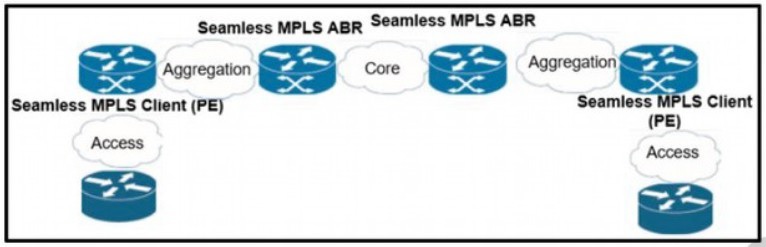
A network operator working for a telecommunication company with an employee
3994:37:650 is implementing a cisco Unified MPLS solution. What is the effect of this implementation?
A. EIGRP is deployed between the PEs and ABRs with RFC 3107.
B. OSPF is deployed between the PEs and ABRs with RFC 3107.
C. IS-IS is deployed between the PEs and ABRs with RFC 3107.
D. BGP is deployed between the PEs and ABRs with RFC 3107
Explanation
In a Cisco Unified MPLS (also called Seamless MPLS) solution, the architecture uses BGP labeled unicast (RFC 3107) between the PE routers (Seamless MPLS Clients) and the ABR routers (Seamless MPLS ABRs). This allows the access and aggregation domains to use their own IGP (typically OSPF or IS-IS) while the BGP labeled unicast session between the PE and ABR provides the end-to-end MPLS forwarding across the core. BGP is used to exchange labeled IPv4 routes between the PE and ABR, stitching together the separate IGP domains into a unified MPLS domain. This makes option D the correct answer.
Why the other options are incorrect:
A. EIGRP is deployed between the PEs and ABRs with RFC 3107 – EIGRP is not used in Unified MPLS for inter-domain label distribution. BGP labeled unicast is the standard mechanism.
B. OSPF is deployed between the PEs and ABRs with RFC 3107 – OSPF does not carry BGP labels (RFC 3107). It can be used as the IGP within each domain, but it is not the protocol used to exchange labeled routes between PEs and ABRs.
C. IS-IS is deployed between the PEs and ABRs with RFC 3107 – Like OSPF, IS-IS can be used as the IGP within each domain, but it does not carry BGP labels. BGP labeled unicast is the protocol used for inter-domain label exchange.
Reference:
RFC 3107 – Carrying Label Information in BGP-4; Cisco IOS XR MPLS Configuration Guide – Unified MPLS and Seamless MPLS; Cisco 350-501 SPCOR Official Cert Guide, MPLS and Segment Routing chapters.
An engineer is implementing a router redistribution within BGP. The route map must be configured to permit all unmatched routes. Which action must the engineer perform to complete this task?
A. Option A
B. Option B
C. Option C
D. Option D
Explanation
When configuring a route map for BGP redistribution, every route map has an implicit deny at the end. If the goal is to permit all unmatched routes, the engineer must add an explicit `permit` statement as the last entry in the route map. This ensures that any route not matching the earlier entries is still permitted rather than being dropped by the implicit deny. Without a final permit statement, all unmatched routes would be denied. This makes option D the correct answer.
Why the other options are incorrect:
A. Include a permit statement as the first entry – A permit statement at the beginning would only match routes based on the first entry's criteria. It would not ensure that all unmatched routes are permitted.
B. Include at least one explicit deny statement – Adding a deny statement would block certain routes, which is the opposite of permitting all unmatched routes.
C. Remove the implicit deny entry – The implicit deny at the end of a route map cannot be removed. It is an inherent part of route map processing. The only way to override it is to add an explicit permit statement as the final entry.
Reference:
Cisco IOS XR Routing Configuration Guide – Implementing Routing Policy: Route Maps and Implicit Deny; RFC 4271 – A Border Gateway Protocol 4 (BGP-4); Cisco 350-501 SPCOR Official Cert Guide, Routing Policy and BGP sections.
Refer to the exhibit
AN engineer is configuring segment routing on an ISP to simplify traffic engineering and management across network domains. What should the engineer do to complete the implementation of segment routing?
A. OSPF must be configured with wide area metrics to support routing.
B. The segment will run without any further configuration.
C. Area authentication must be enable before segment routing will run.
D. Area Authentication must be enable before segment routing will run.
Explanation
Segment Routing with OSPF requires wide metrics to be enabled in the OSPF configuration. The Prefix-SID and Adjacency-SID information is carried in OSPF Extended Link Opaque LSAs (Type 10), which use the extended metric format. Without wide metrics, OSPF cannot properly advertise the Segment Routing extensions, and the SR implementation will not function correctly. This is a fundamental prerequisite for SR-OSPF. This makes option A the correct answer.
Why the other options are incorrect:
B. The segment will run without any further configuration – Segment Routing with OSPF requires explicit configuration, including enabling SR under the OSPF process and configuring prefix SIDs. It does not run without any configuration.
C. Area authentication must be enabled before segment routing will run – Authentication is a security feature and is not a prerequisite for Segment Routing to operate. SR does not require area authentication.
D. Area Authentication must be enabled before segment routing will run – This is a duplicate of option C (likely a typo in the question). Authentication is not required for SR to function.
Reference:
RFC 8665 – OSPF Extensions for Segment Routing; Cisco IOS XR Segment Routing Configuration Guide – Configuring SR-OSPF; Cisco 350-501 SPCOR Official Cert Guide, Segment Routing chapter.
Refer to the exhibit.
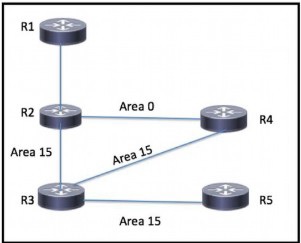
An engineer has started to configure a router for OSPF, as shown Which configuration must an engineer apply on the network so that area 15 traffic from R5 to R1 will prefer the
route through R4?
A. Place the link between R3 and R5 in a stub area to force traffic to use the route through R4.
B. Increase the cost on the link between R2 and R4, to influence the path over R3 and R4.
C. Implement a multiarea adjacency on the link between R2 and R4, with the cost manipulated to make the path through R4 preferred.
D. Implement a sham link on the between R3 and R2 to extend area 0 area 15.
Explanation
The exhibit shows R5 in Area 15, connected to R3, with R3 connected to R4 (also Area 15) and R2 (Area 15 and Area 0). R2 is connected to R1 (Area 0) and R4 (Area 0). Traffic from R5 to R1 currently has two potential paths: R5 → R3 → R2 → R1, or R5 → R3 → R4 → R2 → R1 (since R4 is in both Area 15 and Area 0). To make Area 15 traffic from R5 to R1 prefer the path through R4, the engineer should implement a multiarea adjacency on the link between R2 and R4, with the cost manipulated to make the path through R4 preferred. A multiarea adjacency allows an interface to participate in both Area 0 and Area 15, which is exactly what is needed here because the R2-R4 link is in Area 0, and R4 is also in Area 15. This creates a direct Area 15 path through R4, and manipulating the cost makes it preferred over the path through R2. This makes option C the correct answer.
Why the other options are incorrect:
A. Place the link between R3 and R5 in a stub area to force traffic to use the route through R4 – A stub area would affect external route propagation, not the internal path selection between R3 and R4. It would not force traffic through R4.
B. Increase the cost on the link between R2 and R4 to influence the path over R3 and R4 – Increasing the cost on R2-R4 would make the path through R2 less preferred, but it would not create a direct Area 15 path through R4. The multiarea adjacency is required to make R4 a direct Area 15 next-hop.
D. Implement a sham link between R3 and R2 to extend Area 0 over Area 15 – A sham link is used in MPLS L3VPN to create a virtual link between two Area 0 routers over a VPN backbone. It is not applicable in this plain OSPF topology and does not address the requirement.
Reference:
RFC 2328 – OSPF Version 2; Cisco IOS XR Routing Configuration Guide – Implementing OSPF: Multiarea Adjacencies; Cisco 350-501 SPCOR Official Cert Guide, OSPF chapter.
Refer the exhibit.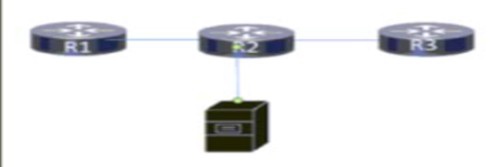
Users on a network connected to router R3 report slow speeds when they connect to the server connected to R2. After analyzing traffic on the network, a network engineer identified congestion on the link between R2 and R3 as the cause. Which QoS service must the engineer implement to drop traffic on the link when it exceeds a configured threshold?
A. first-in, first-out
B. traffic shaping
C. class-based weighted fair queueing
D. traffic policing
Explanation
Traffic policing is the QoS mechanism that monitors traffic rates on an interface and drops packets that exceed a configured threshold (the committed rate). When the goal is to drop excess traffic on the link between R2 and R3 due to congestion, traffic policing is the correct service to implement. Policing enforces a maximum rate by dropping or remarking packets that exceed the configured limit, which directly addresses the requirement. This makes option D the correct answer.
Why the other options are incorrect:
A. First-in, first-out – FIFO is a basic queuing discipline that forwards packets in the order they arrive. It does not drop traffic when a threshold is exceeded, nor does it enforce rate limits.
B. Traffic shaping – Traffic shaping delays (buffers) excess packets rather than dropping them, to smooth out bursts and conform to a configured rate. The requirement is to drop traffic, not delay it.
C. Class-based weighted fair queueing – CBWFQ is a queuing mechanism that provides weighted bandwidth allocation to different traffic classes. It manages congestion but does not drop traffic based on a configured threshold in the way policing does.
Reference:
Cisco IOS XR Modular QoS Configuration Guide – Configuring Traffic Policing; RFC 2475 – An Architecture for Differentiated Services; Cisco 350-501 SPCOR Official Cert Guide, QoS section.
| Page 24 out of 55 Pages |