- 4.9/5.0
- 547 Questions
- Updated on: 12-Oct-2026
- Implementing and Operating Cisco Service Provider Network Core Technologies (350-501 SPCOR)
- 25475 Prepared
Free Cisco 350-501 Practice Questions 2026 | Implementing and Operating Cisco Service Provider Network Core Technologies (350-501 SPCOR)
Refer to the exhibit.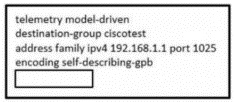
A Cisco engineer is implementing gRPC dial-out on an ASR. Receiver 192.168 1.1 will be assigned one of the subscriptions, and it will manage the ASR. Which command is needed to complete the router configuration?
A. protocol grpc
B. protocol all
C. protocol tcp
D. protocol any
Explanation
The exhibit shows a telemetry model-driven configuration with `destination-group ciscotest` and an address family entry specifying the receiver 192.168.1.1 on port 1025 with `encoding self-describing-gpb`. To complete the gRPC dial-out configuration, the engineer must specify the protocol used for the telemetry stream. For gRPC dial-out telemetry, the correct protocol keyword is `grpc`, which tells the router to use the gRPC protocol to push the telemetry data to the destination. This makes option A the correct answer.
Why the other options are incorrect:
B. protocol all – `protocol all` is not a valid option for gRPC dial-out telemetry configuration. It does not specify the gRPC transport.
C. protocol tcp – While gRPC uses TCP as its underlying transport, the telemetry configuration requires the `grpc` keyword, not `tcp`. Specifying TCP alone would not enable the gRPC dial-out behavior.
D. protocol any – `protocol any` is not a valid keyword for this configuration and would not enable gRPC dial-out.
Reference:
Cisco IOS XR Telemetry Configuration Guide – Configuring gRPC Dial-Out Telemetry; Cisco 350-501 SPCOR Official Cert Guide, Automation and Assurance section.
Refer to the exhibit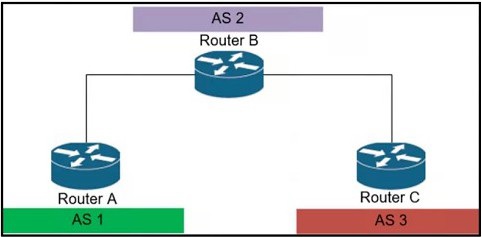
An engineer working for private Service Provider with employee id: 3948:11:613 is configuring the BGPsec framework. Which two conditions must the engineer take into account? (Choose two.)
A. BGPsec uses IPsec tunnel for security.
B. The BGPsec framework secures the AS path.
C. In BGPsec. all route advertisements are given an expiry time by the originator of the route.
D. Private keys are part of the router key pair used to sign route updates.
E. In BGPsec. route advertisements are not given an expiration time by the originator of the route.
D. Private keys are part of the router key pair used to sign route updates.
Explanation
BGPsec (BGP Security) is a framework that extends BGP to provide cryptographic protection of the AS_PATH attribute, ensuring that the path information in BGP updates cannot be tampered with. It uses digital signatures to secure the AS path, allowing routers to validate that the path is authentic. Additionally, BGPsec uses router key pairs consisting of a public and private key, where the rivate key is used to sign route updates (specifically the AS_PATH and other path attributes). These signatures are then verified by receiving routers using the sender's public key. This makes options B and D the correct answers.
Why the other options are incorrect:
A. BGPsec uses IPsec tunnel for security – BGPsec does not rely on IPsec tunnels. It uses cryptographic signatures (digital signatures) applied directly to BGP updates to protect the AS_PATH and associated path attributes.
C. In BGPsec, all route advertisements are given an expiry time by the originator of the route – BGPsec does not define an expiry time for route advertisements. It uses signatures and key lifetimes, but the concept of a per-route expiry time is not part of the BGPsec framework.
E. In BGPsec, route advertisements are not given an expiration time by the originator of the route – While this statement is technically true (BGPsec does not assign an expiration time to route advertisements), it is not one of the two defining conditions that an engineer must take into account when configuring BGPsec. Options B and D are the core operational and security characteristics.
Reference:
RFC 8205 – BGPsec Protocol Specification; RFC 8206 – BGPsec Considerations for Autonomous System (AS) Migration; Cisco 350-501 SPCOR Official Cert Guide, BGP and Security sections.
Refer to the exhibit.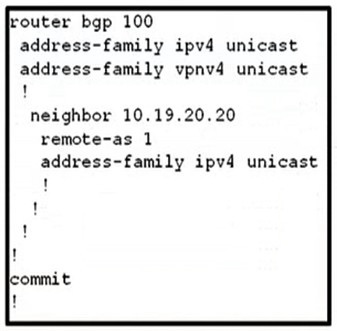
An engineer is trying to implement BGP configuration on a router Which configuration error prevents the ASBR from establishing a BGP neighborship to a directly connected BGP speaker?
A. The routing policy is absent for this Cisco IOS XR eBGP instance.
B. The IPv4 address family configuration under neighbor configuration-mode must be removed.
C. The VPNv4 address family interferes with the 8GP IPv4 address family negotiations.
D. The TCP session parameters are not specified.
Explanation
The exhibit shows a Cisco IOS XR BGP configuration with `address-family ipv4 unicast` and `address-family vpnv4 unicast` enabled globally, and a neighbor 10.19.20.20 with `remote-as 1` and `address-family ipv4 unicast` under the neighbor. In Cisco IOS XR, when an eBGP neighbor is configured without an explicit inbound or outbound route policy, the default behavior is to drop all routes in both directions. This means that although the BGP session may establish (TCP connectivity and OPEN message exchange), no routes will be exchanged, and the neighbor relationship will not be fully functional for route exchange. To establish a working eBGP neighborship that exchanges routes, a routing policy (such as a pass-all policy) must be applied. The absence of this routing policy is the configuration error preventing the ASBR from establishing a functional BGP neighborship. This makes option A the correct answer.
Why the other options are incorrect:
B. The IPv4 address family configuration under neighbor configuration-mode must be removed – The IPv4 address family under the neighbor is correctly configured to activate the neighbor for IPv4 unicast. Removing it would prevent IPv4 route exchange entirely.
C. The VPNv4 address family interferes with the BGP IPv4 address family negotiations – The VPNv4 address family is configured globally but is not activated under the neighbor, so it does not interfere with the IPv4 unicast address family negotiations.
D. The TCP session parameters are not specified – BGP does not require explicit TCP session parameters for basic neighbor establishment. TCP port 179 is used by default, and the session can be established without additional TCP configuration.
Reference:
Cisco IOS XR Routing Configuration Guide – Implementing BGP: Default Behavior for eBGP Neighbors Without Policies; RFC 4271 – A Border Gateway Protocol 4 (BGP-4); Cisco 350-501 SPCOR Official Cert Guide, BGP chapter.
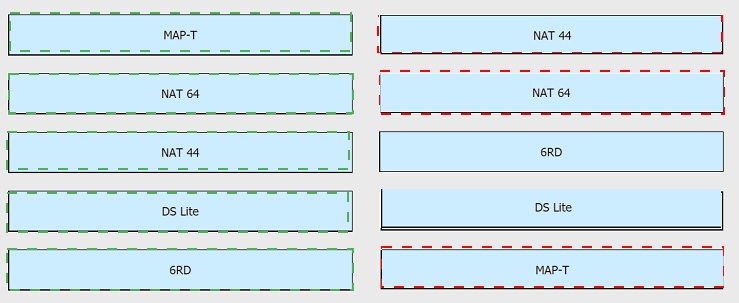
Drag and drop the functionalities from the left onto the correct target fields on the right.
Explanation:
The exhibit requires matching each IPv6 transition technology with its correct functionality. NAT44 translates RFC1918 private IPv4 addresses to public IPv4 addresses. NAT64 can operate in either stateless or stateful mode to translate between IPv6 and IPv4. 6RD (IPv6 Rapid Deployment) provides reachability to IPv4 hosts over IPv6 domains by encapsulating IPv4 traffic within IPv6. DS Lite (Dual-Stack Lite) requires an IPv6 access network to tunnel IPv4 traffic over the IPv6 infrastructure. MAP-T provides reachability of IPv6 hosts over IPv4 domains using stateless IPv4-to-IPv6 mapping and translation. This makes the correct matches as follows:
NAT44 → Can translate RFC1918 IPv4 to Public IPv4
NAT64 → Can be Stateless or stateful
6RD → Provides reachability to IPv4 host over IPv6 domains
DS Lite → Requires IPv6 access network
MAP-T → Provides reachability of IPv6 host over IPv4 domains
Why the other pairings are incorrect:
Matching MAP-T with the "Can translate RFC1918 IPv4 to Public IPv4" description is incorrect because that describes NAT44, not MAP-T. MAP-T is a stateless IPv4-to-IPv6 mapping and translation mechanism that allows IPv6 hosts to communicate with IPv4 resources.
Matching NAT64 with the "Provides reachability of IPv6 host over IPv4 domains" description is incorrect because that is the role of MAP-T. NAT64 allows IPv6-only hosts to reach IPv4 servers by translating IPv6 packets to IPv4, which is the opposite direction.
Matching DS Lite with the "Provides reachability to IPv4 host over IPv6 domains" description is incorrect because that describes 6RD. DS Lite requires an IPv6 access network and uses IPv4-in-IPv6 tunneling with carrier-grade NAT.
Matching 6RD with the "Requires IPv6 access network" description is incorrect because 6RD provides IPv6 connectivity over an existing IPv4 access network, not the other way around. DS Lite is the technology that requires an IPv6 access network.
Reference:
RFC 2663 – IP Network Address Translator (NAT) Terminology and Considerations; RFC 6146 – Stateful NAT64; RFC 5569 – IPv6 Rapid Deployment on IPv4 Infrastructures (6rd); RFC 6333 – Dual-Stack Lite Broadband Deployments Following IPv4 Exhaustion; RFC 7599 – Mapping of Address and Port using Translation (MAP-T); Cisco 350-501 SPCOR Official Cert Guide, Architecture and Services section.
Refer to the exhibit.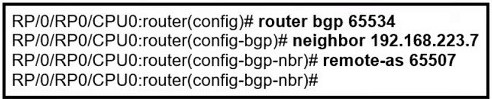
An engineer is securing a customer's network. Which command completes this
configuration and the engineer must use to prevent a DoS attack?
A. neighbor ebgp-multihop
B. ebgp-multihop
C. ttl-security
D. neighbor-ttl-security
Explanation
The exhibit shows an engineer configuring a BGP neighbor with `remote-as 65507` on a Cisco IOS XR router. To prevent a DoS attack on the BGP session, the engineer must enable TTL security (GTSM, Generalized TTL Security Mechanism) for the neighbor. In Cisco IOS XR, the command to enable TTL security for a specific neighbor is `neighbor
Why the other options are incorrect:
A. neighbor ebgp-multihop – The `ebgp-multihop` command allows eBGP peering with neighbors that are more than one hop away. It does not provide security against DoS attacks and is used for multihop peering scenarios.
B. ebgp-multihop – This is the same as option A but without the `neighbor` keyword. It is not a valid command in this context and does not provide TTL security.
C. ttl-security – While `ttl-security` is the correct keyword, in Cisco IOS XR the full command syntax requires `neighbor
Reference:
RFC 5082 – The Generalized TTL Security Mechanism (GTSM); Cisco IOS XR Routing Configuration Guide – Implementing BGP: TTL Security; Cisco 350-501 SPCOR Official Cert Guide, BGP and Security sections.
Refer to the exhibit.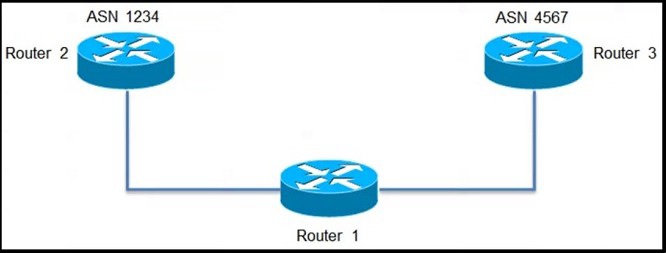
An engineer is configuring path selection on router R1 for two ASNs as shown. Which additional task must the engineer perform on Router 1 so that all outbound traffic utilizes the link between R1 and R3 to reach ASN 4567?
A. Configure a low weigh! on the peer to ASN 4567.
B. Configure a high weight on the peer to ASN 4567.
C. Configure an AS path prepend on the peer to ASN 4567.
D. Configure a high med on the peer to ASN 4567.
Explanation
To ensure that all outbound traffic from Router 1 uses the link between R1 and R3 to reach ASN 4567, the engineer must influence outbound path selection on Router 1. The BGP attribute that controls outbound path selection on a Cisco router is weight, which is a Cisco-proprietary attribute and is locally significant to the router. A higher weight value makes a path more preferred. Therefore, the engineer must configure a high weight on the peer to ASN 4567 (Router 3) so that Router 1 prefers the path through R3 for all outbound traffic destined to ASN 4567. This makes option B the correct answer.
Why the other options are incorrect:
A. Configure a low weight on the peer to ASN 4567 – A low weight would make the path through ASN 4567 less preferred, causing outbound traffic to use a different path. This is the opposite of the requirement.
C. Configure an AS path prepend on the peer to ASN 4567 – AS path prepending is used to influence inbound traffic from other autonomous systems, not outbound traffic from Router 1. It would not affect Router 1's outbound path selection.
D. Configure a high MED on the peer to ASN 4567 – MED (Multi-Exit Discriminator) is used to influence inbound traffic from an external AS. It does not control outbound path selection on Router 1, and a high MED is typically less preferred.
Reference:
Cisco IOS XR Routing Configuration Guide – Implementing BGP: BGP Best Path Selection and Weight; RFC 4271 – A Border Gateway Protocol 4 (BGP-4); Cisco 350-501 SPCOR Official Cert Guide, BGP chapter.
Drag and drop the BGP Best Path Algorithm rules from the left into the corresponding order of importance on the right.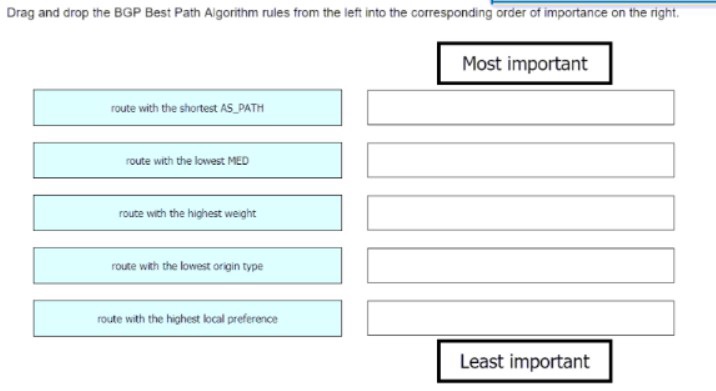
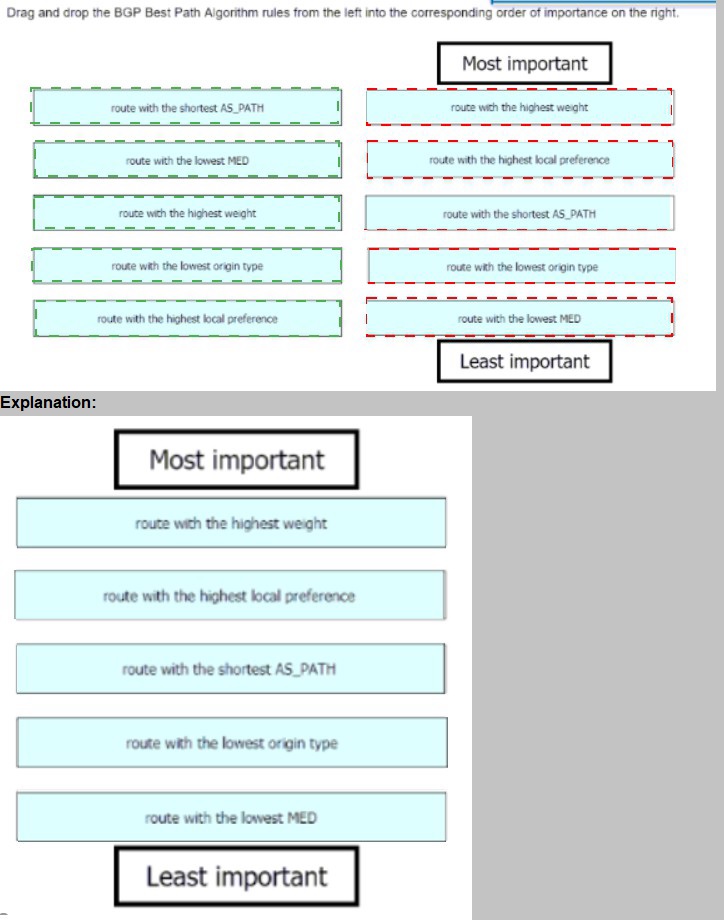
Explanation:
The exhibit requires ordering the BGP Best Path Algorithm rules from most important to least important. The correct order is: highest weight first (Cisco-proprietary, locally significant, most important), then highest local preference (used within the AS for outbound path selection), then shortest AS_PATH (preferred path length), then lowest origin type (IGP < EGP < incomplete), and finally lowest MED (used to influence inbound traffic from external ASes, least important among these). This makes the correct order as follows:
Most important → route with the highest weight
→ route with the highest local preference
→ route with the shortest AS_PATH
→ route with the lowest origin type
Least important → route with the lowest MED
Why the other orderings are incorrect:
Placing the shortest AS_PATH before the highest local preference is incorrect because local preference is evaluated before AS_PATH length in the BGP best path selection process.
Placing the lowest MED above the shortest AS_PATH or lowest origin type is incorrect because MED is evaluated after AS_PATH length and origin type.
Placing the lowest origin type above the highest local preference or highest weight is incorrect because weight and local preference are evaluated first.
Placing the highest weight anywhere other than first is incorrect because weight is the first attribute evaluated in Cisco's BGP best path selection.
Reference:
Cisco IOS XR Routing Configuration Guide – Implementing BGP: BGP Best Path Selection Algorithm; RFC 4271 – A Border Gateway Protocol 4 (BGP-4); Cisco 350-501 SPCOR Official Cert Guide, BGP chapter.
| Page 25 out of 55 Pages |