• 4.9/5.0
  • 547 Questions
  • Updated on: 12-Oct-2026
  • Implementing and Operating Cisco Service Provider Network Core Technologies (350-501 SPCOR)
  • 25475 Prepared

Free Cisco 350-501 Practice Questions 2026 | Implementing and Operating Cisco Service Provider Network Core Technologies (350-501 SPCOR)


Refer to the exhibit.

An engineer implemented OSPF neighbor relationship on an IOS device. Which
configuration must be applied to get the OR/BOR election removed from interfaces running OSPF?

A. ip ospf network broadcast on interfaces running OSPF

B. ip ospf network point-to-point on interfaces running OSPF

C. ip ospf network multipoint-point on interfaces running OSPF

D. ip ospf network non-broadcast on n:erfaces running OSPF

B.   ip ospf network point-to-point on interfaces running OSPF

Explanation

In OSPF, the Designated Router (DR) and Backup Designated Router (BDR) election occurs on broadcast and non-broadcast network types. To eliminate the DR/BDR election entirely, the interface must be configured with a network type that does not require a DR/BDR. The point-to-point network type does not perform DR/BDR election because it assumes only two routers on the link, making the election unnecessary. Therefore, configuring `ip ospf network point-to-point` on the interfaces removes the DR/BDR election. This makes option B the correct answer.

Why the other options are incorrect:

A. ip ospf network broadcast on interfaces running OSPF – Broadcast is the default network type on Ethernet interfaces and does perform DR/BDR election. This does not remove the election.

C. ip ospf network multipoint-point on interfaces running OSPF – This is not a valid OSPF network type. The correct term is point-to-multipoint, which also does not perform DR/BDR election, but the syntax in this option is incorrect.

D. ip ospf network non-broadcast on interfaces running OSPF – Non-broadcast network type does perform DR/BDR election and requires manual neighbor configuration. It does not remove the election.

Reference:
RFC 2328 – OSPF Version 2; Cisco IOS XR Routing Configuration Guide – Implementing OSPF: Network Types and DR/BDR Election; Cisco 350-501 SPCOR Official Cert Guide, OSPF chapter.

An engineer Is implementing NSR with OSPF on a large campus that requires high availability. Which task must an engineer perform to complete the process with minimal disruption to traffic?

A. Reset OSPF neighbour sessions to maintain state Information during router switchover

B. Configure the device to repopulate state information using routing updates received from the BDR

C. increase the keepalive interval on the OSPF neighbours so that traffic continues to pass during the switchover.

D. Ensure that the dual HP has synchronized their state information before performing the switchover operation

D.   Ensure that the dual HP has synchronized their state information before performing the switchover operation

Explanation

Non-Stop Routing (NSR) with OSPF requires that the active and standby Route Processors (RPs) synchronize their OSPF state information before a switchover occurs. This synchronization ensures that the standby RP has the complete OSPF database, neighbor adjacencies, and routing state so that when a switchover happens, the standby RP can take over immediately without disrupting OSPF adjacencies or traffic forwarding. To complete the NSR implementation with minimal disruption, the engineer must ensure that the dual RPs have synchronized their state information before performing the switchover operation. This makes option D the correct answer.

Why the other options are incorrect:

A. Reset OSPF neighbor sessions to maintain state information during router switchover – Resetting OSPF neighbor sessions would cause disruption and defeat the purpose of NSR, which is to avoid neighbor resets and maintain state during switchover.

B. Configure the device to repopulate state information using routing updates received from the BDR – NSR does not repopulate state from the BDR. It synchronizes state internally between the active and standby RPs. Repopulating from routing updates would be slow and disruptive.

C. Increase the keepalive interval on the OSPF neighbors so that traffic continues to pass during the switchover – Increasing the keepalive interval does not provide NSR. NSR maintains adjacencies through internal state synchronization, not by extending timers.

Reference:
Cisco IOS XR High Availability Configuration Guide – Non-Stop Routing (NSR) with OSPF; Cisco 350-501 SPCOR Official Cert Guide, Network Assurance and High Availability sections.

A network engineer has configured TE tunnels in the MPLS provider core. Which two steps ensure traffic traverse? (Choose two.)

A. Static routes is the only option for directing traffic into a tunnel.

B. ECMP between tunnels allows RSVP to function correctly.

C. Forwarding adjacency features allows a tunnel to be Installed in the IGP table as a link.

D. The IGP metric of a tunnel is configured to prefer a certain path

E. A tunnel weight is configured in SPF database the same way as a native link

C.   Forwarding adjacency features allows a tunnel to be Installed in the IGP table as a link.
D.   The IGP metric of a tunnel is configured to prefer a certain path

Explanation

To ensure that traffic traverses MPLS TE tunnels, the engineer can use either forwarding adjacency or autoroute. The forwarding adjacency feature allows a tunnel to be installed in the IGP table as a link, making the tunnel part of the IGP topology so that other routers can use it for forwarding traffic. Additionally, the IGP metric of a tunnel can be configured to prefer a certain path, allowing the engineer to influence path selection so that traffic is directed into the tunnel. These two steps ensure that traffic traverses the TE tunnels. This makes options C and D the correct answers.

Why the other options are incorrect:

A. Static routes is the only option for directing traffic into a tunnel – Static routes are not the only option. Autoroute and forwarding adjacency are the primary mechanisms for directing traffic into TE tunnels. Static routes can be used, but they are not the only option.

B. ECMP between tunnels allows RSVP to function correctly – ECMP (Equal-Cost Multi-Path) is a load-balancing mechanism and does not affect RSVP functionality. RSVP operates independently of ECMP.

E. A tunnel weight is configured in SPF database the same way as a native link – While forwarding adjacency allows the tunnel to be treated as a link in the IGP, the concept of a "tunnel weight" configured in the SPF database is not a standard MPLS TE mechanism. The IGP metric of the tunnel is what influences SPF, not a separate tunnel weight.

Reference:
Cisco IOS XR MPLS Configuration Guide – Implementing MPLS Traffic Engineering: Forwarding Adjacency and Autoroute; RFC 4206 – Label Switched Paths (LSP) Hierarchy with Generalized Multi-Protocol Label Switching (GMPLS) Traffic Engineering; Cisco 350-501 SPCOR Official Cert Guide, MPLS Traffic Engineering chapter.

When Cisco lOS XE REST API uses HTTP request methods what is the purpose of a PUT request?

A. retrieves the specified resource or representation

B. submits data to be processed to the specified resource

C. updates the specified resource with new information

D. creates a new resource

C.   updates the specified resource with new information

Explanation

In REST APIs, including the Cisco IOS XE REST API, the PUT request method is used to update the specified resource with new information. PUT replaces the entire resource at the target URI with the data provided in the request body. If the resource does not exist, PUT can also create it, but its primary purpose in REST is to update or replace an existing resource. This makes option C the correct answer.

Why the other options are incorrect:

A. Retrieves the specified resource or representation – This describes the GET method, which is used to retrieve data from the server.

B. Submits data to be processed to the specified resource – This describes the POST method, which is used to submit data to be processed, often resulting in the creation of a new resource or triggering an operation.

D. Creates a new resource – While PUT can create a resource if it does not exist, the primary purpose of PUT is to update or replace a resource. The POST method is more commonly associated with creating new resources.

Reference:
RFC 7231 – Hypertext Transfer Protocol (HTTP/1.1): Semantics and Content (PUT method); RFC 8040 – RESTCONF Protocol; Cisco IOS XE REST API Configuration Guide – HTTP Methods; Cisco 350-501 SPCOR Official Cert Guide, Automation and Assurance section.

Refer to the exhibit.

If RC is a stub router, which entry must be injected so that it will send traffic outside the OSPF domain?

A. virtual link between RB and RC

B. sham link

C. more specific route

D. default route

D.   default route

Explanation

When a router is configured as an OSPF stub router (using the `max-metric router-lsa` command or `stub-router` configuration), it advertises a maximum metric in its router LSA so that other routers do not use it as a transit path. However, the stub router still needs to send traffic outside the OSPF domain. To enable this, a default route must be injected into the OSPF domain so that the stub router has a path to external destinations. The stub router will use the default route to forward traffic toward the ABR or ASBR that originates it. This makes option D the correct answer.

Why the other options are incorrect:

A. Virtual link between RB and RC – A virtual link is used to connect an area to the backbone through a non-backbone area. It is not used to provide a default route for a stub router.

B. Sham link – A sham link is used in MPLS L3VPN to create a virtual link between two Area 0 routers over a VPN backbone. It is not applicable to this plain OSPF stub router scenario.

C. More specific route – Injecting a more specific route does not provide a general path out of the OSPF domain. A default route is the standard mechanism for providing external reachability to a stub router.

Reference:
RFC 2328 – OSPF Version 2; RFC 3137 – OSPF Stub Router Advertisement; Cisco IOS XR Routing Configuration Guide – Implementing OSPF: Stub Router and Default Route Injection; Cisco 350-501 SPCOR Official Cert Guide, OSPF chapter.

A customer has requested that the service provider use a Cisco MPLS TE tunnel to force the E-line service to take a specific route What is used to send the traffic over the tunnel?

A. static route

B. preferred path

C. forwarding adjacency

D. autoroute destination

B.   preferred path

Explanation

To force an E-line (point-to-point Ethernet) service to take a specific route over a Cisco MPLS TE tunnel, the service provider uses the preferred path feature. In Cisco IOS XR, the `preferred path` command is used under the L2VPN or pseudowire configuration to direct the pseudowire traffic over a specific MPLS TE tunnel. This allows the E-line service to be mapped to the TE tunnel, ensuring that traffic follows the specific route defined by the tunnel. This makes option B the correct answer.

Why the other options are incorrect:

A. Static route – A static route can direct IP traffic, but it is not the mechanism used to map an E-line (Layer 2) service to an MPLS TE tunnel. The preferred path feature is specifically designed for this purpose.

C. Forwarding adjacency – Forwarding adjacency allows a TE tunnel to be advertised into the IGP as a link, making it part of the IGP topology. It does not directly map an E-line service to a specific tunnel.

D. Autoroute destination – Autoroute destination allows traffic to be routed into a TE tunnel based on the destination prefix. It is used for IP traffic, not for mapping Layer 2 E-line services to a tunnel.

Reference:
Cisco IOS XR MPLS Configuration Guide – Implementing MPLS Traffic Engineering: Preferred Path for L2VPN; Cisco IOS XR L2VPN Configuration Guide – Configuring E-Line Services; Cisco 350-501 SPCOR Official Cert Guide, MPLS Traffic Engineering and L2VPN chapters.

An engineer is implementing IGMP with SSM on a multicampus network that supports video streaming. Which task must the engineer perform as part of the process?

A. Configure the network to use IGMPv3.

B. Configure the network to use bidirectional PIM.

C. Configure an RP that uses static assignments only.

D. Configure the network to use the PIM bsr-candidate

A.   Configure the network to use IGMPv3.

Explanation

To implement IGMP with SSM (Source-Specific Multicast) on a multicampus network supporting video streaming, the engineer must configure the network to use IGMPv3. SSM requires IGMPv3 because it allows receivers to specify both the source address and the multicast group address they want to join, which is the defining characteristic of source-specific multicast. IGMPv1 and IGMPv2 do not support source-specific joins. This makes option A the correct answer.

Why the other options are incorrect:

B. Configure the network to use bidirectional PIM – BIDIR-PIM is used for many-to-many communication with a shared bidirectional tree. It is not used for SSM, which builds source-specific shortest-path trees.

C. Configure an RP that uses static assignments only – SSM does not use a Rendezvous Point (RP) at all. Receivers join the source-specific tree directly using IGMPv3, so no RP configuration is needed.

D. Configure the network to use the PIM bsr-candidate – BSR is used for dynamic RP discovery in PIM-SM. Since SSM does not use an RP, BSR configuration is not required for SSM.

Reference:
RFC 4607 – Source-Specific Multicast for IP; RFC 3376 – Internet Group Management Protocol, Version 3; Cisco IOS XR Multicast Configuration Guide – Configuring PIM-SSM and IGMPv3; Cisco 350-501 SPCOR Official Cert Guide, Multicast chapter.

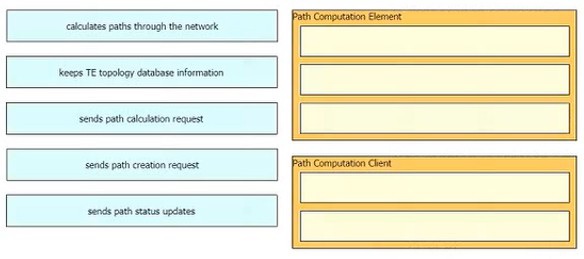
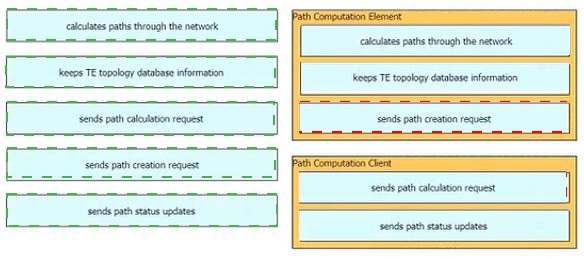
Drag and drop the functions from the path computation element protocol roles on the right.


Explanation:

The exhibit requires matching each PCEP function to the correct role: Path Computation Element (PCE) or Path Computation Client (PCC). The PCE is responsible for calculating paths through the network and keeping the TE topology database information, as it maintains the TED and computes constrained paths based on requests. The PCC is responsible for sending path calculation requests to the PCE, sending path creation requests to establish the computed path, and sending path status updates to report the state of the LSP. This makes the correct matches as follows:

Path Computation Element → calculates paths through the network
Path Computation Element → keeps TE topology database information
Path Computation Client → sends path calculation request
Path Computation Client → sends path creation request
Path Computation Client → sends path status updates

Why the other pairings are incorrect:

Matching "sends path calculation request" with the PCE is incorrect because the PCC is the one that sends path computation requests to the PCE, not the other way around.

Matching "sends path creation request" with the PCE is incorrect because the PCC sends the path creation request (via RSVP-TE signaling) after receiving the computed path from the PCE.

Matching "sends path status updates" with the PCE is incorrect because the PCC sends path status updates to report LSP state changes.

Matching "calculates paths through the network" or "keeps TE topology database information" with the PCC is incorrect because these are core functions of the PCE, which maintains the TED and performs CSPF computations.

Reference:

RFC 5440 – Path Computation Element (PCE) Communication Protocol (PCEP); RFC 4655 – A Path Computation Element (PCE)-Based Architecture; Cisco IOS XR MPLS Configuration Guide – Configuring MPLS TE with PCE; Cisco 350-501 SPCOR Official Cert Guide, MPLS Traffic Engineering chapter.

Refer to the exhibit.
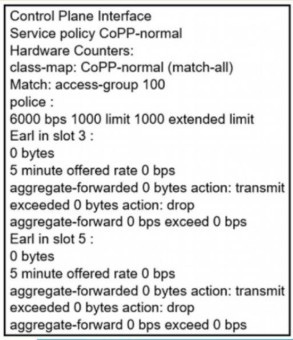
Which show command shows statistics for the control plane policy and is used to troubleshoot?

A. show control-plane CoPP

B. show control-plane

C. show policy-map control-plane

D. show policy control-plane

C.   show policy-map control-plane

Explanation

The exhibit shows output that includes a "Control Plane Interface" section with "Service policy CoPP-normal", class-map details, policing rates, and per-slot statistics. This output is from the `show policy-map control-plane` command, which displays the configuration and statistics for the Control Plane Policing (CoPP) policy applied to the control plane. This command allows the engineer to view the policy map, class map matches, policing actions (transmit/drop), and byte/packet counters for each slot, which is exactly what the exhibit shows. This makes option C the correct answer.

Why the other options are incorrect:

A. show control-plane CoPP – This is not a valid Cisco IOS command. The correct command to display CoPP policy statistics is `show policy-map control-plane`.

B. show control-plane – This command displays control plane information but does not specifically show the policy map statistics for CoPP.

D. show policy control-plane – This is not a valid Cisco IOS command. The correct syntax is `show policy-map control-plane`.

Reference:
Cisco IOS XR Security Configuration Guide – Configuring Control Plane Policing (CoPP); Cisco 350-501 SPCOR Official Cert Guide, Security and Network Assurance sections.

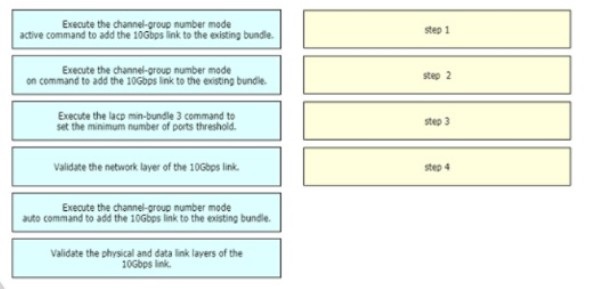
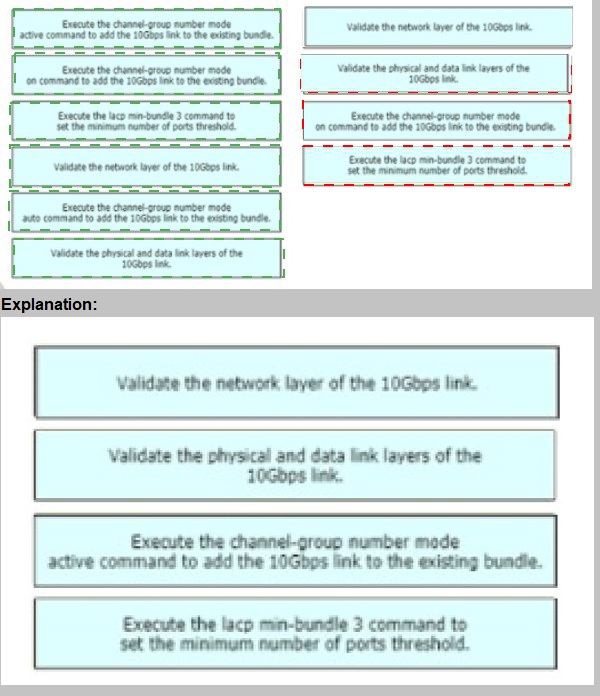
A network engineer is adding 10Gbps link to an existing 2X1Gbps LACP-based LAG to augment its capacity. Network standards require a bundle interface to be take out of service if one of its member links does down, and the new link must be added with minimal impact to the production network. Drag and drop the tasks that the engineer must perform from the left into the sequence on the right. Not all options are used.


Explanation

The exhibit requires ordering the steps to add a 10Gbps link to an existing 2x1Gbps LACP-based LAG. The correct sequence is: first, validate the physical and data link layers of the 10Gbps link to ensure the new link is operational before adding it to the bundle. Second, validate the network layer of the 10Gbps link to confirm IP connectivity and routing. Third, execute the channel-group number mode active command to add the 10Gbps link to the existing bundle, using LACP active mode to negotiate the aggregation with minimal disruption. Fourth, execute the lacp min-bundle 3 command to set the minimum number of ports threshold to 3, ensuring the bundle interface goes out of service if any member link goes down (as required by network standards). This makes the correct order as follows:

Step 1 → Validate the physical and data link layers of the 10Gbps link.
Step 2 → Validate the network layer of the 10Gbps link.
Step 3 → Execute the channel-group number mode active command to add the 10Gbps link to the existing bundle.
Step 4 → Execute the lacp min-bundle 3 command to set the minimum number of ports threshold.

Why the other orderings are incorrect:

Placing the lacp min-bundle 3 command before adding the link would set the threshold to 3 when only 2 links are present, causing the bundle to go down immediately and disrupting production traffic.

Placing the channel-group command before validating the link's physical, data link, and network layers risks adding a faulty link to the bundle, which could cause instability.

Using mode on or mode auto instead of mode active is incorrect because mode active is required for LACP negotiation, and the question specifies an LACP-based LAG.

Reference:
IEEE 802.3ad – Link Aggregation; Cisco IOS XR Interface and Hardware Component Configuration Guide – Configuring Link Bundling: LACP and min-bundle; Cisco 350-501 SPCOR Official Cert Guide, Network Assurance section.

Page 26 out of 55 Pages