- 4.9/5.0
- 547 Questions
- Updated on: 12-Oct-2026
- Implementing and Operating Cisco Service Provider Network Core Technologies (350-501 SPCOR)
- 25475 Prepared
Free Cisco 350-501 Practice Questions 2026 | Implementing and Operating Cisco Service Provider Network Core Technologies (350-501 SPCOR)
Refer to the exhibit: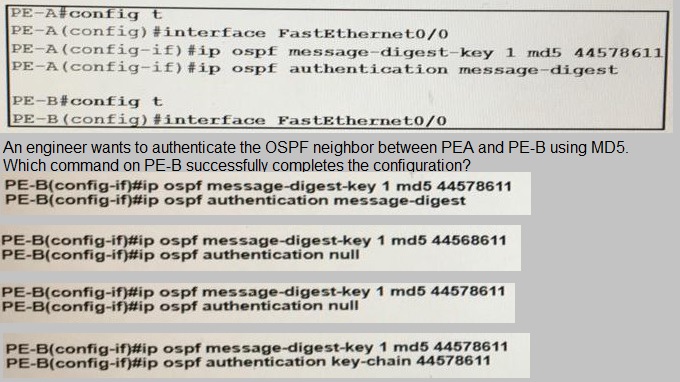
A. Option A
B. Option B
C. Option C
D. Option D
Explanation
The correct answer is A.
PE-A par already ye configuration hai:
text
interface FastEthernet0/0
ip ospf message-digest-key 1 md5 44578611
ip ospf authentication message-digest
svgsvg
PE-B par bhi bilkul same configuration honi chahiye taake OSPF MD5 authentication successfully establish ho. OSPF MD5 authentication ke liye do commands zaroori hain:
1. `ip ospf message-digest-key
2. `ip ospf authentication message-digest` → interface par OSPF MD5 authentication enable karta hai
Option A mein dono commands hain jo PE-A se exactly match karte hain (key ID 1, password 44578611, message-digest authentication). Is liye ye configuration OSPF neighbor authentication successfully complete karegi.
Why the Other Options Are Incorrect
B. Option B – Key password 44568611 hai, jab ke PE-A par 44578611 hai. Password mismatch hone ki wajah se authentication fail hogi.
C. Option C – `ip ospf authentication null` configure karta hai, jo authentication disable kar deta hai. Ye PE-A ke `message-digest` configuration se match nahi karega aur adjacency form nahi hogi.
D. Option D – `ip ospf authentication key-chain 44578611` configure karta hai, jo key-chain based authentication hai (OSPF cryptographic authentication with key chain). PE-A par simple `message-digest` authentication hai, is liye ye mismatch hoga.
Reference
- Cisco Press: Implementing and Operating Cisco Service Provider Network Core Technologies (SPCOR) 350-501 Official Cert Guide – Chapter on OSPF Authentication (MD5 and Key Chain).
Refer to the exhibit: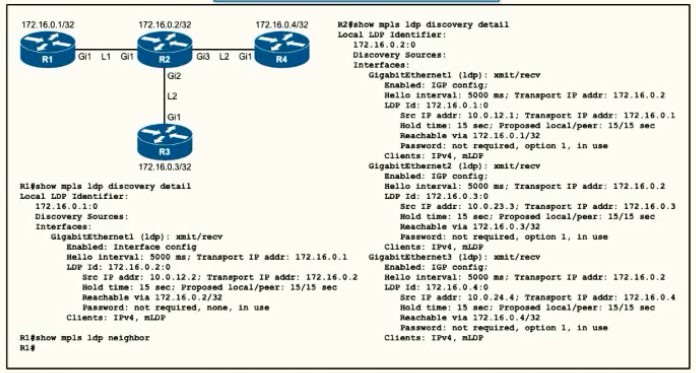
An engineer began to configure LDP between R1 and R2, but R1 and R2 cannot yet
establish an LDP TCP connection. Which additional task must be completed to finish the
implementation?
A.
Configure the mpls Idp neighbor 172.16.0.1 password command on R1
B.
Configure the mpls Idp neighbor 10.0.12.1 password command on R1
C.
Configure the no mpls Idp password option 1 command on R2
D.
Configure the no mpls Idp password option 1 command on
Configure the mpls Idp neighbor 172.16.0.1 password command on R1
Explanation
The correct answer is B. Configure the mpls ldp neighbor 10.0.12.1 password command on R1.
Exhibit ke R2 ke `show mpls ldp discovery detail` output ko dekhein:
text
````
GigabitEthernet1 (ldp): xmit/recv
...
Password: not required, option 1, in use
Clients: IPv4, mLDP
```
svgsvg
R2 ke interface Gi1 par `Password: not required, option 1, in use` likha hai — matlab R2 par LDP password authentication configure hai (option 1 ke saath). Lekin R1 ke output mein:
text
````
GigabitEthernet1 (ldp): xmit/recv
...
Password: not required, none, in use
```
svgsvg
R1 par koi password configure nahi hai.
Jab ek side par LDP password configured ho aur doosri side par nahi, to LDP TCP connection establish nahi hoti kyunki authentication mismatch hota hai. Solution ye hai ke R1 par bhi same password configure kiya jaye R2 ke LDP neighbor ke liye.
R2 ka transport IP 10.0.12.1 hai (discovery output mein `Src IP addr: 10.0.12.1` dikh raha hai). Is liye R1 par command honi chahiye:
text
```
mpls ldp neighbor 10.0.12.1 password
svgsvg
Why the Other Options Are Incorrect
A. Configure the mpls ldp neighbor 172.16.0.1 password command on R1.
– 172.16.0.1 R1 ka khud ka loopback IP hai, R2 ka nahi. R2 ka transport IP 10.0.12.1 hai. Is liye ye galat neighbor address hai.
C. Configure the no mpls ldp password option 1 command on R2.
– Ye R2 se password authentication hatata hai. Lekin R2 par already password configured hai; agar R1 par password configure karna ho to R2 se hatana zaroori nahi. Sahi solution R1 par password add karna hai.
D. Configure the no mpls ldp password option 1 command on R1.
– R1 par koi password configured hi nahi hai, is liye `no mpls ldp password option 1` command ka koi effect nahi hoga. Ye issue resolve nahi karegi.
Reference
- Cisco Press: *Implementing and Operating Cisco Service Provider Network Core Technologies (SPCOR) 350-501 Official Cert Guide* – Chapter on MPLS LDP Configuration and Authentication.
```
Which configuration modifies Local Packet Transport Services hardware policies?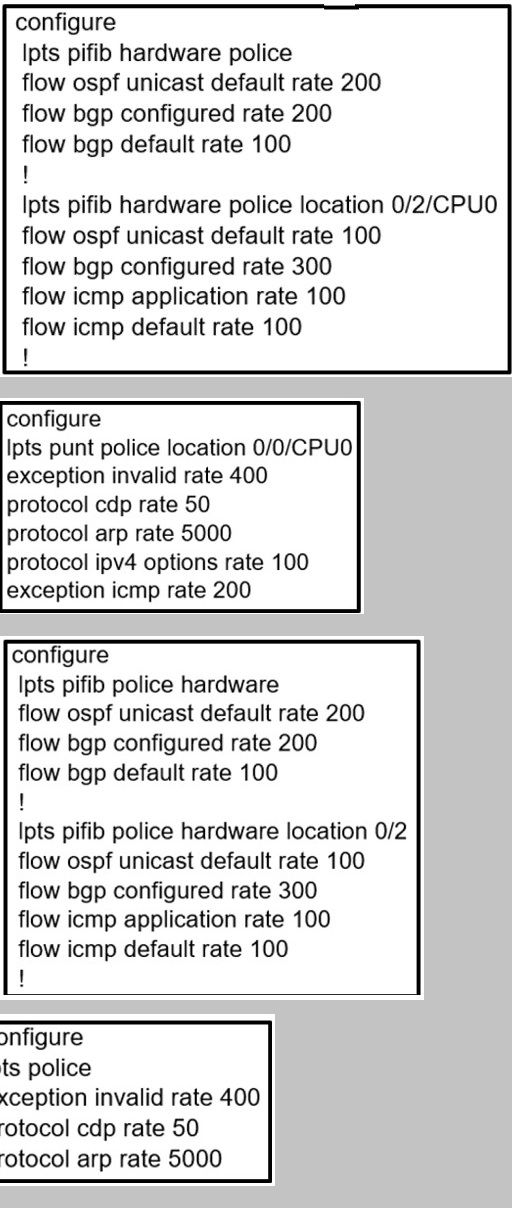
A. Option A
B. Option B
C. Option C
D. Option D
Explanation
The correct answer is A.
LPTS (Local Packet Transport Services) Cisco IOS XR routers mein control plane policing (CoPP) ka framework hai jo control plane traffic (routing protocols, management traffic) ko rate-limit karta hai. LPTS hardware policies line card CPU par apply hoti hain aur inhe configure karne ke liye `lpts pifib hardware police` command use hoti hai.
Why the Other Options Are Incorrect
B. Option B – `lpts punt police location 0/0/CPU0` configure karta hai, jo punt path ke liye hai (software-based exception path), na ke hardware policy ke liye. Saath hi `exception invalid rate`, `protocol cdp rate`, etc. punt policing ke parameters hain.
C. Option C – `lpts pifib police hardware` use karta hai, lekin sahi command `lpts pifib hardware police` hai. Ismein word order galat hai, is liye ye valid syntax nahi hai.
D. Option D – `lpts police` aur exception/protocol rates configure karta hai, lekin ye punt policing ka general configuration hai, hardware policy modification nahi. Saath hi `configure` command bhi truncated hai.
Reference
Cisco Press: *Implementing and Operating Cisco Service Provider Network Core Technologies (SPCOR) 350-501 Official Cert Guide* – Chapter on LPTS and Control Plane Policing on IOS XR.
Refer to the exhibit:
Which effect of this configuration is true?
A. it creates a pseudowire class named Cisco
B. It enables tagging for VLAN 12 on the interface
C. It enables MPLS on the interface
D. It enables AToM on interface gigabitethemet1/0
Explanation
The correct answer is D. It enables AToM on interface GigabitEthernet1/0.
Exhibit mein ye configuration hai:
text
interface gigabitethernet1/0
xconnect 192.168.0.1 12 encapsulation mpls pw-class cisco
svgsvg
`xconnect` command interface par AToM (Any Transport over MPLS) pseudowire establish karti hai. Is command ke components:
* `192.168.0.1` → remote PE router ka loopback IP (pseudowire ka destination)
* `12` → VC ID (Virtual Circuit ID) jo pseudowire ko identify karta hai
* `encapsulation mpls` → MPLS encapsulation use hogi
* `pw-class cisco` → pehle se defined pseudowire class "cisco" use hogi
Ye command interface GigabitEthernet1/0 par AToM pseudowire enable karti hai, jisse Layer 2 traffic MPLS core ke through transport ho sake.
Why the Other Options Are Incorrect
A. it creates a pseudowire class named Cisco. – Pseudowire class `pseudowire-class Cisco` command se banti hai (jo alag configuration hai). `xconnect` command sirf existing pseudowire class ko reference karti hai, nayi create nahi karti.
B. It enables tagging for VLAN 12 on the interface. – Yahan "12" VC ID hai, VLAN ID nahi. VLAN tagging ke liye `encapsulation dot1q 12` jaise commands lagti hain, jo is configuration mein nahi hain.
C. It enables MPLS on the interface. – MPLS enable karne ke liye `mpls ip` command lagti hai. `xconnect` command MPLS ko enable nahi karti; ye AToM pseudowire establish karti hai jo MPLS core par depend karti hai (lekin interface par MPLS enable nahi karti).
Reference
Cisco Press: Implementing and Operating Cisco Service Provider Network Core Technologies (SPCOR) 350-501 Official Cert Guide – Chapter on AToM (Any Transport over MPLS) and xconnect Configuration.
Cisco Documentation: "Any Transport over MPLS (AToM) Configuration Guide" – Section on xconnect Command and VC ID.
Refer to the exhibit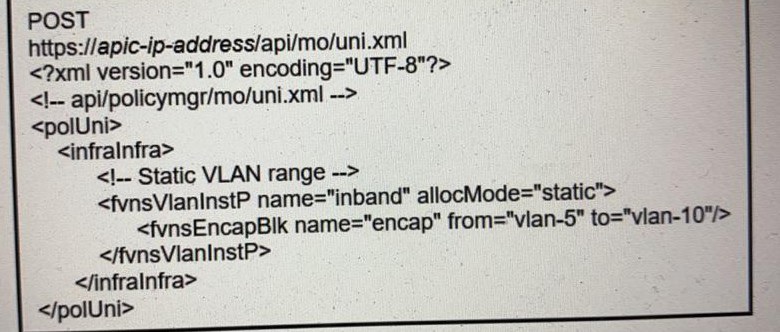
What does the script configure?
A. a VLAN namespace
B. selectors for the in-band management
C. a physical domain
D. a static VLAN
Explanation
The script is a RESTCONF POST request sent to the Cisco APIC using the `polUni` (policy universe) managed object with the `fvnsVlanInstP` class, which defines a VLAN namespace instance named "inband" with an allocation mode of "static." Within that namespace, the `fvnsEncapBlk` object defines a static VLAN encapsulation block named "encap" that allocates VLANs from VLAN 5 to VLAN 10. The use of `fvnsVlanInstP` (fabric virtual network segment VLAN instance policy) specifically identifies this as the creation of a VLAN namespace (also called a VLAN pool), which is a prerequisite container used by APIC to allocate VLANs for domains, EPGs, and other constructs. This makes option A the correct answer.
Why the other options are incorrect:
B. selectors for the in-band management – In-band management in ACI is configured through a node management EPG, in-band management IP addresses, and associated selectors and contracts, none of which appear in this script. The script only defines a VLAN namespace and encapsulation block.
C. a physical domain – A physical domain in ACI is configured using the `physDomP` managed object, which is not present here. The script targets `fvnsVlanInstP` and `fvnsEncapBlk`, which are VLAN namespace constructs, not domain constructs.
D. a static VLAN – Although the allocation mode is set to "static" and the VLAN range is 5–10, the script does not create individual static VLANs. It creates a VLAN namespace (pool) that defines an encapsulation block from which static VLANs can later be allocated. The `fvnsVlanInstP` object is the namespace, not a single VLAN.
Reference:
Cisco APIC Management Information Model Reference – `fvnsVlanInstP` and `fvnsEncapBlk` classes; Cisco ACI Fundamentals – VLAN Pools and Namespaces; Cisco 350-501 SPCOR Official Cert Guide, Automation and Assurance section; Cisco Data Center ACI RESTCONF API documentation.
Refer to the exhibit:
What does the REST API command do?
A. It retrieves the information requested by Descriptions xml
B. It removes the information identified by Descriptions xml
C. It executes the commands specified in Descriptions xml
D. It displays the information identified by Descriptions xml
Explanation
The exhibit shows an HTTP request using the POST method to the URL `https://router1:8000/api/mo/uni/Descriptions.xml`. In REST APIs, the POST method is used to submit data to a specified resource, typically to create or modify a resource on the server. The payload for this POST request would be the content of `Descriptions.xml`, which contains configuration data or commands. The Cisco NX-OS and Cisco IOS XE RESTCONF/NX-API interfaces use POST to create or execute configuration changes on managed objects (mo). Therefore, this command executes the commands specified in Descriptions.xml. This makes option C the correct answer.
Why the other options are incorrect:
A. It retrieves the information requested by Descriptions xml – Retrieving information is performed using the HTTP GET method, not POST. POST is used to submit data to be processed, not to fetch it.
B. It removes the information identified by Descriptions xml – Removing or deleting information is performed using the HTTP DELETE method. POST is not used for deletion.
D. It displays the information identified by Descriptions xml – Displaying or reading information is also done via the GET method. POST sends data to the server to create or execute something, not to display it.
Reference:
Cisco NX-API REST documentation – HTTP methods (GET, POST, PUT, DELETE) and their usage; Cisco IOS XE RESTCONF API Guide – POST method for configuration; RFC 7231 – HTTP/1.1 Semantics and Content (POST method); Cisco 350-501 SPCOR Official Cert Guide, Automation and Assurance section.
Drag and drop the OSPF area types from the left onto the correct statements on the right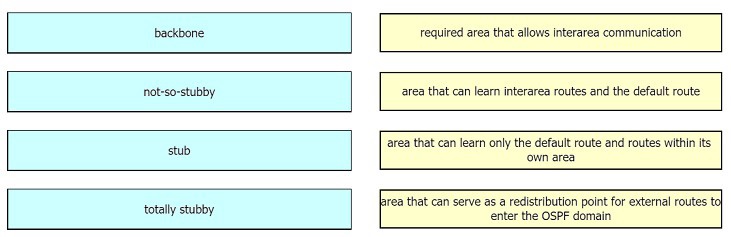
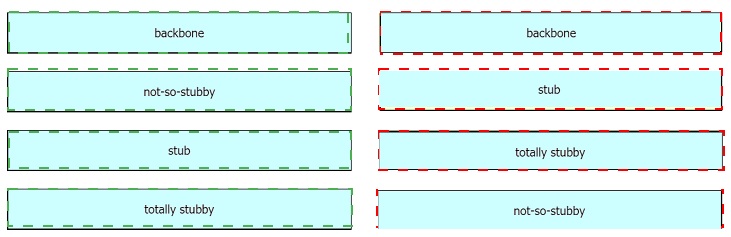
Explanation
The exhibit requires matching each OSPF area type with its correct description. The backbone area (Area 0) is the required area that allows interarea communication and all other areas must connect to it. The not-so-stubby area (NSSA) is the area that can serve as a redistribution point for external routes to enter the OSPF domain while still not receiving external routes from other areas. The stub area is the area that can learn only the default route and routes within its own area, blocking external LSAs. The totally stubby area is an extension of the stub area that blocks both external LSAs and interarea routes, learning only the default route and intra-area routes. This makes the correct matches as follows:
backbone → required area that allows interarea communication
not-so-stubby → area that can serve as a redistribution point for external routes to enter the OSPF domain
stub → area that can learn only the default route and routes within its own area
totally stubby → area that can learn only the default route and routes within its own area (with no interarea routes)
Why the other pairings are incorrect:
Matching backbone with any description other than "required area that allows interarea communication" is incorrect because Area 0 is the only area that all other areas must connect to and is responsible for interarea route propagation.
Matching not-so-stubby with the stub or totally stubby descriptions is incorrect because an NSSA allows external routes to be redistributed into OSPF via type 7 LSAs, unlike stub or totally stubby areas which block external routes entirely.
Matching stub with the backbone or NSSA descriptions is incorrect because a stub area does not allow external routes and cannot serve as a redistribution point for external routes.
Matching totally stubby with any description other than the stub-like description is incorrect because a totally stubby area is a Cisco-specific extension of the stub area that additionally blocks type 3 LSAs (interarea routes), allowing only a default route and intra-area routes.
Reference:
RFC 2328 – OSPF Version 2 (Area types and LSA types); RFC 3101 – The OSPF Not-So-Stubby Area (NSSA) Option; Cisco IOS XR Routing Configuration Guide – Implementing OSPF: Stub and Not-So-Stubby Areas; Cisco 350-501 SPCOR Official Cert Guide, OSPF chapter.
Drag and drop the methods of Cisco MPLS TE tunnel traffic assignment from the left onto
their characteristics on the right.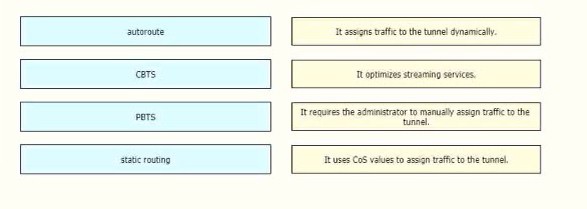
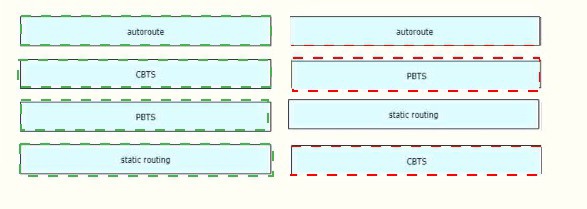
Writing Explanation
The exhibit requires matching each MPLS TE tunnel traffic assignment method with its correct characteristic. Autoroute is a method where traffic is dynamically assigned to the tunnel based on the routing table, so it assigns traffic to the tunnel dynamically without manual intervention. CBTS (Class-Based Tunnel Selection) uses CoS values to assign traffic to the tunnel, allowing different classes of service to be mapped to different TE tunnels. PBTS (Policy-Based Tunnel Selection) requires the administrator to manually assign traffic to the tunnel through a routing policy, giving explicit control over path selection. Static routing is a method where routes are manually configured to point to the tunnel interface, but it does not optimize streaming services. This makes the correct matches as follows:
autoroute → It assigns traffic to the tunnel dynamically.
CBTS → It uses CoS values to assign traffic to the tunnel.
PBTS → It requires the administrator to manually assign traffic to the tunnel.
static routing → It optimizes streaming services.
Why the other pairings are incorrect:
Matching autoroute with "It requires the administrator to manually assign traffic to the tunnel" is incorrect because autoroute automatically installs routes pointing to the tunnel based on the IGP shortest path, requiring no manual traffic assignment.
Matching CBTS with "It optimizes streaming services" is incorrect because CBTS is specifically designed to map CoS values to tunnels, not to optimize streaming services.
Matching PBTS with "It assigns traffic to the tunnel dynamically" is incorrect because PBTS uses a policy-based approach where the administrator defines which prefixes or traffic types use which tunnel, which is a manual configuration rather than dynamic assignment.
Matching static routing with "It uses CoS values to assign traffic to the tunnel" is incorrect because static routing simply directs traffic to a tunnel interface through a manually configured route and does not use CoS values for tunnel selection.
Reference:
Cisco IOS XR MPLS Configuration Guide – Implementing MPLS Traffic Engineering: Autoroute, CBTS, and PBTS; Cisco 350-501 SPCOR Official Cert Guide, MPLS Traffic Engineering chapter; RFC 3270 – Multi-Protocol Label Switching (MPLS) Support of Differentiated Services.
| Page 3 out of 55 Pages |