- 4.9/5.0
- 547 Questions
- Updated on: 12-Oct-2026
- Implementing and Operating Cisco Service Provider Network Core Technologies (350-501 SPCOR)
- 25475 Prepared
Free Cisco 350-501 Practice Questions 2026 | Implementing and Operating Cisco Service Provider Network Core Technologies (350-501 SPCOR)
Refer to the exhibit.
While troubleshooting the OSPF adjacency between routers R1 and R2 an engineer
noticed that both routers are stuck in the EXCHANGE/EXSTART state. What should the
engineer fix to solve the ongoing issue?
A. match IPv4 addresses
B. match OSPF areas
C. match OSPF network types
D. match MTU value
Explanation
The exhibit shows that R1's OSPF interface is configured with `Network Type POINT_TO_POINT` and an MTU of 9216 bytes, while R2's OSPF interface is configured with `Network Type POINT_TO_MULTIPOINT` and an MTU of 1500 bytes. When two OSPF routers are stuck in EXCHANGE/EXSTART state, the most common cause is an MTU mismatch, because during database descriptor (DBD) exchange each router includes its MTU in the DBD packets, and if the MTUs do not match the routers refuse to proceed. Additionally, the network type mismatch (point-to-point vs point-to-multipoint) is also present and would cause adjacency problems because the hello and dead timer behavior differs between these network types. However, the specific symptom of being stuck in EXCHANGE/EXSTART is directly tied to the MTU mismatch. Among the options provided, matching the MTU value is the fix that addresses the EXCHANGE/EXSTART hang. This makes option D the correct answer.
Why the other options are incorrect:
A. match IPv4 addresses – The IP addresses 172.20.1.12/31 and 172.20.1.13/31 are in the same /31 subnet and are correctly configured. IP addresses do not need to match; they only need to be in the same subnet, which they are.
B. match OSPF areas – R1 is in Area 0.0.1.255 and R2 is in Area 511, which is a mismatch. While area mismatch would prevent adjacency, the routers would not progress to EXCHANGE/EXSTART state at all. They would be stuck in DOWN or INIT. The EXCHANGE/EXSTART symptom specifically points to MTU mismatch.
C. match OSPF network types – The network type mismatch (point-to-point vs point-to-multipoint) is a real issue that should also be corrected, but it is not the direct cause of the EXCHANGE/EXSTART hang. Network type mismatch typically causes the adjacency to fail earlier (INIT or DOWN) due to hello timer or DR election differences. The specific EXCHANGE/EXSTART state is a classic MTU mismatch indicator.
Reference:
RFC 2328 – OSPF Version 2 (Database Description packet MTU field); Cisco IOS XR Routing Configuration Guide – Implementing OSPF: Troubleshooting Adjacency Issues; Cisco 350-501 SPCOR Official Cert Guide, OSPF chapter.
Refer to the exhibit: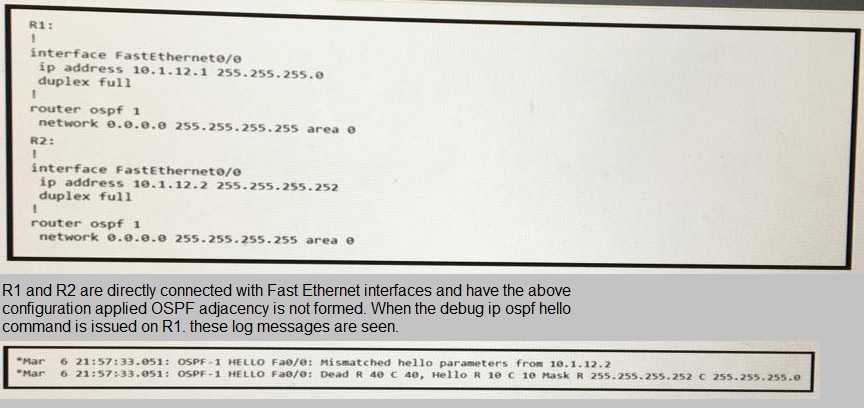
Which command can be configured on routers R1 and R2 on fO/O interfaces to form OSPF
adjacency?
A. ip ospf network non-broadcast
B. ip ospf network point-to- multipoint non-broadcast
C. ip ospf network point-to-point
D. ip ospf network broadcast
Explanation
The exhibit shows that R1 and R2 are directly connected on FastEthernet0/0 interfaces and are receiving OSPF hello mismatch errors. The debug output reveals a Mask mismatch (`Mask R 255.255.255.252 C 255.255.255.0`), meaning R1 has a /24 mask (255.255.255.0) while R2 has a /30 mask (255.255.255.252). On a broadcast network type (the default for FastEthernet), OSPF requires the subnet mask to match between neighbors, and this mismatch prevents adjacency formation. Changing the OSPF network type to point-to-point on both interfaces eliminates the subnet mask check, because point-to-point network type does not require masks to match. This allows the adjacency to form. This makes option C the correct answer.
Why the other options are incorrect:
A. ip ospf network non-broadcast – Non-broadcast network type still requires the subnet mask to match and requires manual neighbor configuration. It would not resolve the mask mismatch issue.
B. ip ospf network point-to-multipoint non-broadcast – Point-to-multipoint does not require mask matching, but the non-broadcast variant requires manual neighbor statements and is unnecessarily complex for a direct point-to-point link. The simpler and standard fix is point-to-point.
D. ip ospf network broadcast – Broadcast is the default network type on FastEthernet, which is already in effect and is causing the mask mismatch problem. Changing to broadcast explicitly would not fix anything.
Reference:
RFC 2328 – OSPF Version 2 (Network types and mask requirements); Cisco IOS XR Routing Configuration Guide – Implementing OSPF: Network Types; Cisco 350-501 SPCOR Official Cert Guide, OSPF chapter.
Refer to the exhibit.
What does the number 2 mean in the configuration?
A. It dictates the number of sessions that will be open with the SNMP manager
B. It represents the version of SNMP running.
C. It indicates two SNMP managers are able to read and write with the agent using community string ciscotest.
D. It is the numeric name of the ACL that contains the list of SNMP managers with access to the agent.
Explanation
In the Cisco IOS command `snmp-server community ciscotest ro 2`, the string `ciscotest` is the community string, `ro` grants read-only access, and the number `2` at the end is an access list number. This number references a standard IP access list that defines which SNMP managers (by source IP address) are permitted to query the router using this community string. It does not specify the SNMP version or the number of managers. This makes option D the correct answer.
Why the other options are incorrect:
A. It dictates the number of sessions that will be open with the SNMP manager – The command does not limit or define the number of SNMP sessions. SNMP sessions are not controlled by this parameter.
B. It represents the version of SNMP running – SNMP version is not configured with this command. SNMPv1, v2c, and v3 are enabled through different commands such as `snmp-server host` or `snmp-server group`, not by a number appended to the community string.
C. It indicates two SNMP managers are able to read and write with the agent using community string ciscotest – The number 2 does not specify a count of managers. It is an ACL reference, and the access is read-only (`ro`), not read-write.
Reference:
Cisco IOS Network Management Command Reference – snmp-server community; RFC 1157 – A Simple Network Management Protocol (SNMP); Cisco 350-501 SPCOR Official Cert Guide, Network Assurance section.
Refer to the exhibit
This configuration is being applied on an IOS XR router.
Which statement about this configuration is true?
A. It is used to create a subscription to specify the streaming interval
B. It is used to identify traps for SNMP polling
C. It is used to identify MIB entries and has a list of YANG models
D. It is used to create a sensor-group and has a list of YANG models for streaming
Explanation
The exhibit shows a model-driven telemetry configuration on an IOS XR router. The `telemetry model-driven` command enters telemetry configuration mode. The `sensor-group cisco` command creates a sensor group named "cisco". The `sensor-path Cisco-IOS-XR-infra-statsd-oper:infra-statistics/interfaces/interface/latest/generic-counters` command adds a YANG model path to that sensor group, which specifies the exact data to be streamed. This configuration creates a sensor group containing a list of YANG model paths used for streaming telemetry data. This makes option D the correct answer.
Why the other options are incorrect:
A. It is used to create a subscription to specify the streaming interval – A subscription is created with the `subscription` command under telemetry configuration, not with `sensor-group`. The exhibit does not show any subscription or streaming interval configuration.
B. It is used to identify traps for SNMP polling – This is model-driven telemetry, not SNMP. SNMP traps are configured with `snmp-server host` and related commands, which are not present here.
C. It is used to identify MIB entries and has a list of YANG models – While MIBs and YANG models are related concepts, this configuration specifically defines a sensor group with YANG model paths for streaming, not MIB entries for polling. The distinction is that telemetry uses YANG paths, not MIB OIDs.
Reference:
Cisco IOS XR Telemetry Configuration Guide – Model-Driven Telemetry: Sensor Groups and Sensor Paths; RFC 7950 – The YANG 1.1 Data Modeling Language; Cisco 350-501 SPCOR Official Cert Guide, Automation and Assurance section.
Refer to the exhibit.
A network engineer is implementing a standard customer route-policy on ASBR1 with these
requirements:
• It must accept only customer-assigned prefixes
• It must preserve customer advertised BGP communities
• It must set the local-preference to 110 for all prefixes
• It must attach the ORIGINATION-PE and LOCAL-CITY communities to all accepted
prefixes.
Which route policy must the engineer implement on ASBR1 to satisfy the requirements?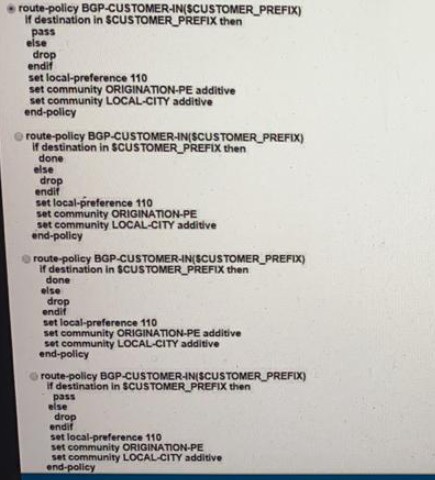
A. Option A
B. Option B
C. Option C
D. Option D
Explanation
The route-policy must accept only customer-assigned prefixes, preserve customer-advertised BGP communities, set local-preference to 110, and attach the ORIGINATION-PE and LOCAL-CITY communities. The `additive` keyword is critical because it appends the new communities to the existing ones instead of overwriting them, which satisfies the requirement to preserve customer-advertised communities. The correct policy must use `set community ORIGINATION-PE additive` and `set community LOCAL-CITY additive`, along with `set local-preference 110` and the `if destination in $CUSTOMER_PREFIX then pass else drop` logic. Only Option A contains both `additive` keywords on both community statements, making it the correct answer.
Why the other options are incorrect:
B. Option B – It is missing the `additive` keyword on `set community ORIGINATION-PE`, which means the ORIGINATION-PE community would overwrite the customer's existing communities, violating the requirement to preserve them.
C. Option C – It is missing the `additive` keyword on `set community LOCAL-CITY`, which means the LOCAL-CITY community would overwrite existing communities, violating the preservation requirement.
D. Option D – It is missing the `additive` keyword on both community statements, so both ORIGINATION-PE and LOCAL-CITY would overwrite the customer's advertised communities, failing the requirement.
Reference:
Cisco IOS XR Routing Configuration Guide – Implementing Routing Policy: Set Community Additive; RFC 1997 – BGP Communities Attribute; Cisco 350-501 SPCOR Official Cert Guide, BGP chapter.
Refer to the exhibit.
A. Option A
B. Option B
C. Option C
D. Option D
Explanation
In a Unified MPLS architecture with partitioned IGP domains, the ABR (R102) must act as a BGP route reflector for its iBGP labeled unicast clients and must enable label distribution to those peers. The correct configuration under the IPv4 address family must include `route-reflector-client` for each iBGP peer (172.16.0.5 and 172.16.0.11, and optionally 172.16.0.12), `next-hop-self` to ensure next-hop reachability across IGP domain boundaries, and `send-label` to distribute MPLS labels via BGP labeled unicast. Option D includes all three required elements — route-reflector-client, next-hop-self, and send-label — for every neighbor, which satisfies the requirements for Unified MPLS with partitioned IGP domains. This makes option D the correct answer.
Why the other options are incorrect:
A. Option A – It includes `route-reflector-client` and `send-label` but omits `next-hop-self`. Without next-hop-self, the next hop for reflected routes may be unreachable across the partitioned IGP domains, breaking the Unified MPLS forwarding path.
B. Option B – It includes all three elements for neighbor 172.16.0.5, but for neighbors 172.16.0.11 and 172.16.0.12 it omits `route-reflector-client`, which is required for R102 to act as a route reflector for those iBGP peers.
C. Option C – It includes `route-reflector-client` and `next-hop-self` but omits `send-label` on all neighbors. Without send-label, BGP labeled unicast is not enabled, so MPLS labels are not exchanged and the Unified MPLS LSP cannot be built.
Reference:
Cisco IOS XR MPLS Configuration Guide – Unified MPLS and BGP Labeled Unicast; RFC 3107 – Carrying Label Information in BGP-4; RFC 4456 – BGP Route Reflection; Cisco 350-501 SPCOR Official Cert Guide, MPLS and BGP chapters.
| Page 6 out of 55 Pages |