- 4.9/5.0
- 547 Questions
- Updated on: 12-Oct-2026
- Implementing and Operating Cisco Service Provider Network Core Technologies (350-501 SPCOR)
- 25475 Prepared
Free Cisco 350-501 Practice Questions 2026 | Implementing and Operating Cisco Service Provider Network Core Technologies (350-501 SPCOR)
Refer to the exhibit: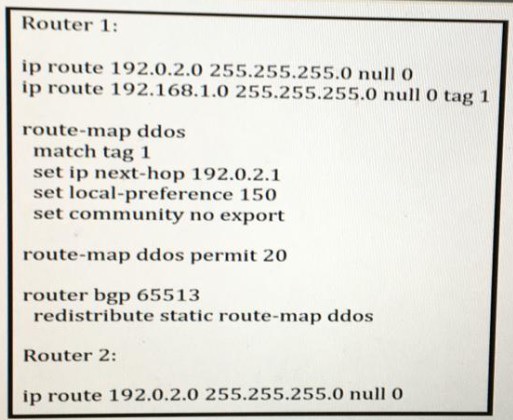
An engineer is preparing to implement data plane security configuration.
Which statement about this configuration is true?
A. Router 1 drops all traffic with a local-preference set to 150
B. All traffic is dropped
C. All traffic to 192.168.1.0/24 is dropped
D. Router 1 and Router 2 advertise the route to 192.0.2.0/24 to all BGFD peers.
Explanation
The exhibit shows that Router 1 has a static route for 192.168.1.0/24 pointing to null 0 with tag 1, and a route-map named "ddos" that matches tag 1, sets the next-hop to 192.0.2.1, sets local-preference to 150, and sets the community to no-export. Under BGP, the static route is redistributed using `redistribute static route-map ddos`. The static route to 192.168.1.0/24 points to null 0, which means traffic destined for that prefix is dropped at Router 1. This is a common DDoS mitigation technique, often called Remotely Triggered Black Hole (RTBH) filtering, where traffic to the attacked prefix is blackholed by routing it to null 0. Therefore, all traffic to 192.168.1.0/24 is dropped. This makes option C the correct answer.
Why the other options are incorrect:
A. Router 1 drops all traffic with a local-preference set to 150 – The local-preference of 150 is a BGP attribute set by the route-map and is used for BGP path selection. It does not cause the router to drop traffic matching that local-preference. Traffic is dropped because the route points to null 0, not because of the local-preference value.
B. All traffic is dropped – Only traffic destined for the specific prefix 192.168.1.0/24 is blackholed. The route to 192.0.2.0/24 is also a null 0 route on both routers, but the question focuses on the 192.168.1.0/24 prefix that is tagged and redistributed. Traffic to other destinations is not dropped.
D. Router 1 and Router 2 advertise the route to 192.0.2.0/24 to all BGP peers – The 192.0.2.0/24 static route is not tagged and is not matched by the route-map "ddos" (which matches tag 1). Therefore, it is not redistributed into BGP by the `redistribute static route-map ddos` command, so it is not advertised to BGP peers.
Reference:
RFC 3882 – Configuring BGP to Block Denial-of-Service Attacks; RFC 7999 – BLACKHOLE Community; Cisco IOS XR Routing Configuration Guide – Implementing BGP: Remotely Triggered Black Hole Filtering; Cisco 350-501 SPCOR Official Cert Guide, BGP and Security sections.
Refer to the exhibit. Which additional configuration must an engineer to the adge router to
inject a default router into the MP-BGP address family for the internet_Shared_Services
dedicated VRF?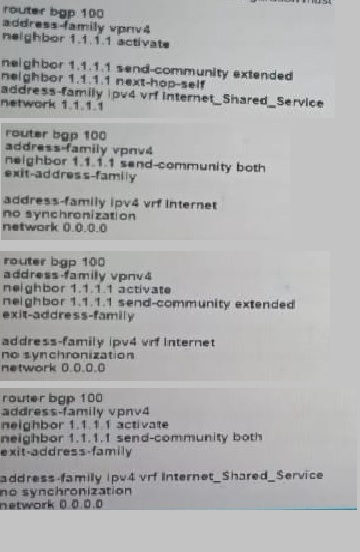
A. Option A
B. Option B
C. Option C
D. Option D
Explanation
To inject a default route into the MP-BGP address family for the Internet_Shared_Services VRF, the configuration must include the `address-family ipv4 vrf Internet_Shared_Services` block with `network 0.0.0.0` and the correct neighbor activation under the VPNv4 address family. Option D shows the VPNv4 neighbor activated with `send-community both`, and the VRF address family configured as `address-family ipv4 vrf Internet_Shared_Services` with `no synchronization` and `network 0.0.0.0`. This combination injects the default route into the specified VRF and allows the community attributes to be carried across MP-BGP. This makes option D the correct answer.
Why the other options are incorrect:
A. Option A – The VRF address family is configured as `address-family ipv4 vrf Internet_Shared_Services`, but the `network 0.0.0.0` command is missing, and `send-community extended` is used instead of `send-community both`. Without the network statement, the default route is not injected.
B. Option B – The VRF address family is configured as `address-family ipv4 vrf Internet`, which is the wrong VRF name. The requirement specifies the Internet_Shared_Services VRF, so this option targets the wrong VRF and injects the default route into the wrong table.
C. Option C – The VRF address family is configured as `address-family ipv4 vrf Internet`, again the wrong VRF name, and it is missing the `network 0.0.0.0` statement, so the default route is not injected into the required VRF.
Reference:
Cisco IOS XR Routing Configuration Guide – Implementing BGP: Configuring VRF Address Families and Default Route Injection; RFC 4364 – BGP/MPLS IP VPNs; Cisco 350-501 SPCOR Official Cert Guide, MPLS L3VPN chapter.
Refer to the exhibit.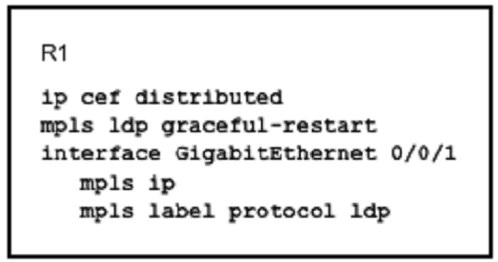
What is the effect of this configuration?
A. R1 supports a graceful restart operation on the peer, even if graceful restart is disabled on the peer.
B. R1 supports a peer that is configured for LDP SSO/NSF as the peer recovers from an outage.
C. R1 failovers only to a peer that is configured for LDP SSO/NSF.
D. R1 failovers to any peer.
Explanation
The exhibit shows `mpls ldp graceful-restart` configured on R1. This command enables LDP Graceful Restart (GR) with Non-Stop Forwarding (NSF) on R1, allowing R1 to help a neighboring LDP router recover from a control-plane outage without disrupting the MPLS forwarding plane. When the peer restarts, R1 preserves the MPLS label bindings and continues forwarding traffic using the existing labels while the peer re-establishes its LDP session and re-synchronizes its label database. This means R1 supports a peer that is configured for LDP SSO/NSF as the peer recovers from an outage, which makes option B the correct answer.
Why the other options are incorrect:
A. R1 supports a graceful restart operation on the peer, even if graceful restart is disabled on the peer – Graceful Restart is a negotiated capability. Both routers must have LDP GR enabled for the GR procedures to take effect. R1 cannot unilaterally provide GR support if the peer has it disabled.
C. R1 failovers only to a peer that is configured for LDP SSO/NSF – LDP Graceful Restart is not a failover mechanism to a specific type of peer. It is a recovery mechanism that preserves forwarding state during a peer restart. The phrasing about "failovers only" is incorrect.
D. R1 failovers to any peer – LDP GR does not cause R1 to fail over to any peer. It simply allows the LDP session and label bindings to survive a peer restart. There is no concept of failing over to an arbitrary peer in this context.
Reference:
RFC 3478 – Graceful Restart Mechanism for Label Distribution Protocol (LDP); Cisco IOS XR MPLS Configuration Guide – Implementing LDP: Graceful Restart and NSF; Cisco 350-501 SPCOR Official Cert Guide, MPLS chapter.
Which configuration enables BGP FlowSpec client function and installation of policies on all
local interfaces?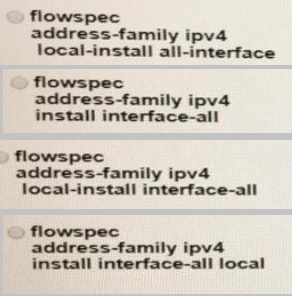
A. Option A
B. Option B
C. Option C
D. Option D
Explanation
To enable the BGP FlowSpec client function and install policies on all local interfaces, the correct configuration is `flowspec` followed by `address-family ipv4` and `local-install interface-all`. The `local-install interface-all` keyword tells the router to install the received FlowSpec policies on all local interfaces, which is exactly what the requirement specifies. This makes option C the correct answer.
Why the other options are incorrect:
A. Option A – The keyword `all-interface` is not valid syntax in this context. The correct keyword is `interface-all`, so this configuration would be rejected.
B. Option B – The keyword `install interface-all` is missing the `local-` prefix. The correct command is `local-install interface-all`, which enables local installation of FlowSpec policies on all interfaces. Without `local-install`, the behavior is not the same.
D. Option D – The keyword `install interface-all local` places `local` at the end, which is incorrect syntax. The correct order is `local-install interface-all`.
Reference:
Cisco IOS XR Routing Configuration Guide – Implementing BGP: BGP FlowSpec; RFC 5575 – Dissemination of Flow Specification Rules; Cisco 350-501 SPCOR Official Cert Guide, BGP and Security sections.
Refer to the exhibit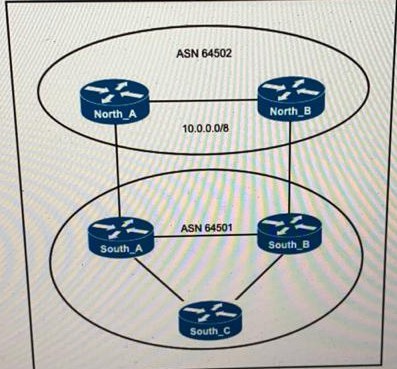
ASN 64501 currently reaches the networks under the 10.0.0.0/8 prefix via the North_B
router, which is a slow backup link. The administrator of ASN 64502 wants traffic from ASN
64501 to 10.0.0.0/8 to travel via the primary link North_A. Which change to the network
configuration accomplishes this task?
A. Set a higher local preference between North_A and South_A
B. Advertise the 10.0.0.0/8 prefix through North_B and specific subnets through North_A
C. Set a Lower Weight value for incoming traffic on North_A
D. Set a lower MED between North_B and South_B
Explanation
To influence inbound traffic from ASN 64501 so that it prefers the primary link via North_A instead of the backup link via North_B, the administrator of ASN 64502 should advertise more specific subnets of 10.0.0.0/8 through North_A while continuing to advertise the aggregate 10.0.0.0/8 through North_B. BGP always prefers the longest match (more specific prefix) regardless of other attributes such as local preference, MED, or weight. By advertising specific subnets through North_A, ASN 64501 will forward traffic for those subnets via North_A, while the less specific /8 remains available via North_B as a backup. This makes option B the correct answer.
Why the other options are incorrect:
A. Set a higher local preference between North_A and South_A – Local preference is used within an autonomous system to influence outbound path selection. It is not advertised to external peers, so it cannot influence how ASN 64501 selects its inbound path.
C. Set a Lower Weight value for incoming traffic on North_A – Weight is a Cisco-proprietary attribute that is locally significant and only affects outbound path selection on the local router. It is not advertised to external peers and cannot influence inbound traffic from ASN 64501.
D. Set a lower MED between North_B and South_B – MED is used to influence inbound traffic from an external AS, but a lower MED would make North_B more preferred, not less. Additionally, MED is evaluated only after other attributes and is less preferred than a more specific prefix match.
Reference:
RFC 4271 – A Border Gateway Protocol 4 (BGP-4); Cisco IOS XR Routing Configuration Guide – Implementing BGP: Influencing Inbound Path Selection; Cisco 350-501 SPCOR Official Cert Guide, BGP chapter.
Refer to the exhibit: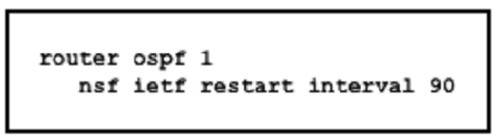
Which purpose of implementing NSF with this configuration is true?
A. The router uses NSF to load balance traffic between two links, with the primary link alternating every 90 seconds
B. The router uses NSF to reduce neighbor-relationship downtime during RP switchover
C. The router uses NSF to load balance traffic on a routed EtherChannel
D. The router uses NSF to handle RP switchover while allowing neighbor relationships to remain up
Explanation
The exhibit shows `router ospf 1` with `nsf ietf restart interval 90` configured. NSF (Non-Stop Forwarding) with the IETF restart interval is used to maintain OSPF neighbor relationships and continue forwarding traffic during a Route Processor (RP) switchover or a software restart. The `restart interval 90` specifies the maximum time (90 seconds) that the router will wait for the restart to complete while neighbors keep the adjacency up. This allows the neighbor relationships to remain up during the switchover, which is the purpose described in option D. This makes option D the correct answer.
Why the other options are incorrect:
A. The router uses NSF to load balance traffic between two links, with the primary link alternating every 90 seconds – NSF is not a load-balancing mechanism. The restart interval of 90 seconds has nothing to do with alternating traffic between links.
B. The router uses NSF to reduce neighbor-relationship downtime during RP switchover – While NSF does reduce downtime, the more precise and complete description is that it allows neighbor relationships to remain up entirely during the switchover, not just reduces downtime. Option D is the more accurate answer.
C. The router uses NSF to load balance traffic on a routed EtherChannel – NSF is not used for load balancing on EtherChannels. It is a high-availability feature for control-plane restart while preserving the forwarding plane.
Reference:
RFC 4811 – OSPF Out-of-Band LSDB Resynchronization (NSF); RFC 3623 – Graceful OSPF Restart; Cisco IOS XR Routing Configuration Guide – Implementing OSPF: Non-Stop Forwarding; Cisco 350-501 SPCOR Official Cert Guide, OSPF and Network Assurance sections.
| Page 8 out of 55 Pages |