Implementing and Operating Cisco Security Core Technologies (SCOR 350-701)
27215 Prepared
Free Cisco 350-701 Practice Questions 2026 | Implementing and Operating Cisco Security Core Technologies (SCOR 350-701)
Topic 1: Exam Pool A
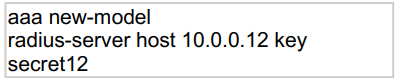
Refer to the exhibit.
Which statement about the authentication protocol used in the configuration is true?
A.
The authentication request contains only a password
B.
The authentication request contains only a username
C.
The authentication and authorization requests are grouped in a single packet
D.
There are separate authentication and authorization request packets
C.
The authentication and authorization requests are grouped in a single packet
ExplanationThis command uses RADIUS which combines authentication and authorization in one function (packet).
Which cloud model is a collaborative effort where infrastructure is shared and jointly accessed by several organizations from a specific group?
A. Hybrid
B. Community
C. Private
D. Public
B. Community
Explanation:
This question is testing your knowledge of the fundamental cloud deployment models. The key phrase in the question is "collaborative effort where infrastructure is shared and jointly accessed by several organizations from a specific group."
B (Community) is correct.
A community cloud is a multi-tenant model where the infrastructure is shared by several organizations that have common concerns, such as specific security requirements, compliance policies, or a shared mission (e.g., government agencies, financial institutions, or healthcare providers within a region). It is a collaborative effort, often managed by the organizations themselves or a third party.
A (Hybrid) is incorrect.
A hybrid cloud is a composition of two or more distinct cloud infrastructures (private, community, or public) that remain unique entities but are bound together by standardized or proprietary technology. It is not defined by a collaborative group of organizations sharing a single infrastructure.
C (Private) is incorrect.
A private cloud is operated solely for a single organization. It is not shared with or accessed by other external organizations.
D (Public) is incorrect.
A public cloud is open for use by the general public. While it is shared by many tenants (multi-tenant), it is not a collaborative effort for a specific, closed group. Any individual or organization can purchase services from a public cloud provider.
Reference:
NIST Special Publication 800-145, "The NIST Definition of Cloud Computing," which defines the four primary cloud deployment models: Public, Private, Community, and Hybrid.
A switch with Dynamic ARP Inspection enabled has received a spoofed ARP response on a trusted interface. How does the switch behave in this situation?
A.
It forwards the packet after validation by using the MAC Binding Table.
B.
It drops the packet after validation by using the IP & MAC Binding Table
C.
It forwards the packet without validation
D.
It drops the packet without validation
C.
It forwards the packet without validation
What are two DDoS attack categories? (Choose two)
A.
sequential
B.
protocol
C.
database
D.
volume-based
E.
screen-based
B.
protocol
D.
volume-based
There are three basic categories of attack:+ volume-based attacks, which use high traffic to inundate the network bandwidth+ protocol attacks, which focus on exploiting server resources+ application attacks, which focus on web applications and are considered the most sophisticated and serious type of attacks Reference: https://www.esecurityplanet.com/networks/types-of-ddos-attacks/
An administrator is configuring a DHCP server to better secure their environment. They need to be able to ratelimit the traffic and ensure that legitimate requests are not dropped. How would this be accomplished?
A.
Set a trusted interface for the DHCP server
B.
Set the DHCP snooping bit to 1
C.
Add entries in the DHCP snooping database
D.
Enable ARP inspection for the required VLAN
A.
Set a trusted interface for the DHCP server
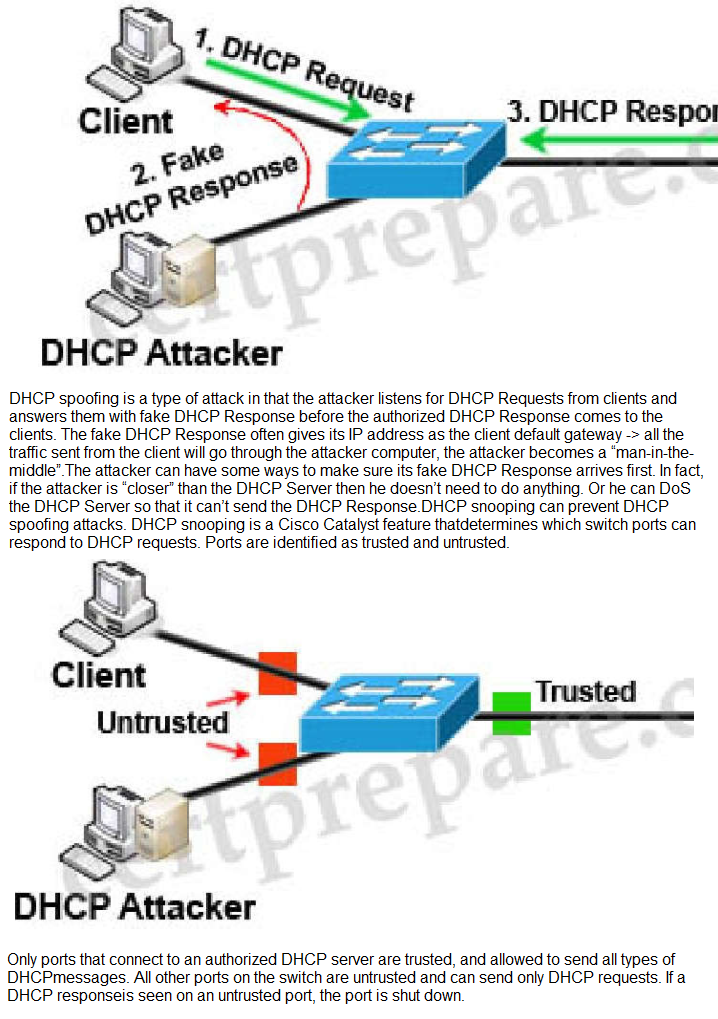
To understand DHCP snooping we need to learn about DHCP spoofing attack first.
In which cloud services model is the tenant responsible for virtual machine OS patching?
A. IaaS
B. UCaaS
C. PaaS
D. SaaS
A. IaaS
Explanation
This question tests the understanding of the shared responsibility model in cloud computing. The key is knowing which layers of the stack are managed by the cloud provider and which are managed by the tenant (customer).
IaaS (Infrastructure as a Service):
In this model, the cloud provider is responsible for the core infrastructure: the physical data center, network, storage, and servers. The tenant is responsible for everything on top of that, including the operating system, runtime, data, and applications. Therefore, patching the guest operating system of a virtual machine is the tenant's responsibility.
Why the other options are incorrect:
B. UCaaS (Unified Communications as a Service):
This is a specific type of SaaS for communication tools (e.g., Webex). The provider manages the entire application and its underlying platform and infrastructure. The tenant has no responsibility for OS patching.
C. PaaS (Platform as a Service):
In this model, the cloud provider manages the underlying infrastructure (servers, storage, network) and the operating system, middleware, and runtime environment. The tenant is only responsible for their application and data. The tenant does not have access to or responsibility for the OS.
D. SaaS (Software as a Service):
In this model, the cloud provider manages the entire application stack, from the infrastructure all the way up to the application itself. The tenant is only responsible for their use of the application and their data. The tenant has zero responsibility for any OS patching.
Reference:
The shared responsibility model is a fundamental concept for cloud security.
A common analogy used in Cisco and other cloud training is:
IaaS: The cloud provider is the landlord; you are responsible for everything inside your rented unit (the VM), including maintenance (patching).
PaaS: The cloud provider manages the building and utilities; you are only responsible for your business operations inside (the application).
SaaS: You are just a customer using a service; the provider manages everything.
In which two ways does Easy Connect help control network access when used with Cisco TrustSec? (Choose two)
A. It allows multiple security products to share information and work together to enhance security posture in the network.
B. It creates a dashboard in Cisco ISE that provides full visibility of all connected endpoints.
C. It allows for the assignment of Security Group Tags and does not require 802.1x to be configured on the switch or the endpoint.
D. It integrates with third-party products to provide better visibility throughout the network.
E. It allows for managed endpoints that authenticate to AD to be mapped to Security Groups (PassiveID).
C. It allows for the assignment of Security Group Tags and does not require 802.1x to be configured on the switch or the endpoint. E. It allows for managed endpoints that authenticate to AD to be mapped to Security Groups (PassiveID).
Explanation:
Easy Connect is a specific deployment model for Cisco TrustSec designed to simplify the implementation of micro-segmentation without the complexity of a full 802.1X rollout. It achieves this by leveraging alternative methods to assign Security Group Tags (SGTs).
Let's break down why C and E are correct and the others are not:
C) It allows for the assignment of Security Group Tags and does not require 802.1x to be configured on the switch or the endpoint.
This is CORRECT. This is the core value proposition of Easy Connect. Instead of relying solely on 802.1X authentication (which can be complex to deploy on all switches and endpoints), Easy Connect uses other methods like Device Registration (via the My Devices portal) or Web Authentication to classify an endpoint and assign it an SGT. The switchport is configured with a static SGT, which is applied to all traffic from a connected device.
E) It allows for managed endpoints that authenticate to AD to be mapped to Security Groups (PassiveID).
This is CORRECT. Passive Identity (PassiveID) is a key component of Easy Connect. ISE can integrate with Active Directory (AD) by monitoring authentication traffic (e.g., from a Domain Controller). When a managed corporate laptop authenticates to AD, ISE learns the user's identity and IP address. It can then map that IP address to a specific Security Group, allowing for dynamic policy enforcement based on user identity without requiring 802.1X on the network access layer.
Why the other options are incorrect:
A) It allows multiple security products to share information and work together to enhance security posture in the network.
This is INCORRECT. While this is a general benefit of a security platform architecture (like pxGrid), it is not the specific purpose or defining feature of Easy Connect. This describes ecosystem integration, not the simplified access control method that Easy Connect provides.
B) It creates a dashboard in Cisco ISE that provides full visibility of all connected endpoints.
This is INCORRECT. Cisco ISE does have dashboards for endpoint visibility (via Profiling), but this is not a feature unique to or created by "Easy Connect." Easy Connect is a deployment methodology that uses existing ISE profiling and context services.
D) It integrates with third-party products to provide better visibility throughout the network.
This is INCORRECT. Similar to option A, this describes the function of pxGrid, which is a separate, though complementary, technology within the ISE ecosystem. Easy Connect itself is focused on simplifying the initial SGT assignment for access control.
Reference:
Cisco TrustSec Solution Design Guide:
Documentation on Easy Connect explicitly states its purpose is to "enable SGT assignment without 802.1X" using methods like "Central Web Auth, Native Supplicant Profile, and Device Registration."
Cisco ISE Administrator Guide on Passive Identity:
The documentation for PassiveID describes how it "leverages existing authentication systems (like AD) to identify users and their devices without deploying 802.1X," which is a cornerstone of the Easy Connect model.
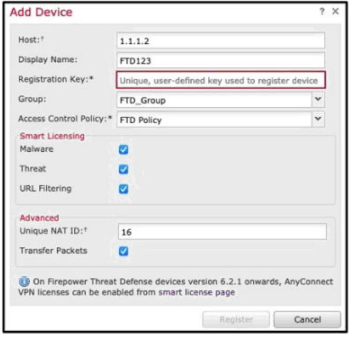
Refer to the exhibit.
An administrator is adding a new Cisco FTD device to their network and wants to manage it with Cisco FMC. The Cisco FTD is not behind a NAT device. Which command is needed to enable this on the Cisco FTD?
configure manager add <FMC IP address> <registration key>
D.
configure manager add <FMC IP address> <registration key>
Which two deployment model configurations are supported for Cisco FTDv in AWS? (Choose two)
A.
Cisco FTDv configured in routed mode and managed by an FMCv installed in AWS
B.
Cisco FTDv with one management interface and two traffic interfaces configured
C.
Cisco FTDv configured in routed mode and managed by a physical FMC appliance on premises
D.
Cisco FTDv with two management interfaces and one traffic interface configured
E.
Cisco FTDv configured in routed mode and IPv6 configured
A.
Cisco FTDv configured in routed mode and managed by an FMCv installed in AWS
C.
Cisco FTDv configured in routed mode and managed by a physical FMC appliance on premises
What are the two types of managed Intercloud Fabric deployment models? (Choose two)
A. Service Provider managed
B. Public managed
C. Hybrid managed
D. User managed
E. Enterprise managed
B. Public managed C. Hybrid managed
Explanation for Each Option:
A. Public managed (Incorrect):
"Public managed" is not a recognized deployment model for Cisco Intercloud Fabric. The Intercloud Fabric focuses on hybrid cloud connectivity, with specific managed models tied to service providers or enterprises, not a generic public category, making this option incorrect. (Reference: Cisco Intercloud Fabric Overview.)
B. Service Provider managed (Correct):
In the Service Provider managed model, a third-party service provider manages the Intercloud Fabric infrastructure, including connectivity and orchestration between private and public clouds. This is a standard deployment option, making it a correct choice. (Reference: Cisco Intercloud Fabric Deployment Guide, Service Provider Model.)
C. Enterprise managed (Correct):
In the Enterprise managed model, the organization itself manages the Intercloud Fabric deployment, maintaining control over the infrastructure and connectivity across its private and public cloud environments. This is another standard model, making it a correct choice. (Reference: Cisco Intercloud Fabric Deployment Guide, Enterprise Model.)
D. User managed (Incorrect):
"User managed" is not a defined deployment model for Intercloud Fabric. Management is categorized by the entity (service provider or enterprise), not the end user, rendering this option incorrect. (Reference: Cisco Intercloud Fabric Management Options.)
E. Hybrid managed (Incorrect):
While Intercloud Fabric supports hybrid cloud environments, "Hybrid managed" is not a specific deployment model. The management is either service provider or enterprise-led, not a distinct hybrid management category, making this option incorrect. (Reference: Cisco Intercloud Fabric Hybrid Cloud Support.)
Additional Notes:
Understanding Intercloud Fabric deployment models is a key topic in the 350-701 SCOR exam under cloud security. As of 1:05 PM PKT, October 03, 2025, these models support hybrid connectivity.