Topic · 117 of 336 questions freeTopic 3: Exam Pool C
Question 111Choose 1
What is the purpose of a NetFlow version 9 template record?
Correct answer:
B.
It provides a standardized set of information about an IP flow.
Question 112Choose 1
Which VMware platform does Cisco ACI integrate with to provide enhanced visibility, provide policy integration and deployment, and implement security policies with access lists?
Correct answer:
A. VMware APIC
Explanation
The integration between Cisco Application Centric Infrastructure (ACI) and VMware is a key partnership for software-defined data centers. The specific component that enables this deep integration is the Cisco ACI Virtual Edge, which integrates directly with the VMware vSphere Distributed Switch (VDS).
The integration point is the Application Policy Infrastructure Controller (APIC), which is the brain of the Cisco ACI fabric. The VMware vCenter server communicates with the Cisco APIC to exchange information and enforce policies. This integration provides:
Enhanced Visibility:
The Cisco APIC can see VMware virtual machines, their attributes, and their location within vCenter.
Policy Integration and Deployment:
Network and security policies defined in ACI (called Endpoint Groups or EPGs) can be dynamically applied to VMs based on their vCenter attributes (e.g., VM name, vSphere portgroup).
Security Policies with Access Lists:
The ACI fabric enforces security policies between these EPGs using contract-based microsegmentation, which functions as a distributed, stateful access control list.
Why the other options are incorrect:
B. VMware vRealize:
This is VMware's cloud management and automation platform. While it can interact with ACI for orchestration, it is not the primary platform for the deep, kernel-level integration that provides real-time visibility and policy enforcement for VMs.
C. VMware Fusion:
This is a desktop hypervisor for running virtual machines on Apple Mac computers. It is not an enterprise data center platform for integration with ACI.
D. VMware Horizon:
This is VMware's Virtual Desktop Infrastructure (VDI) solution. While ACI can be used in a VDI environment, Horizon itself is not the platform that ACI directly integrates with for hypervisor-level policy control; that integration is still with vCenter/APIC.
Reference:
The integration architecture between Cisco ACI and VMware is documented in the ACI configuration guides.
The Cisco ACI Virtualization Guide details the integration with VMware vCenter, explaining that the "Cisco APIC integrates with VMware vCenter to provide a unified point of management for the physical and virtual infrastructure" and enables "policy enforcement based on virtual machine attributes." This confirms the role of the APIC-vCenter integration.
Question 113Choose 2
When a next-generation endpoint security solution is selected for a company, what are two key deliverables that help justify the implementation? (Choose two.)
Correct answer:
C. continuous monitoring of all files that are located on connected endpoints
E. real-time feeds from global threat intelligence centers
Explanation for Each Option:
A. signature-based endpoint protection on company endpoints (Incorrect):
Signature-based protection relies on known malware patterns, which is a traditional approach and less effective against zero-day threats. A next-generation endpoint security solution prioritizes advanced, behavior-based detection over signature-based methods, making this deliverable insufficient to justify its implementation. (Reference: Cisco Next-Generation Endpoint Security Overview.)
B. macro-based protection to keep connected endpoints safe (Incorrect):
Macro-based protection focuses on defending against macro viruses in documents (e.g., Office files), which is a narrow scope. Next-generation solutions offer broader threat detection (e.g., fileless attacks, ransomware), and macro protection alone does not provide the advanced capabilities needed to justify the investment in a modern endpoint security solution. (Reference: Cisco Secure Endpoint Datasheet.)
C. continuous monitoring of all files that are located on connected endpoints (Correct):
Continuous monitoring of files enables real-time detection and response to suspicious activities, a hallmark of next-generation endpoint security. This proactive approach, supported by behavioral analysis and machine learning, justifies implementation by providing enhanced visibility and protection against evolving threats, aligning with modern security needs. (Reference: Cisco Secure Endpoint Features.)
D. email integration to protect endpoints from malicious content that is located in email (Incorrect):
Email integration is valuable for securing email gateways (e.g., Cisco Secure Email Gateway), but it is not a core deliverable of endpoint security solutions, which focus on device-level protection. This feature is secondary and does not fully justify the adoption of a next-generation endpoint solution. (Reference: Cisco Secure Email Gateway Overview.)
E. real-time feeds from global threat intelligence centers (Correct):
Real-time feeds from global threat intelligence centers, such as Cisco Talos, provide up-to-date information on emerging threats, enabling proactive defense. This capability enhances a next-generation endpoint solution’s effectiveness, offering a strong justification for implementation by ensuring endpoints are protected against the latest attack vectors. (Reference: Cisco Talos Intelligence Integration.)
Additional Notes:
Next-generation endpoint security is a key focus in the 350-701 SCOR exam under endpoint security. As of 10:36 AM PKT, October 02, 2025, continuous monitoring and threat intelligence feeds are critical deliverables. For details, refer to the Cisco Secure Endpoint documentation (cisco.com) and the 350-701 Exam Blueprint (Section 2.0 Endpoint Security).
Question 114Choose 1
A network engineer must migrate a Cisco WSA virtual appliance from one physical host to another physical host by using VMware vMotion. What is a requirement for both physical hosts?
Correct answer:
C.
The hosts must have access to the same defined network
Question 115Choose 2
Which two methods must be used to add switches into the fabric so that administrators can control how switches are added into DCNM for private cloud management? (Choose two.)
Correct answer:
C.
PowerOn Auto Provisioning
D.
Seed IP
Question 116
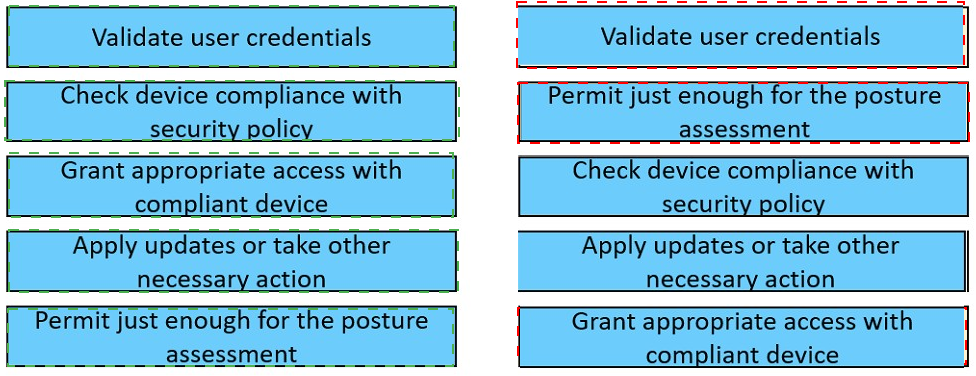
Drag and drop the posture assessment flow actions from the left into a sequence on the
Question 117Choose 1
Which type of data exfiltration technique encodes data in outbound DNS requests to specific servers and can be stopped by Cisco Umbrella?
Correct answer:
A.
DNS tunneling
That's the last free question in Topic 3: Exam Pool C
You've seen the free 35% of this topic (117 of 336 questions). Get complete access for every question, explanation and the timed mock exam.