• 4.9/5.0
  • 57 Questions
  • Updated on: 25-May-2026
  • Engineering Cisco Meraki Solutions v1.0
  • 2575 Prepared

Free Cisco 500-220 Practice Questions 2026 | Engineering Cisco Meraki Solutions v1.0


Prepare smarter for your Engineering Cisco Meraki Solutions v1.0 certification. Our carefully curated free Cisco 500-220 350-401 practice questions 2026 mirror the actual exam format and difficulty level. Each 500-220 practice test question includes detailed explanations to help you understand the 'why' behind every answer. Start your journey to becoming Engineering Cisco Meraki Solutions v1.0 certified today.


Which design requirement is met by implementing syslog versus SNMP?

A.

when automation capabilities are needed

B.

when proactive alerts for critical events must be generated

C.

when organization-wide information must be collected

D.

when information such as flows and client connectivity must be gathered

D.   

when information such as flows and client connectivity must be gathered


Reference:
https://documentation.meraki.com/General_Administration/Monitoring_and_Reporting/
Meraki_Device_Reporting_-_Syslog%2C_SNMP%2C_and_API

When an SSID is configured with Sign-On Splash page enabled, which two settings must be configured for unauthenticated clients to have full network access and not be allow listed? (Choose two.)

A.

Controller disconnection behavior

B.

Captive Portal strength

C.

Simultaneous logins

D.

Firewall & traffic shaping

E.

RADIUS for splash page settings

A.   

Controller disconnection behavior


B.   

Captive Portal strength


Reference: https://documentation.meraki.com/MR/Access_Control

For which two reasons can an organization become “Out of License”? (Choose two.)

A.

licenses that are in the wrong network

B.

more hardware devices than device licenses

C.

expired device license

D.

licenses that do not match the serial numbers in the organization

E.

MR licenses that do not match the MR models in the organization

B.   

more hardware devices than device licenses


C.   

expired device license


Reference:
https://documentation.meraki.com/General_Administration/Licensing/Meraki_Licensing_FA
Qs

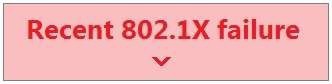
Refer to the exhibit.

For an AP that displays this alert, which network access control method must be in use?

A.

preshared key

B.

WPA2-enterprise with my RADIUS server

C.

splash page with my RADIUS server

D.

MAC-based access control with RADIUS server

A.   

preshared key


Which type of authentication protocol is used when using OSPF on an MX appliance?

A.

MD5

B.

certificate

C.

plaintext

D.

SHA-1

A.   

MD5


Reference: https://documentation.meraki.com/MX/Site-to-site_VPN/
Using_OSPF_to_Advertise_Remote_VPN_Subnets

Which information is used to calculate whether a WAN link has high usage?

A.

data under Security & SD WAN > Appliance Status > Uplink > Live Data

B.

total historical throughput of an uplink

C.

total number of devices that are actively passing traffic

D.

value under Security & SD WAN > SD WAN & Traffic Shaping > Uplink Configuration

D.   

value under Security & SD WAN > SD WAN & Traffic Shaping > Uplink Configuration


A new application needs to be pushed to all iOS devices. Some devices report “NotNow” in
the event log and do not install the application.
What does the “NotNow” event indicate?

A.

The application requires the most recent iOS version.

B.

The device is locked with a passcode.

C.

The device cannot connect to Apple servers.

D.

The device cannot connect to Cisco Meraki servers.

B.   

The device is locked with a passcode.


Reference: https://community.meraki.com/t5/Mobile-Device-Management/Check-NotNow-
Status/td-p/3887

In an organization that uses the Co-Termination licensing model, which two operations enable licenses to be applied? (Choose two.)

A.

Renew the Dashboard license.

B.

License a network.

C.

License more devices.

D.

Call Meraki support.

E.

Wait for the devices to auto-renew

A.   

Renew the Dashboard license.


C.   

License more devices.


Reference:
https://documentation.meraki.com/General_Administration/Licensing/Meraki_Co-
Termination_Licensing_Overview

Which requirement is needed to implement Fast Lane on Cisco Meraki APs?

A.

wireless profile installed on an Apple iOS device

B.

wireless profile installed on a Cisco iOS access point

C.

adaptive 802.11r disabled

D.

traffic shaping rule tagging traffic with a DSCP value of 46 to Apple.com

A.   

wireless profile installed on an Apple iOS device


Reference: https://documentation.meraki.com/MR/WiFi_Basics_and_Best_Practices/
Wireless_QoS_and_Fast_Lane

What are two ways peers interact with ports that Auto VPN uses? (Choose two.)

A.

For IPsec tunneling, peers use high UDP ports within the 32768 to 61000 range.

B.

Peers contact the VPN registry at UDP port 9350.

C.

For IPsec tunneling, peers use high TCP ports within the 32768 to 61000 range.

D.

Peers contact the VPN registry at TCP port 9350.

E.

For IPsec tunneling, peers use UDP ports 500 and 4500.

B.   

Peers contact the VPN registry at UDP port 9350.


C.   

For IPsec tunneling, peers use high TCP ports within the 32768 to 61000 range.


Reference: https://documentation.meraki.com/MX/Site-to-site_VPN/Meraki_Auto_VPN_-
_Configuration_and_Troubleshooting

Page 1 out of 6 Pages
123

Why Prepare with Our Cisco 500-220 Practice Test?


Our 500-220 practice tests are designed to closely match the real Engineering Cisco Meraki Solutions v1.0 exam format and difficulty. Each question helps you understand the key concepts. With regularly updated content, detailed Engineering Cisco Meraki Solutions v1.0 exam questions explanations, and a user-friendly interface, you can confidently assess your knowledge and improve your Cisco exam readiness.

Cisco 500-220 Exam Details


Exam Code: 500-220
Exam Name: Engineering Cisco Meraki Solutions (ECMS)
Certification Name: Cisco Meraki Solutions Specialist
Certification Provider: Cisco
Exam Questions: 55–65 questions
Exam Time: 90 minutes
Passing Score: Variable 800–850