
Question 1
Choose 1

Correct answer:
D.
Option D
Topic: Topic 3, Exam Pool C
Option D
An engineer configured VRF-Lite on a router for VRF blue and VRF red. OSPF must be enabled on each VRF to peer to a directly connected router in each VRF. Which configuration forms OSPF neighbors over the network 10.10.10.0/28 for VRF blue and 192.168.0.0/30 for VRF red?
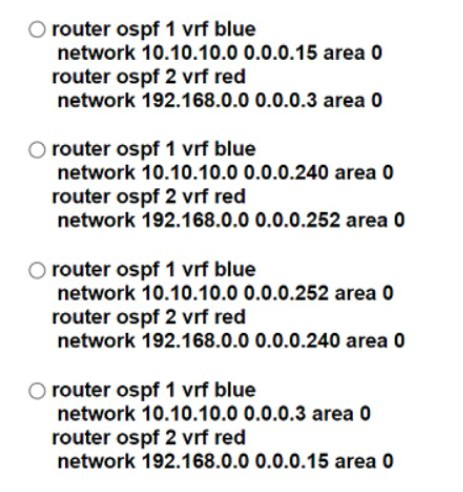
Option A
An engineer is creating a policy that overrides normal routing behavior.if the route to a destination of 10.100.100.0/24 is withdrawn from the routing Table, the policy must direct traffic to a next hop of 10.1 1.1. if the route is present in the routing table, then normal forwarding must occur. Which configuration meets the requirements?
access-list 100 permit ip any 10.100.100.0 0.0.0.255
!
route map POLICY permit 10
match ip address 100
Set ip next-hop recursive 10.1.1.1
!
route-map POLICY permit 20
Refer to the exhibit.
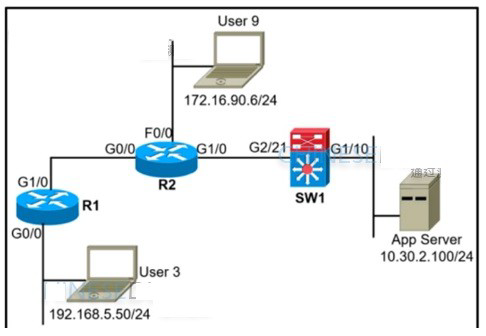
A network administrator must block ping from user 3 to the App Server only. An inbound standard access list is applied to R1 interface G0/0 to block ping. The network administrator was notified that user 3 cannot even ping user 9 anymore. Where must the access list be applied in the outgoing direction to resolve the issue?
SW1 interface G2/21
A network engineer must configure a DMVPN network so that a spoke establishes a direct path to another spoke if the two must send traffic to each other. A spoke must send traffic directly to the hub if required Which configuration meets this requirement?
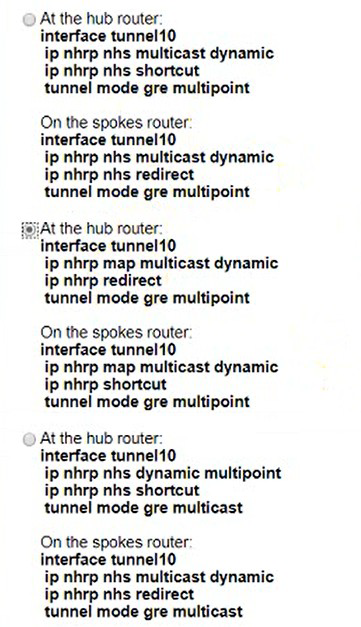
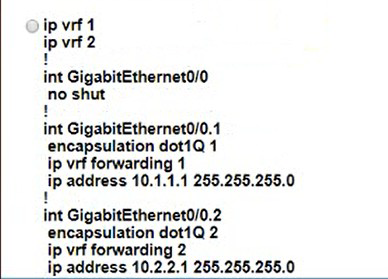
Option B
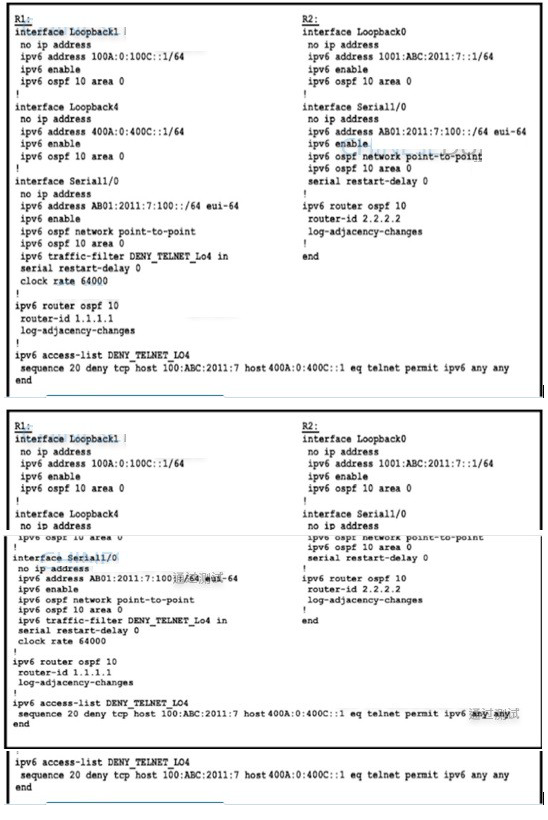
Refer to the exhibit. An engineer implemented an access list on R1 to allow anyone to Telnet except R2 Loopback0 to R1 Loopback4 How must sequence 20 be replaced on the R1 access list to resolve the issue?
sequence 20 deny tcp host 1001:ABC:2011:7::1 host 400A:0:400C::1 eq telnet
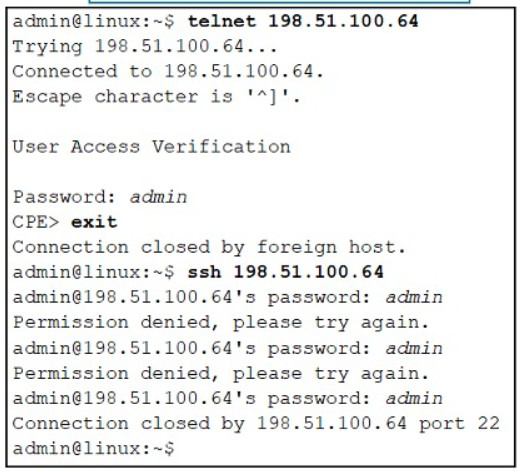
Refer to the exhibit. An administrator can log in to the device using Telnet but the attempts to log in to the same device using SSH with the same credentials fail Which action resolves this issue?
Configure SSH service on the router
Refer to the exhibit.
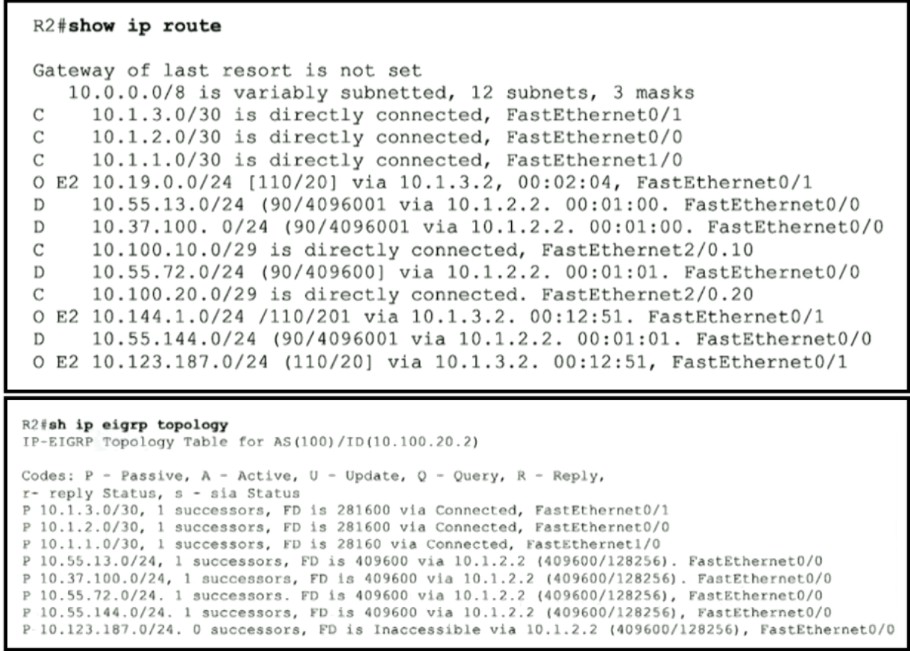
Router R2 should be learning the route for 10.123.187.0/24 via EIGRP. Which action resolves the issue without introducing more issues?
Use distribute-list to filter the external router in OSPF

Refer to the exhibit. An engineer cannot determine the time of the problem on R1 due to a mismatch between the router local clock and legs. Which command synchronizes the time between new log entries and the local clock on R1?
service timestamps log datetime locatetime msec
Refer to the exhibit.
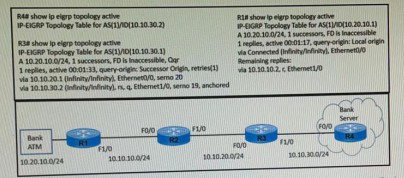
A bank ATM site has difficulty connecting with the bank server. A network engineer troubleshoots the issue and finds that R4 has no active route to the bank ATM site. Which action resolves the issue?
Advertise 10.10.30.0/24 subnet in R3 EIGRP AS.
Our timed 300 410 mock exam mirrors the format, number of questions and time limit of the official exam, so you can build speed and stamina.
Take the 300 410 mock examThe Cisco Enterprise Advanced Routing and Services (300-410 ENARSI) exam tests your ability to configure, implement, and troubleshoot advanced enterprise networks. It is a 90-minute concentration exam for the CCNP Enterprise certification and leads to the Cisco Certified Specialist – Enterprise Advanced Infrastructure Implementation credential.
Success requires practical routing knowledge, troubleshooting skills, and a clear understanding of Cisco's official exam objectives.
The ENARSI v1.1 exam blueprint divides the syllabus into four major domains:
| Exam Domain | Weightage |
|---|---|
| Layer 3 Technologies | 35% |
| VPN Technologies | 20% |
| Infrastructure Security | 20% |
| Infrastructure Services | 25% |
| Total | 100% |
Understanding these percentages helps you allocate study time according to exam importance.
Layer 3 Technologies (35%)
This is the highest-weighted domain. Prioritize:
EIGRP and OSPFv2/OSPFv3 troubleshooting.
BGP path selection, attributes, and route filtering.
Route redistribution and route maps.
Policy-Based Routing (PBR) and VRF-Lite.
VPN Technologies (20%)
Understand MPLS operations, MPLS Layer 3 VPNs, and DMVPN configurations involving GRE, NHRP, and IPsec.
Infrastructure Security (20%)
Study AAA authentication, TACACS+, RADIUS, IPv4/IPv6 ACLs, uRPF, Control Plane Policing (CoPP), and IPv6 first-hop security.
Infrastructure Services (25%)
Focus on DHCP troubleshooting, SNMP, Syslog, IP SLA, NetFlow, device management, and Cisco DNA Center Assurance.
Allocate approximately 60% of your preparation time to Layer 3 Technologies and Infrastructure Services, reflecting their combined blueprint weightage.
Pay particular attention to BGP troubleshooting, OSPF neighbor issues, redistribution loops, routing-table interpretation, and network performance monitoring.
Memorizing commands alone is not sufficient for ENARSI preparation. Practice interpreting the outputs of show ip route, show ip bgp summary, and show ip ospf neighbor.
Build routing labs, introduce configuration errors, and identify the causes of connectivity failures. These exercises strengthen the troubleshooting skills emphasized by Cisco.
Cistified.com provides free Cisco 300-410 ENARSI practice questions and paid mock tests to support your preparation.
Use free questions to identify knowledge gaps, then take full-length mock exams to practice under timed conditions.
Review incorrect answers, revisit weak blueprint domains, and repeat practice sessions to measure improvement.
Before scheduling your exam, make sure you can:
Troubleshoot advanced routing and VPN configurations.
Interpret Cisco IOS command outputs.
Apply routing policies and security controls.
Diagnose infrastructure service failures.
Complete timed practice tests with consistent results.
Start practicing with Cistified and turn your ENARSI knowledge into exam-ready troubleshooting skills.
Preparing for the ENARSI exam involves understanding how different networking technologies work together in enterprise environments. Practice scenario-based questions that require you to analyze routing failures, identify configuration errors, and select appropriate solutions.
Memorizing commands without understanding their functionality.
Ignoring IPv6 routing and security concepts.
Overlooking route filtering and redistribution scenarios.
Studying individual protocols without understanding their interactions.
Reviewing correct answers without analyzing incorrect options.
Regularly attempt Cisco 300-410 practice questions to evaluate your understanding of advanced networking concepts. Track your accuracy, identify recurring mistakes, and revisit challenging topics. Consistent practice combined with hands-on lab experience can improve your problem-solving skills and exam readiness.