• 4.9/5.0
  • 287 Questions
  • Updated on: 25-May-2026
  • Implementing and Configuring Cisco Identity Services Engine (SISE) v4.0 (300-715 SISE)
  • 22875 Prepared

Free Cisco 300-715 Practice Questions 2026 | Implementing and Configuring Cisco Identity Services Engine (SISE) v4.0 (300-715 SISE)


Prepare smarter for your Implementing and Configuring Cisco Identity Services Engine (SISE) v4.0 (300-715 SISE) certification. Our carefully curated free Cisco 300-715 350-401 practice questions 2026 mirror the actual exam format and difficulty level. Each 300-715 practice test question includes detailed explanations to help you understand the 'why' behind every answer. Start your journey to becoming Implementing and Configuring Cisco Identity Services Engine (SISE) v4.0 (300-715 SISE) certified today.


Refer to the exhibit.
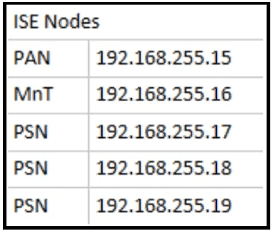


Which two configurations are needed on a catalyst switch for it to be added as a network access device in a Cisco ISE that is being used for 802 1X authentications? (Choose two )

A.

B.

C.

D.

E.

A.   
C.   

Explanation:
For 802.1X authentication, a Catalyst switch must use RADIUS (not TACACS+) and point to a PSN node, not PAN or MnT. The ISE node table shows PSNs at .17, .18, .19. The switch config incorrectly includes MnT (.16) and PAN (.15) as RADIUS servers. Proper NAD addition requires correct PSN IP and matching shared secret.

Correct Option A (example: radius server ISE1 address ipv4 192.168.255.17):
This points to a valid PSN (192.168.255.17). RADIUS authentication for 802.1X must terminate on a PSN. The PAN handles administration, and MnT handles monitoring/logging — neither processes RADIUS requests. Using a PSN ensures scalability and proper policy evaluation.

Correct Option C (example: key 7 with matching secret on ISE):
The shared secret must be identical on the switch and in the ISE network device definition. Without a matching key, RADIUS packets are rejected due to invalid Message-Authenticator. The key format (type 7) is Cisco’s obfuscated password. The hash alone does not matter; consistency does.

Incorrect Option (using 192.168.255.15 — PAN):
The PAN (Primary Administration Node) does not process RADIUS authentication requests. It pushes policy to PSNs and handles configuration, but 802.1X requests sent to PAN will time out or be rejected. This is a common mistake in exam questions.

Incorrect Option (using 192.168.255.16 — MnT):
The MnT node collects logs and alerts from PSNs but does not answer RADIUS Access-Requests. Configuring MnT as a RADIUS server for 802.1X will fail because no RADIUS service listens on MnT by default.

Incorrect Option (using TACACS+ server for 802.1X):
TACACS+ is for device administration (AAA for Telnet/SSH/console), not for network access control (802.1X). 802.1X requires RADIUS. TACACS+ servers cannot process EAP or 802.1X authentication requests.

Reference:

Cisco ISE Administrator Guide: “Policy Services Node (PSN) – handles all RADIUS, TACACS+, and pxGrid requests”

Cisco Catalyst Switch Configuration Guide: “802.1X authentication requires RADIUS server configuration”

Cisco SISE (300-715) Official Cert Guide, Chapter: “ISE Deployment Nodes and Personas”

When configuring Active Directory groups, what does the Cisco ISE use to resolve ambiguous group names?

A. MIB

B. TGT

C. OMAB

D. SID

D.   SID

Explanation:
In Cisco ISE, when you join an Active Directory domain and configure groups, group names can be ambiguous if the same name exists in different organizational units (OUs). ISE uses the Security Identifier (SID) to uniquely resolve and store group identities, avoiding confusion caused by identical local names.

Correct Option:

D. SID
The Security Identifier (SID) is a unique, immutable identifier assigned by Active Directory to every security principal (user, group, computer). ISE retrieves and stores the SID during group import, ensuring accurate resolution even when multiple groups share the same name across different OUs.

Incorrect Options:

A. MIB –
Management Information Base (MIB) is used for SNMP monitoring, not for AD group resolution. ISE does not rely on MIBs for identity management or group mapping.

B. TGT –
Ticket-Granting Ticket (TGT) is a Kerberos component used for authentication ticket requests. It does not help resolve ambiguous group names in ISE.

C. OMAB –
Not a valid Cisco ISE or Active Directory term for group resolution. This is a distracter; no such mechanism exists in this context.

Reference:
Cisco ISE Administration Guide, “Configure Active Directory” → “Join ISE to an Active Directory Domain” → “Group Retrieval and SID Usage”.

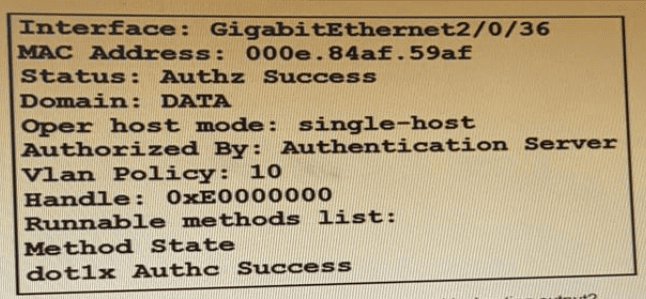
Refer to the exhibit:


Which command is typed within the CU of a switch to view the troubleshooting output?

A. show authentication sessions mac 000e.84af.59af details

B. show authentication registrations

C. show authentication interface gigabitethemet2/0/36

D. show authentication sessions method

A.   show authentication sessions mac 000e.84af.59af details

Explanation:
The exhibit shows detailed session information for a specific MAC address, including authorization status, VLAN assignment, and authentication methods. To reproduce this detailed output on a Cisco Catalyst switch, the command must target the specific MAC address using the details keyword.

Correct Option:

A. show authentication sessions mac 000e.84af.59af details
This command displays verbose authentication session information for a single supplicant identified by its MAC address. The output matches the exhibit exactly, showing method lists, authorization status, VLAN policy, and operational host mode. The details keyword adds granular information like handle ID and runnable methods.

Incorrect Options:

B. show authentication registrations
This command lists all registered authentication methods (dot1x, MAB, web-auth) on the switch, not session-specific details for a client. It does not show MAC address, VLAN policy, or authorization status per endpoint.

C. show authentication interface gigabitethernet2/0/36
This displays authentication settings and session status for the entire port, but not with the depth shown in the exhibit. It summarizes per-interface status, missing the per-MAC details like handle, runnable methods, and individual method states.

D. show authentication sessions method
This is not a valid Cisco IOS command. The correct syntax requires either interface, mac, or supplicant parameters. method alone is not recognized, and even if extended, it would not output the detailed block shown.

Reference:

Cisco Catalyst Switch Command Reference – show authentication sessions mac details

Cisco SISE 300-715 Official Cert Guide, Chapter: "Troubleshooting 802.1X and MAB"

A Cisco ISE engineer is creating a certificate authentication profile to be used with machine authentication for the network. The engineer wants to be able to compare the userpresented certificate with a certificate stored in Active Directory. What must be done to accomplish this?

A. Configure the user-presented password hash and a hash stored in Active Directory for comparison

B. Add the subject alternative name and the common name to the CAP.

C. Enable the option for performing binary comparison.

D. Use MS-CHAPv2 since it provides machine credentials and matches them to credentials stored in Active Directory


Explanation:
To compare a user‑presented certificate with a certificate stored in Active Directory during machine authentication, ISE must perform a binary comparison of the two certificate blobs. This ensures the certificate presented by the endpoint exactly matches the certificate stored in the AD computer object.

Correct Option:

C. Enable the option for performing binary comparison.
The certificate authentication profile in ISE includes a setting called "Perform binary comparison with certificate stored in Active Directory." When enabled, ISE retrieves the machine’s certificate from AD and compares it byte‑for‑byte with the certificate presented during EAP‑TLS. This prevents certificate spoofing and ensures the AD‑joined machine is authentic.

Incorrect Options:

A. Configure the user‑presented password hash and a hash stored in Active Directory for comparison –
This describes password‑based authentication (e.g., PEAP‑MSCHAPv2), not certificate‑based machine authentication. Certificates are not password hashes.

B. Add the subject alternative name and the common name to the CAP –
SAN and CN are used for identity extraction and matching against AD attributes (e.g., CN=machine-name). This helps locate the correct AD object but does not perform a binary certificate comparison. Binary comparison is an explicit, separate setting.

D. Use MS‑CHAPv2 since it provides machine credentials and matches them to credentials stored in Active Directory –
MS‑CHAPv2 is a password‑based protocol within PEAP or EAP‑MSCHAPv2. It does not involve certificate comparison and is not used when the requirement is to compare two certificates (EAP‑TLS or similar).

Reference:

Cisco ISE Administration Guide → "Certificate Authentication Profile" → "Binary Comparison with Active Directory"

Cisco SISE 300‑715 Official Cert Guide, Chapter: "External Identity Sources – Active Directory – Certificate‑Based Machine Authentication"

Which two ports do network devices typically use for CoA? (Choose two)

A. 443

B. 19005

C. 8080

D. 3799

E. 1700

D.   3799
E.   1700

Explanation:
Change of Authorization (CoA) allows Cisco ISE to dynamically modify session parameters after authentication starts. Network devices (switches, WLCs) listen on specific UDP ports for CoA requests. The two standard ports are 1700 (legacy/commonly used) and 3799 (officially assigned by IANA for CoA).

Correct Options:

D. 3799 –
This is the IANA-registered UDP port for RADIUS Change of Authorization (CoA). It is the modern standard port used by Cisco ISE and most vendors for dynamic policy updates, session termination, and reauthentication.

E. 1700 –
This UDP port is traditionally used by Cisco devices for CoA, especially in older implementations. Many switches and wireless controllers still accept CoA on port 1700 alongside 3799 for backward compatibility.

Incorrect Options:

A. 443 –
TCP port 443 is used for HTTPS (GUI) and EAP over RADIUS (EoR) or pxGrid, not for CoA. CoA uses UDP, not TCP.

B. 19005 –
This is a default REST API port for ISE's external RESTful services (ERS) or monitoring, not a CoA port on network devices.

C. 8080 –
Commonly used for HTTP proxy or ISE’s Guest portal (HTTP), but not for CoA. CoA ports are 1700 and 3799.

Reference:
IANA Service Name and Transport Protocol Port Number Registry: coa (UDP 3799)

A network engineer must configure a centralized Cisco ISE solution for wireless guest access with users in different time zones. The guest account activation time must be independent of the user time zone, and the guest account must be enabled automatically when the user self-registers on the guest portal. Which option in the time profile settings must be selected to meet the requirement?

A. Select FromFirstLogin from the Account Type dropdown.

B. Select FromCreation from the Account Type dropdown.

C. Set the Maximum Account Duration to 1 Day.

D. Set the Duration field to 24:00:00.

B.   Select FromCreation from the Account Type dropdown.

Explanation:
Guest accounts in Cisco ISE have two activation timing options: FromCreation (account becomes active immediately upon creation, independent of user time zone) and FromFirstLogin (account activation begins when user first logs in). Since the account must enable automatically when the user self-registers, FromCreation is required.

Correct Option:

B. Select FromCreation from the Account Type dropdown.
FromCreation activates the guest account immediately at the moment of creation (self-registration) based on ISE's system time, not the user's local time zone. This ensures consistent activation time across all time zones. The account duration countdown starts from that fixed creation timestamp, meeting the requirement for time‑zone independence.

Incorrect Options:

A. Select FromFirstLogin from the Account Type dropdown –
FromFirstLogin starts the account duration only after the guest authenticates for the first time. This creates dependency on user behavior (when they actually log in) and does not activate the account automatically at creation.

C. Set the Maximum Account Duration to 1 Day –
This sets the total lifetime of the account but does not control when activation begins. Without specifying FromCreation, the activation trigger remains undefined or default.

D. Set the Duration field to 24:00:00 –
This defines the length of access (e.g., 24 hours) but not the activation start event. The question requires time‑zone independence and automatic enablement upon self‑registration — only FromCreation provides that.

Reference:

Cisco ISE Administrator Guide → "Guest Access" → "Guest Account Time Settings"

Cisco SISE 300-715 Official Cert Guide, Chapter: "Guest Services – Creating Guest Accounts and Time Profiles"

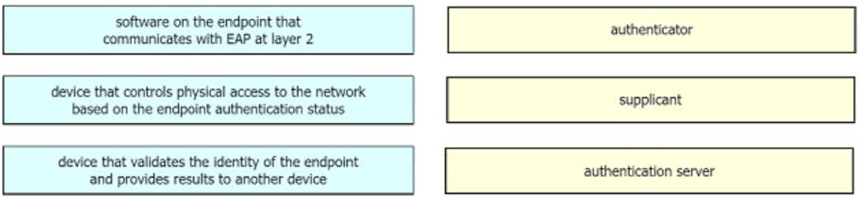
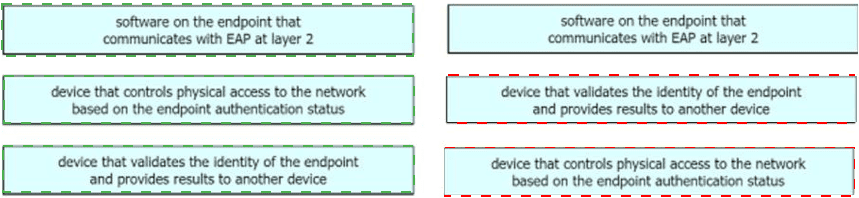
Drag the descriptions on the left onto the components of 802.1X on the right.

Refer to the exhibit.



An engineer is configuring a client but cannot authenticate to Cisco ISE During troubleshooting, the show authentication sessions command was issued to display the authentication status of each port Which command gives additional information to help identify the problem with the authentication?

A. show authentication sessions

B. show authentication sessions Interface Gil/0/1 output

C. show authentication sessions interface Gi1/0/1 details

D. show authentication sessions output

C.   show authentication sessions interface Gi1/0/1 details

Explanation:
The exhibit shows show authentication sessions output where Gi1/0/1 has "Unauth" status (failed authentication). The basic output lacks specific failure reasons (e.g., RADIUS timeout, bad credentials, EAP failure). Adding the details keyword provides granular troubleshooting information.

Correct Option:

C. show authentication sessions interface Gi1/0/1 details
This command displays comprehensive authentication details for a single port, including the method list state (dot1x/MAB), EAP failure messages, RADIUS server IP used, session timeout, posture status, and final authorization result. The details keyword reveals exactly why the client remains "Unauth" (e.g., invalid credentials, no response from supplicant, rejected by ISE).

Incorrect Options:

A. show authentication sessions –
This is the base command shown in the exhibit. It provides only a summary table (interface, MAC, method, status). No additional failure details are shown to diagnose the "Unauth" status on Gi1/0/1.

B. show authentication sessions interface Gi1/0/1 output –
The keyword output is not a valid Cisco IOS argument for this command. It will be rejected or produce the same summary without details. Only details expands the output.

D. show authentication sessions output –
Invalid syntax. The show authentication sessions command requires either interface, mac, supplicant, or session-id. Using output alone results in a command error.

Reference:

Cisco Catalyst Switch Command Reference – show authentication sessions interface details

Cisco SISE 300-715 Official Cert Guide, Chapter: "Troubleshooting 802.1X and MAB"

Which controller option allows a user to switch from the provisioning SSID to the employee SSID after registration?

A. User Idle Timeout

B. Fast SSID Change

C. AP SSID Fallback

D. AAA Override

B.   Fast SSID Change

Explanation:
In wireless guest provisioning workflows, a client first connects to an open provisioning SSID to self-register. After successful registration, the client must seamlessly transition to the secure employee SSID without user intervention. The controller feature enabling this transition is Fast SSID Change.

Correct Option:

B. Fast SSID Change
Fast SSID Change allows a wireless client to quickly switch between SSIDs (e.g., from provisioning to employee SSID) without complete reassociation or DHCP renewal. When the client registers successfully, ISE sends a Change of Authorization (CoA) instructing the WLC to direct the client to the new SSID. Fast SSID Change must be enabled on the WLC for this seamless transition.

Incorrect Options:

A. User Idle Timeout –
This disconnects idle users after a defined period of inactivity. It does not trigger or facilitate SSID switching after registration. It is a session cleanup mechanism, not a transition tool.

C. AP SSID Fallback –
Not a standard Cisco WLC feature. AP fallback typically refers to AP failing back to a primary controller after a reboot. This option does not apply to client SSID transitions during provisioning.

D. AAA Override –
This allows RADIUS to override VLAN or ACL attributes assigned locally on the WLC. While it can change the client's VLAN post-authentication, it does not actively switch the client from one SSID to a different SSID. SSID change requires Fast SSID Change.

Reference:

Cisco Wireless Controller Configuration Guide – "Fast SSID Change for Guest Provisioning"

Cisco SISE 300-715 Official Cert Guide, Chapter: "Guest Services – Wireless Guest Access Flow"

An organization has a fully distributed Cisco ISE deployment When implementing probes, an administrator must scan for unknown endpoints to learn the IP-to-MAC address bindings. The scan is complete on one FPSN. but the information is not available on the others. What must be done to make the information available?

A. Scanning must be initiated from the PSN that last authenticated the endpoint

B. Cisco ISE must learn the IP-MAC binding of unknown endpoints via DHCP profiling, not via scanning

C. Scanning must be initiated from the MnT node to centrally gather the information

D. Cisco ISE must be configured to learn the IP-MAC binding of unknown endpoints via RADIUS authentication, not via scanning

B.   Cisco ISE must learn the IP-MAC binding of unknown endpoints via DHCP profiling, not via scanning

Explanation:
In a distributed ISE deployment, active scanning (e.g., nmap scanning from a PSN) for unknown endpoints discovers IP-to-MAC bindings only locally on the initiating PSN. This information is not automatically synchronized across other PSNs. To make bindings available globally, ISE should use DHCP profiling instead of active scanning.

Correct Option:

B. Cisco ISE must learn the IP-MAC binding of unknown endpoints via DHCP profiling, not via scanning
DHCP profiling uses DHCP snooping or DHCP span to capture DHCP Request/Ack packets, which inherently contain IP-to-MAC bindings. These bindings are stored in the ISE endpoint database and automatically synchronized across all PSNs in a distributed deployment via the PAN. Active scanning (nmap) creates local, unsynchronized bindings and is not recommended for distributed environments.

Incorrect Options:

A. Scanning must be initiated from the PSN that last authenticated the endpoint –
This does not solve the synchronization problem. Scanning results remain local to that PSN unless propagated manually. Scanning is not designed for global visibility.

C. Scanning must be initiated from the MnT node to centrally gather information –
The MnT node is for monitoring and troubleshooting, not for active network scanning. It cannot perform scanning functions. Even if it could, scanning results would not automatically replicate to PSNs.

D. Cisco ISE must be configured to learn the IP-MAC binding of unknown endpoints via RADIUS authentication, not via scanning –
RADIUS authentication provides the MAC address (from Calling-Station-ID) but not the IP address (unless using specific AVPs like Framed-IP-Address, which are not always present). DHCP is the reliable, built-in method for IP-MAC binding.

Reference:

Cisco ISE Administrator Guide – "Profiling – Active vs. Passive Probing"

Cisco SISE 300-715 Official Cert Guide, Chapter: "Profiling Services – Distributed Deployment Considerations"

Page 1 out of 29 Pages

Why Prepare with Our Cisco 300-715 Practice Test?


Our 300-715 practice tests are designed to closely match the real Implementing and Configuring Cisco Identity Services Engine (SISE) v4.0 (300-715 SISE) exam format and difficulty. Each question helps you understand the key concepts. With regularly updated content, detailed Implementing and Configuring Cisco Identity Services Engine (SISE) v4.0 (300-715 SISE) exam questions explanations, and a user-friendly interface, you can confidently assess your knowledge and improve your Cisco exam readiness.

Cisco 300-715 Exam Details


Exam Code: 300-715
Exam Name: Implementing and Configuring Cisco Identity Services Engine (SISE)
Certification Name: CCNP Security
Certification Provider: Cisco
Exam Questions: 55–65 questions
Exam Time: 90 minutes
Passing Score: 800–850