Topic · 42 of 121 questions freeTopic 2: Exam Pool B
Question 121Choose 1
A network administrator needs to find out what assets currently exist on the network. Thirdparty systems need to be able to feed host data into Cisco Firepower. What must be configured to accomplish this?
Correct answer:
A.
a Network Discovery policy to receive data from the host
You can configure discovery rules to tailor the discovery of host and application data to your needs.The Firepower System can use data from NetFlow exporters to generate connection and discovery events, and to add host and application data to the network map.A network analysis policy governs how traffic is decoded and preprocessed so it can be further evaluated, especially for anomalous traffic that might signal an intrusion attempt -> Answer D is not correct.
Question 122
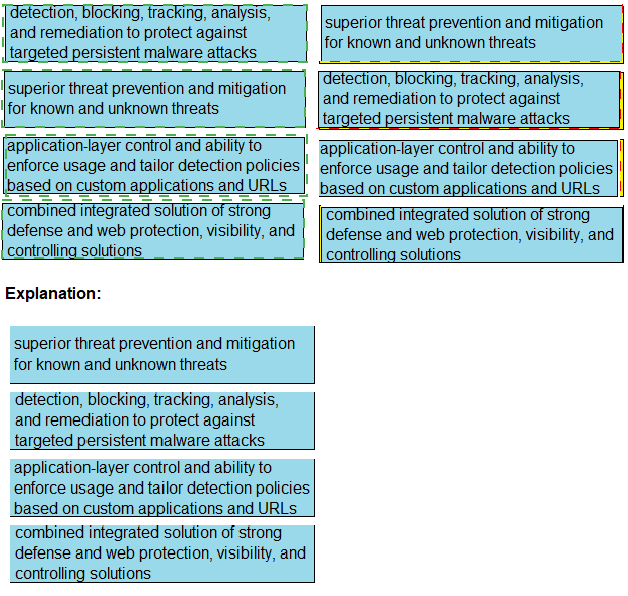
Drag and drop the capabilities from the left onto the correct technologies on the right.
Text, chat or text message
Description automatically generated
Question 123Choose 1
Which suspicious pattern enables the Cisco Tetration platform to learn the normal behavior of users?
A network administrator is configuring a switch to use Cisco ISE for 802.1X. An endpoint is failing authentication and is unable to access the network. Where should the administrator begin troubleshooting to verify the authentication details?
Correct answer:
D. RADIUS Live Logs
Explanation:
When an endpoint is failing authentication in an 802.1X scenario, the most direct and detailed source of real-time information is the RADIUS Live Logs.
Let's analyze why this is the correct answer and the role of the other options:
D) RADIUS Live Logs is CORRECT.
The RADIUS Live Logs in Cisco ISE provide a real-time, step-by-step record of every authentication attempt. For a failed authentication, it will show you critical details, such as:
The identity of the endpoint (MAC address, username).
The network access device (switch IP and port) it connected to.
The exact time of the attempt.
The specific failure reason (e.g., "19013 Authentication failed," "User not found in identity store," "Wrong password," "Endpoint failed posture check").
Which specific policy and rule was matched.
This detailed breakdown is the definitive starting point for understanding why the authentication failed.
Why the other options are incorrect for beginning troubleshooting:
A) Adaptive Network Control Policy List is INCORRECT.
This is a configuration section where you define authorization policies (what access to grant). You would check this after you know the authentication is successful to see why an endpoint is getting the wrong level of access, not why it's failing to authenticate in the first place.
B) Context Visibility is INCORRECT.
While the Context Visibility service (especially the Endpoints and Network Devices pages) is incredibly useful for gathering information about an endpoint's history and profiling data, it is not the primary tool for real-time authentication debugging. You would use Context Visibility to look up an endpoint's profile or past sessions, but the Live Logs are the source of truth for the current authentication failure.
C) Accounting Reports is INCORRECT.
RADIUS accounting packets are sent after a successful authentication to track session start, stop, and usage data (like data usage). If the endpoint is failing authentication, no accounting session would be established, so these reports would not contain any information about the failure.
Troubleshooting Workflow:
The recommended troubleshooting flow for an 802.1X failure is:
Start with the RADIUS Live Logs to identify the specific error code and failed policy.
Use Context Visibility to investigate the endpoint's profile and history.
Check the Policy Sets and Authentication/Authorization Rules to verify the configuration matches the expected behavior.
Check the switch configuration and logs for any local issues.
Reference:
Cisco ISE Administrator Guide, "Monitoring RADIUS Live Logs":
The official documentation explicitly states that the Live Logs are the "first place to look when you are troubleshooting authentication and authorization issues."
Cisco ISE Troubleshooting Guide:
All standard troubleshooting procedures for network access begin with querying the Live Logs to capture the details of the failed authentication attempt.
Question 125Choose 1
An engineer notices traffic interruption on the network. Upon further investigation, it is learned that broadcast packets have been flooding the network. What must be configured, based on a predefined threshold, to address this issue?
Correct answer:
C. storm control
Explanation
The problem described is a classic broadcast storm, where broadcast traffic floods the network, consuming all available bandwidth and causing a traffic interruption.
Storm control is a switch feature specifically designed to mitigate this exact issue. It works by monitoring the level of specific traffic types (broadcast, multicast, or unknown unicast) on a switch port. You can configure a predefined threshold (as a percentage of the total bandwidth or a specific packet rate).
When the traffic of the specified type exceeds this threshold, the switch will block that excess traffic on the port for the duration of the storm.
Once the traffic level falls back below the threshold, the port resumes normal operation.
This prevents a single misbehaving device or a network loop from taking down the entire network segment.
Why the other options are incorrect:
A. Bridge Protocol Data Unit (BPDU) guard:
This feature is used in Spanning Tree Protocol (STP) to protect the network topology. It disables a port if it receives a BPDU, preventing unauthorized switches from being connected. It does not monitor or control broadcast flood rates.
B. Embedded Event Manager (EEM):
EEM is a powerful tool for automating responses to specific events on a Cisco device. While you could write a complex EEM script to react to high broadcast levels, it is not the standard, built-in, and direct solution for this problem. Storm control is the dedicated, simple, and effective feature for this specific task.
D. Access Control Lists (ACLs):
ACLs are used for permitting or denying traffic based on Layer 3 (IP addresses) or Layer 4 (ports) information. They are not efficient or designed for rate-limiting a specific type of traffic like broadcast packets based on a bandwidth threshold. Storm control operates at Layer 2 and is the correct tool for this job.
Reference:
Storm control is a fundamental feature covered in Cisco switch configuration guides.
The Cisco IOS Interface and Hardware Component Configuration Guide for storm control states its purpose is to "prevent ports from being disrupted by a broadcast, multicast, or unicast storm" and that it "monitors incoming traffic levels over a 1-second interval and compares the level with a predefined threshold." This directly matches the requirement in the question.
Question 126Choose 1
What is a functional difference between a Cisco ASA and a Cisco IOS router with Zonebased policy firewall?
Correct answer:
A. The Cisco ASA denies all traffic by default whereas the Cisco IOS router with Zone- Based Policy Firewall starts out by allowing all traffic, even on untrusted interfaces
Explanation:
This difference stems from their core security philosophies: the ASA is a purpose-built firewall, while the ZBFW is a security feature added to a multi-function router.
A) is CORRECT.
Cisco ASA (Stateful Firewall):
Operates on the principle of "implicit deny." By default, all traffic flowing through the ASA is blocked unless an explicit access-list rule permits it. This is a fundamental characteristic of a dedicated firewall—it assumes everything is a threat until explicitly allowed.
Cisco IOS Router with ZBFW:
Operates on the principle of "implicit permit" for traffic within a zone, but implicit deny for traffic moving between zones. However, the critical detail is that interfaces are not assigned to any zone by default. If an interface is not a member of a security zone, there are no restrictions on traffic to/from that interface. This is why the statement "starts out by allowing all traffic, even on untrusted interfaces" is accurate for the initial, unconfigured state.
Why the other options are incorrect:
B) The Cisco IOS router with Zone-Based Policy Firewall can be configured for high availability, whereas the Cisco ASA cannot is INCORRECT. This is factually false. The Cisco ASA has robust, long-standing high-availability capabilities using failover pairs (Active/Standby or Active/Active). While IOS routers can also be configured for high availability (e.g., with HSRP/VRRP and stateful failover for the firewall), the ASA is certainly capable of it.
C) The Cisco IOS router with Zone-Based Policy Firewall denies all traffic by default, whereas the Cisco ASA starts out by allowing all traffic until rules are added is INCORRECT. This is the exact opposite of the truth. As explained above, the ASA denies by default, and the unconfigured ZBFW allows traffic on interfaces not assigned to a zone.
D) The Cisco ASA can be configured for high availability whereas the Cisco IOS router with Zone-Based Policy Firewall cannot is INCORRECT. As stated for option B, both platforms can be configured for high availability. This is not a functional difference between them.
Reference:
Cisco ASA Configuration Guide, "Information About ASA Access Rules":
Explicitly states, "By default, the ASA allows no traffic to pass through it unless it is explicitly permitted by an access rule."
Cisco IOS Security Configuration Guide:
Zone-Based Policy Firewall, "Default Policy": Explains that "The default policy between zones is deny," but crucially notes that "If an interface is not a member of a zone, any traffic to or from that interface is allowed." This is the "default-allow" behavior for unassigned interfaces that the question references.
Question 127Choose 1
An organization has noticed an increase in malicious content downloads and wants to use Cisco Umbrella to prevent this activity for suspicious domains while allowing normal web traffic. Which action will accomplish this task?
Correct answer:
B.
Configure the intelligent proxy
Question 128Choose 1
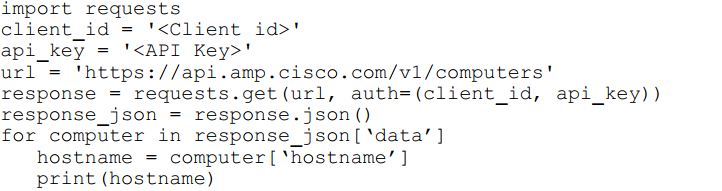
Refer to the exhibit.
What will happen when the Python script is executed?
Correct answer:
C.
The script will pull all computer hostnames and print them
Question 129Choose 1
After a recent breach, an organization determined that phishing was used to gain initial access to the network before regaining persistence. The information gained from the phishing attack was a result of users visiting known malicious websites. What must be done in order to prevent this from happening in the future?
Correct answer:
D. Modify web proxy settings
Explanation
The problem statement is very specific: "users visiting known malicious websites." The primary defense mechanism against this specific action is a web proxy or web security gateway (like Cisco Umbrella or the Cisco Web Security Appliance - WSA).
A web proxy can be configured with policies that block access to websites based on their reputation and category. "Known malicious websites" would fall into a category like "Malware," "Phishing," or "Newly Seen Domains," which can be explicitly blocked. Modifying the web proxy settings is the direct action needed to prevent users from successfully connecting to these sites in the future.
Why the other options are incorrect:
A. Modify an access policy:
Access policies (like those on a firewall or in Cisco ISE) typically control if a user can reach a network segment or the internet at all, based on identity, device, location, etc. They are generally not granular enough to inspect and block specific malicious websites based on dynamic URL categorization.
B. Modify identification profiles:
Identification profiles are used in systems like Cisco ISE to define how to identify users and devices on the network (e.g., via MAC address, 802.1X, etc.). This is about who is on the network, not where they are allowed to go on the internet.
C. Modify outbound malware scanning policies:
This is a good security practice, but it is a reactive measure. Malware scanning inspects files as they are being downloaded. The goal here is to prevent the initial contact with the malicious site altogether, which stops the attack before any file download or exploit attempt can even occur. Blocking access at the DNS or URL level via a web proxy is more proactive.
Reference:
This defense-in-depth strategy is a core principle of the Cisco Secure Internet Gateway (SIG) and solutions like Cisco Umbrella.
The official documentation for Cisco Umbrella states that its primary function is to "block requests to malicious destinations before a connection is ever established" using a vast database of categorized and malicious domains. Implementing or modifying such a solution directly addresses the root cause described in the scenario.
Question 130Choose 1
An organization is using Cisco Firepower and Cisco Meraki MX for network security and needs to centrally manage cloud policies across these platforms. Which software should be used to accomplish this goal?
Correct answer:
A.
Cisco Defense Orchestrator
Timed mock exam
Experience the real exam before you take it
Our timed 350 701 mock exam mirrors the format, number of questions and time limit of the official exam, so you can build speed and stamina.