Topic · 117 of 336 questions freeTopic 3: Exam Pool C
Question 241Choose 1
What is the result of the ACME-Router(config)#login block-for 100 attempts 4 within 60 command on a Cisco IOS router?
Correct answer:
D.
If four failures occur in 60 seconds, the router goes to quiet mode for 100 seconds.
Question 242Choose 1
An organization wants to implement a cloud-delivered and SaaS-based solution to provide visibility and threat detection across the AWS network. The solution must be deployed without software agents and rely on AWS VPC flow logs instead. Which solution meets these requirements?
Correct answer:
A. Cisco Stealthwatch Cloud
Explanation for Each Option:
A. Cisco Stealthwatch Cloud (Correct):
Cisco Stealthwatch Cloud is a cloud-delivered, SaaS-based solution that provides visibility and threat detection across AWS networks using AWS VPC flow logs. It operates without software agents, analyzing flow data to detect anomalies and threats, meeting the organization’s requirements for agentless deployment and AWS integration. (Reference: Cisco Stealthwatch Cloud Datasheet, AWS Integration.)
B. Cisco Umbrella (Incorrect):
Cisco Umbrella offers DNS-layer security and visibility, protecting against malware and phishing via cloud-delivered services. While it integrates with AWS, it relies on DNS traffic analysis, not VPC flow logs, and is not designed for comprehensive network visibility and threat detection without agents, making it unsuitable. (Reference: Cisco Umbrella AWS Integration Guide.)
C. NetFlow collectors (Incorrect):
NetFlow collectors are tools or hardware that collect and analyze NetFlow data, but they are not a cloud-delivered, SaaS-based solution. They require deployment and configuration, often with agents or local infrastructure, and do not provide a turnkey SaaS solution for AWS VPC flow log analysis, rendering this option incorrect. (Reference: Cisco NetFlow Configuration Guide.)
D. Cisco Cloudlock (Incorrect):
Cisco Cloudlock (now part of Cisco Secure Cloud Analytics) is a CASB solution focused on securing cloud applications (e.g., SaaS, IaaS) with DLP and user behavior analytics. It does not rely on VPC flow logs for network visibility and requires integration, often with agents, making it inappropriate for the specified agentless, flow-log-based requirement. (Reference: Cisco Cloudlock Overview.)
Additional Notes:
Deploying cloud-delivered security for AWS is a key topic in the 350-701 SCOR exam under cloud security. As of 12:45 PM PKT, October 03, 2025, Stealthwatch Cloud excels in agentless flow analysis.
Question 243Choose 1
A small organization needs to reduce the VPN bandwidth load on their headend Cisco ASA in order to ensure that bandwidth is available for VPN users needing access to corporate resources on the10.0.0.0/24 local HQ network. How is this accomplished without adding additional devices to the network?
Correct answer:
A. Use split tunneling to tunnel traffic for the 10.0.0.0/24 network only.
Explanation
The goal is to reduce VPN bandwidth load on the headend ASA. The key requirement is that VPN users must still have access to the corporate resources on the 10.0.0.0/24 network.
Split Tunneling is a VPN feature that allows a remote user's traffic to be divided (split) into two paths:
Encrypted VPN Tunnel:
Traffic destined for specific, protected networks (like the corporate network 10.0.0.0/24) is sent through the secure VPN tunnel to the headend ASA.
Direct Internet Access:
All other traffic (e.g., general web browsing, streaming) is sent directly to the internet from the user's local connection, bypassing the VPN tunnel and the corporate network entirely.
By configuring split tunneling to only tunnel traffic for the 10.0.0.0/24 network, all other internet-bound traffic from the VPN users is offloaded from the ASA's internet link. This directly accomplishes the goal of reducing bandwidth load on the headend without needing any new hardware.
Why the other options are incorrect:
B. Configure VPN load balancing to distribute traffic for the 10.0.0.0/24 network:
VPN load balancing requires multiple ASAs to form a cluster. The scenario explicitly states the solution must work "without adding additional devices." Furthermore, load balancing distributes user sessions across multiple devices but does not reduce the total internet bandwidth consumed by all user traffic, which is the core problem.
C. Configure VPN load balancing to send non-corporate traffic straight to the internet:
This is conceptually incorrect. VPN load balancing is about distributing the initial connection load, not inspecting and routing user traffic based on its destination after the tunnel is established. Traffic routing is handled by split tunneling, not the load-balancing mechanism itself.
D. Use split tunneling to tunnel all traffic except for the 10.0.0.0/24 network:
This is the inverse of the correct configuration. This would send all user traffic except the corporate traffic through the VPN tunnel. This would massively increase the bandwidth load on the headend ASA, as general web browsing would be hair-pinned through the corporate internet connection.
Reference:
Split tunneling is a standard feature on the Cisco ASA for managing remote access VPN performance.
The Cisco ASA Series VPN CLI Configuration Guide describes split tunneling as a method to "conserve bandwidth on the central-site network and the remote user's internet connection" by allowing you to "specify which traffic should be secured through the VPN tunnel and which traffic should not." For this scenario, the secured traffic is defined by the 10.0.0.0/24 network.
Question 244Choose 1
An engineer is configuring device-hardening on a router in order to prevent credentials from being seen if the router configuration was compromised. Which command should be used?
Correct answer:
A.
service password-encryption
Question 245Choose 1
What is the purpose of a NetFlow version 9 template record?
Correct answer:
B.
It provides a standardized set of information about an IP flow.
Question 246Choose 1
Which VMware platform does Cisco ACI integrate with to provide enhanced visibility, provide policy integration and deployment, and implement security policies with access lists?
Correct answer:
A. VMware APIC
Explanation
The integration between Cisco Application Centric Infrastructure (ACI) and VMware is a key partnership for software-defined data centers. The specific component that enables this deep integration is the Cisco ACI Virtual Edge, which integrates directly with the VMware vSphere Distributed Switch (VDS).
The integration point is the Application Policy Infrastructure Controller (APIC), which is the brain of the Cisco ACI fabric. The VMware vCenter server communicates with the Cisco APIC to exchange information and enforce policies. This integration provides:
Enhanced Visibility:
The Cisco APIC can see VMware virtual machines, their attributes, and their location within vCenter.
Policy Integration and Deployment:
Network and security policies defined in ACI (called Endpoint Groups or EPGs) can be dynamically applied to VMs based on their vCenter attributes (e.g., VM name, vSphere portgroup).
Security Policies with Access Lists:
The ACI fabric enforces security policies between these EPGs using contract-based microsegmentation, which functions as a distributed, stateful access control list.
Why the other options are incorrect:
B. VMware vRealize:
This is VMware's cloud management and automation platform. While it can interact with ACI for orchestration, it is not the primary platform for the deep, kernel-level integration that provides real-time visibility and policy enforcement for VMs.
C. VMware Fusion:
This is a desktop hypervisor for running virtual machines on Apple Mac computers. It is not an enterprise data center platform for integration with ACI.
D. VMware Horizon:
This is VMware's Virtual Desktop Infrastructure (VDI) solution. While ACI can be used in a VDI environment, Horizon itself is not the platform that ACI directly integrates with for hypervisor-level policy control; that integration is still with vCenter/APIC.
Reference:
The integration architecture between Cisco ACI and VMware is documented in the ACI configuration guides.
The Cisco ACI Virtualization Guide details the integration with VMware vCenter, explaining that the "Cisco APIC integrates with VMware vCenter to provide a unified point of management for the physical and virtual infrastructure" and enables "policy enforcement based on virtual machine attributes." This confirms the role of the APIC-vCenter integration.
Question 247Choose 2
When a next-generation endpoint security solution is selected for a company, what are two key deliverables that help justify the implementation? (Choose two.)
Correct answer:
C. continuous monitoring of all files that are located on connected endpoints
E. real-time feeds from global threat intelligence centers
Explanation for Each Option:
A. signature-based endpoint protection on company endpoints (Incorrect):
Signature-based protection relies on known malware patterns, which is a traditional approach and less effective against zero-day threats. A next-generation endpoint security solution prioritizes advanced, behavior-based detection over signature-based methods, making this deliverable insufficient to justify its implementation. (Reference: Cisco Next-Generation Endpoint Security Overview.)
B. macro-based protection to keep connected endpoints safe (Incorrect):
Macro-based protection focuses on defending against macro viruses in documents (e.g., Office files), which is a narrow scope. Next-generation solutions offer broader threat detection (e.g., fileless attacks, ransomware), and macro protection alone does not provide the advanced capabilities needed to justify the investment in a modern endpoint security solution. (Reference: Cisco Secure Endpoint Datasheet.)
C. continuous monitoring of all files that are located on connected endpoints (Correct):
Continuous monitoring of files enables real-time detection and response to suspicious activities, a hallmark of next-generation endpoint security. This proactive approach, supported by behavioral analysis and machine learning, justifies implementation by providing enhanced visibility and protection against evolving threats, aligning with modern security needs. (Reference: Cisco Secure Endpoint Features.)
D. email integration to protect endpoints from malicious content that is located in email (Incorrect):
Email integration is valuable for securing email gateways (e.g., Cisco Secure Email Gateway), but it is not a core deliverable of endpoint security solutions, which focus on device-level protection. This feature is secondary and does not fully justify the adoption of a next-generation endpoint solution. (Reference: Cisco Secure Email Gateway Overview.)
E. real-time feeds from global threat intelligence centers (Correct):
Real-time feeds from global threat intelligence centers, such as Cisco Talos, provide up-to-date information on emerging threats, enabling proactive defense. This capability enhances a next-generation endpoint solution’s effectiveness, offering a strong justification for implementation by ensuring endpoints are protected against the latest attack vectors. (Reference: Cisco Talos Intelligence Integration.)
Additional Notes:
Next-generation endpoint security is a key focus in the 350-701 SCOR exam under endpoint security. As of 10:36 AM PKT, October 02, 2025, continuous monitoring and threat intelligence feeds are critical deliverables. For details, refer to the Cisco Secure Endpoint documentation (cisco.com) and the 350-701 Exam Blueprint (Section 2.0 Endpoint Security).
Question 248Choose 1
A network engineer must migrate a Cisco WSA virtual appliance from one physical host to another physical host by using VMware vMotion. What is a requirement for both physical hosts?
Correct answer:
C.
The hosts must have access to the same defined network
Question 249Choose 2
Which two methods must be used to add switches into the fabric so that administrators can control how switches are added into DCNM for private cloud management? (Choose two.)
Correct answer:
C.
PowerOn Auto Provisioning
D.
Seed IP
Question 250
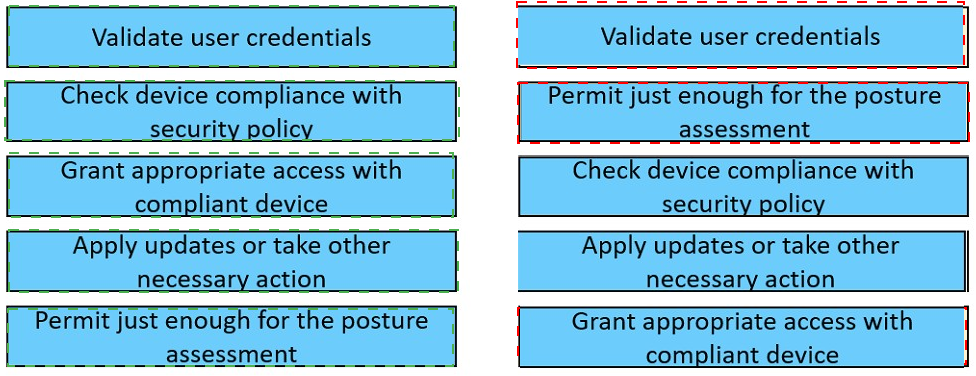
Drag and drop the posture assessment flow actions from the left into a sequence on the
Timed mock exam
Experience the real exam before you take it
Our timed 350 701 mock exam mirrors the format, number of questions and time limit of the official exam, so you can build speed and stamina.