Free practice test

Free 300 215 practice questions

180 questions Updated 27-Nov-2026 62 free questions

Get familiar with the Conducting Forensic Analysis and Incident Response Using Cisco CyberOps Technologies (CBRFIR) question format and find your weak spots before exam day. Work through the free 300-215 practice questions below, check each answer and read the explanation.

Better Preparation. Better Results. 300 215 Practice exam help candidates identify knowledge gaps, improve accuracy, and build exam confidence.

Question 1 Choose 1
Refer to the exhibit.

The application x-dosexec with hash 691c65e4fb1d19f82465df1d34ad51aaeceba14a78167262dc7b2840a6a6aa87 is reported as malicious and labeled as "Trojan.Generic" by the threat intelligence tool. What is considered an indicator of compromise?
Question 2 Choose 1
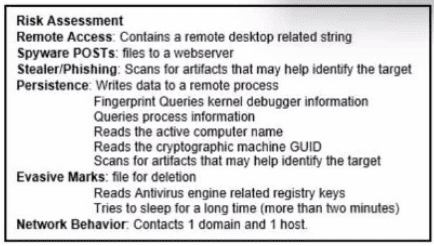
Refer to the exhibit.
Question 3 Choose 1
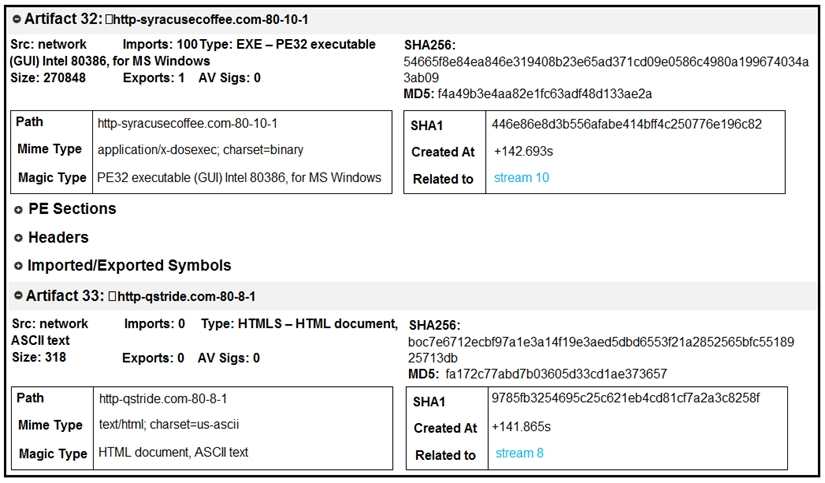
Refer to the exhibit.

What do these artifacts indicate?
Question 4 Choose 1
Which issue is associated with gathering evidence from virtualized environments provided by major cloud vendors?
Question 5 Choose 1
An employee receives an email from a “trusted” person containing a hyperlink that is malvertising. The employee clicks the link and the malware downloads. An information analyst observes an alert at the SIEM and engages the cybersecurity team to conduct an analysis of this incident in accordance with the incident response plan. Which event detail should be included in this root cause analysis?
Question 6 Choose 2
During a routine security audit, an organization's security team detects an unusual spike in network traffic originating from one of their internal servers. Upon further investigation, the team discovered that the server was communicating with an external IP address known for hosting malicious content. The security team suspects that the server may have been compromised. As the incident response process begins, which two actions should be taken during the initial assessment phase of this incident? (Choose two.)
Question 7 Choose 1
Which technique exemplifies an antiforensic technique?
Question 8 Choose 1
What are YARA rules based upon?
Question 9 Choose 2
A security team detected an above-average amount of inbound tcp/135 connection attempts from unidentified senders. The security team is responding based on their incident response playbook. Which two elements are part of the eradication phase for this incident?
(Choose two.)
Question 10 Choose 2
A company had a recent data leak incident. A security engineer investigating the incident discovered that a malicious link was accessed by multiple employees. Further investigation revealed targeted phishing attack attempts on macOS systems, which led to backdoor installations and data compromise. Which two security solutions should a security engineer recommend to mitigate similar attacks in the future? (Choose two.)
Timed mock exam

Experience the real exam before you take it

Our timed 300 215 mock exam mirrors the format, number of questions and time limit of the official exam, so you can build speed and stamina.

Take the 300 215 mock exam
  • Build exam stamina Stay focused for the full exam time.
  • Master time management Learn to pace yourself so you never rush.
  • A new test every time Random questions from the full pool.
  • Unlimited attempts Practise until you're confident.

What to Study for the Cisco 300-215 CBRFIR Exam: Blueprint and Preparation Strategy

Understanding the Cisco 300-215 CBRFIR Exam

The Cisco 300-215 CBRFIR exam evaluates candidates' understanding of digital forensic analysis, cybersecurity incident response, threat investigation, and security technologies. This 90-minute exam is part of the CCNP Cybersecurity certification pathway.

Cisco 300-215 CBRFIR Exam Domains and Weightage

The official Cisco CBRFIR v1.2 exam blueprint includes five major domains:

Exam DomainWeightage
Fundamentals20%
Forensics Techniques20%
Incident Response Techniques30%
Forensics Processes15%
Incident Response Processes15%
Total100%

Important Topics to Prepare

Incident Response Techniques – 30%

This is the highest-weighted domain. Focus on security alert investigation, attack vectors, indicators of compromise (IOCs), threat intelligence, event correlation, and incident mitigation strategies.

Fundamentals – 20%

Study forensic investigation principles, root cause analysis, anti-forensic techniques, malware obfuscation, YARA rules, memory forensics, and cloud evidence collection.

Forensics Techniques – 20%

Prepare malware analysis, MITRE ATT&CK, endpoint investigations, SIEM logs, network traffic analysis, and basic Python, PowerShell, or Bash scripting.

Forensics Processes – 15%

Understand suspicious file analysis, web server log investigations, network traffic examination using Wireshark and NetFlow, and binary file analysis.

Incident Response Processes – 15%

Review incident response playbooks, investigation workflows, endpoint scanning, malware analysis reports, and threat intelligence standards such as STIX and TAXII.

Which Exam Topics Should You Prioritize?

Incident Response Techniques deserves the most attention because it represents 30% of the exam blueprint. Fundamentals and Forensics Techniques contribute another 40%.

Together, these three domains account for 70% of the exam content, making them important preparation priorities.

Recommended Hands-On Practice

Candidates should gain practical experience with:

  • Analyzing network traffic using Wireshark.

  • Identifying suspicious activity in security logs.

  • Investigating malware and indicators of compromise.

  • Interpreting cybersecurity alerts and incident reports.

  • Applying incident response procedures to realistic scenarios.

Improve Your Preparation with Cistified Practice Tests

Cistified.com provides free Cisco 300-215 CBRFIR practice questions and paid mock tests to help candidates evaluate their knowledge.

Free practice questions help identify weak areas, while paid mock exams provide additional exam-style practice, support time management, and help candidates assess their readiness.

Final Tips for Cisco CBRFIR Exam Success

Follow the official Cisco exam blueprint, prioritize high-weightage domains, practice forensic investigation scenarios, and review incorrect answers. Combine hands-on exercises with regular mock testing to improve your understanding and confidence before exam day.