Topic · 39 of 114 questions freeTopic 2, Exam Pool B
Question 51Choose 1
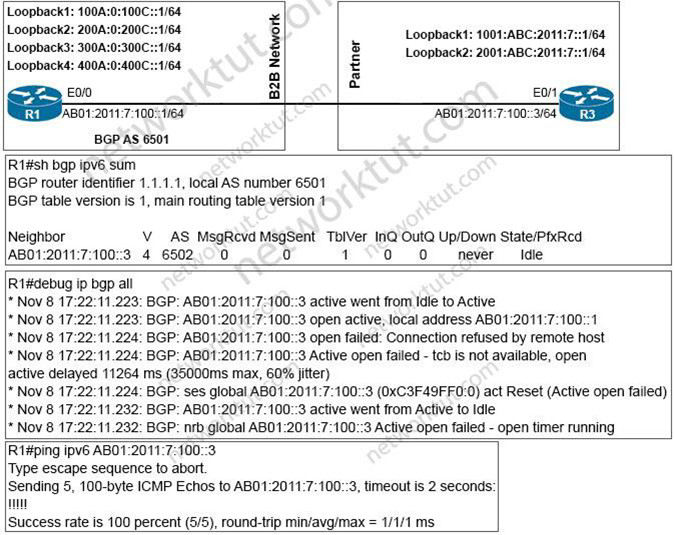
Refer to the exhibit.
An engineer configured BGP between routers R1 and R3 The BOP peers cannot establish neighbor adjacency to be able to exchange routes. Which configuration resolves this issue?
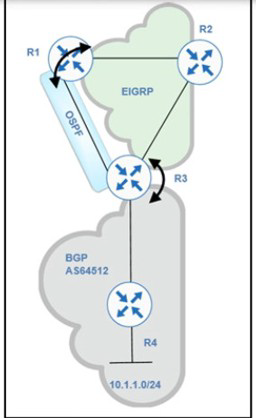
Routing protocols are mutually redistributed on R3 and R1. Users report intermittent connectivity to services hosted on the 10.1.1.0/24 prefix. Significant routing update changes are noticed on R3 when the show ip route profile command is run. How must the services be stabilized?
Correct answer:
B.
The routing loop must be fixed by reducing the admin distance of iBGP from 200 to 100 on R3
Question 53Choose 1
Refer to the exhibit.
R1 is being monitored using SNMP and monitoring devices are getting only partial information. What action should be taken to resolve this issue?
Correct answer:
D.
Modify the access list to add a second line to allow udp any any eq snmp
Question 54Choose 2
Refer to Exhibit. A network administrator has successfully configured DMVPN topology between a hub and two spoke routers. Which two configuration commands should establish direct communications between spoke 1 and spoke 2 without going through the hub? (Choose two).
Correct answer:
C.
At the hub router, configure ip nhrp redirect the command
D.
At the spoke routers, configure the ip nhrp shortcut command
Question 55Choose 1
Refer to the exhibit.
A client is concerned that passwords are visible when running this show archive log config all. Which router configuration is needed to resolve this issue?
Correct answer:
D.
MASS-RTR(config-archive-log-cfg)#hidekeys
Question 56Choose 1
Refer to the exhibit.
PC-2 failed to establish a Telnet connection to the terminal server. Which configuration resolves the issue?
Correct answer:
A.
Option A
Question 57Choose 1
What is the minimum time gap required by the local system before putting a BFD control packet on the wire?
Correct answer:
C.
Desired Min TX Interval
Question 58Choose 1
An engineer configured policy-based routing for a destination IP address that does not exist in the routing table. How is the packet treated through the policy for configuring the set ip default next-hop command?
Correct answer:
D.
Packets are forwarded to the specific next hop
Question 59Choose 1
Refer to the exhibits.
A user on the 192.168.1.0/24 network can successfully ping 192.168.3.1, but the administrator cannot ping 192.168.3.1 from the LA router. Which set of configurations fixes the issue?
Correct answer:
B.
Option B
Question 60Choose 1
Refer to Exhibit:
AS 111 wanted to use AS 200 as the preferred path for 172.20.5.0/24 and AS 100 as the backup. After the configuration, AS 100 is not used for any other routes. Which configuration resolves the issue?
Correct answer:
A.
route-mmap SETLP permit 10 match ip address prefix-list PLIST1 set local-preference 99 route-map SETLP permit 20
Explanation: There is an implicit deny all at the end of any route-map so all other traffic that does not match 172.20.5.0/24 would be dropped. Therefore we have to add a permitsequence at the end of the route-map to allow other traffic. The default value of Local Preference is 100 and higher value is preferred so we have to set the local preference of AS100 lower than that of AS200.
Timed mock exam
Experience the real exam before you take it
Our timed 300 410 mock exam mirrors the format, number of questions and time limit of the official exam, so you can build speed and stamina.