• 4.9/5.0
  • 547 Questions
  • Updated on: 12-Oct-2026
  • Implementing and Operating Cisco Service Provider Network Core Technologies (350-501 SPCOR)
  • 25475 Prepared

Free Cisco 350-501 Practice Questions 2026 | Implementing and Operating Cisco Service Provider Network Core Technologies (350-501 SPCOR)


Prepare smarter for your Implementing and Operating Cisco Service Provider Network Core Technologies (350-501 SPCOR) certification. Our carefully curated free Cisco 350-501 350-401 practice questions 2026 mirror the actual exam format and difficulty level. Each 350-501 practice test question includes detailed explanations to help you understand the 'why' behind every answer. Start your journey to becoming Implementing and Operating Cisco Service Provider Network Core Technologies (350-501 SPCOR) certified today.


Which two uses of the YANG data modeling language are true? (Choose two)

A. It can be used to shape slats data of network elements

B. It can be used to access a device by HTTP

C. It can be used to model the configuration used by NETCONF operations

D. It can be used to replace the OSI model for troubleshooting

E. It can be used to replace RESTCONF as a mechanism to install and manipulate configuration

A.   It can be used to shape slats data of network elements
C.   It can be used to model the configuration used by NETCONF operations

Explanation

The correct answers are A and C.

YANG (Yet Another Next Generation) ek data modeling language hai jo network devices ke configuration aur state data ko model karne ke liye use hoti hai. Ye NETCONF aur RESTCONF protocols ke saath mil kar kaam karti hai.

A. It can be used to shape data of network elements.
– YANG ka primary purpose yehi hai ke woh network elements ke configuration data aur state data ko structure (shape kare). YANG modules define karte hain ke device ka data kaise organized hoga — containers, lists, leafs, leaf-lists ke through. Is se data consistent aur machine-readable format mein aata hai.

C. It can be used to model the configuration used by NETCONF operations.
– YANG originally NETCONF ke liye design kiya gaya tha. NETCONF operations (``, ``, ``, etc.) YANG models ke through data ko represent karte hain. YANG hi batata hai ke NETCONF ke through kaun sa configuration data valid hai aur kaise structured hoga.

Why the Other Options Are Incorrect

B. It can be used to access a device by HTTP.
– YANG khud kisi device ko access nahi karta. Ye sirf data model hai. Access ke liye NETCONF (SSH), RESTCONF (HTTPS), ya gNMI jaise protocols chahiye. YANG HTTP access mechanism nahi hai.

D. It can be used to replace the OSI model for troubleshooting.
– YANG aur OSI model ka koi taalluq nahi. OSI model network communication layers ka conceptual framework hai; YANG data modeling language hai. Ye dono completely different concepts hain.

E. It can be used to replace RESTCONF as a mechanism to install and manipulate configuration.
– YANG aur RESTCONF alag cheezein hain aur ek doosre ke complementary hain. RESTCONF ek protocol hai jo YANG-modeled data ko HTTPS ke through transport karta hai. YANG RESTCONF ko replace nahi karta — dono saath mil kar kaam karte hain.

Reference

Cisco Press: Implementing and Operating Cisco Service Provider Network Core Technologies (SPCOR) 350-501 Official Cert Guide – Chapter on YANG Data Modeling, NETCONF, and RESTCONF.

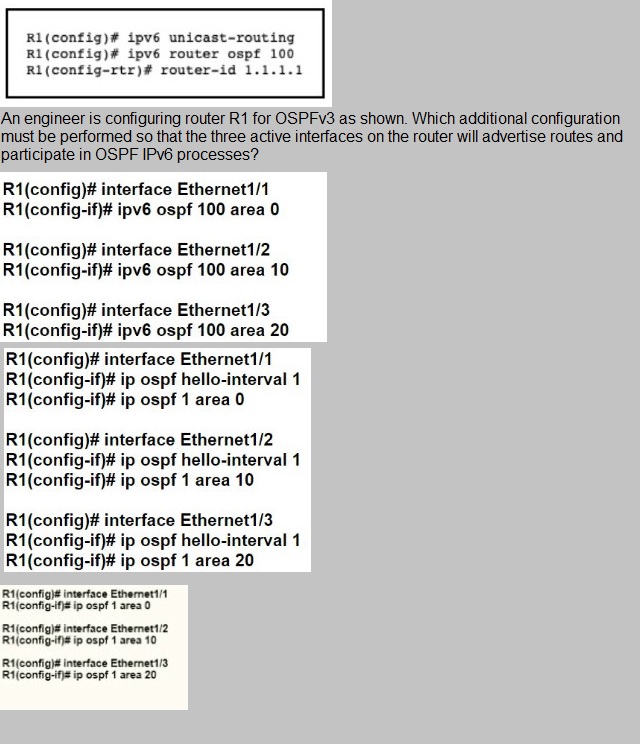
Refer to the exhibit.


Explanation

The correct answer is A.

Exhibit mein R1 par IPv6 unicast-routing enabled hai aur OSPFv3 process 100 configure hai (`ipv6 router ospf 100` with router-id 1.1.1.1). OSPFv3 mein interfaces ko enable karne ke liye interface level par `ipv6 ospf area ` command lagani hoti hai.

Option A exactly yahi karta hai:
* Interface Ethernet1/1 → `ipv6 ospf 100 area 0`
* Interface Ethernet1/2 → `ipv6 ospf 100 area 10`
* Interface Ethernet1/3 → `ipv6 ospf 100 area 20`

Ye teeno active interfaces ko OSPFv3 process 100 ke saath sahi areas mein enable karta hai, jisse woh routes advertise karein aur OSPFv3 processes mein participate karein.

Why the Other Options Are Incorrect

B. Option B
– Ye IPv4 OSPF commands use kar raha hai (`ip ospf hello-interval`, `ip ospf 1 area 0`). Exhibit mein IPv6 OSPF (OSPFv3) configure hai, IPv4 OSPF nahi. Is liye ye galat hai.

C. Option C
– Ye bhi IPv4 OSPF commands use kar raha hai (`ip ospf 1 area 0`, `ip ospf 1 area 10`, `ip ospf 1 area 20`) jo IPv6 OSPFv3 scenario mein applicable nahi hain.

Reference

Cisco Press: Implementing and Operating Cisco Service Provider Network Core Technologies (SPCOR) 350-501 Official Cert Guide – Chapter on OSPFv3 Configuration for IPv6.

Cisco Documentation: "IPv6 OSPFv3 Configuration Guide" – Section on Enabling OSPFv3 on Interfaces.

Which regular expression query modifier function indicates the start of a string?

A. ^

B. [^]

C. +

D. $

A.   ^

Explanation

The correct answer is A. ^

Regular expression mein `^` (caret) character string ke start ko indicate karta hai. Jab aap `^` ko regex ke shuru mein use karte hain, to ye ensure karta hai ke match sirf string ke beginning se ho. Misal ke tor par, regex `^BGP` sirf un strings se match karega jo "BGP" se shuru hoti hain, chahe baad mein kuch bhi ho. Ye anchoring character hai jo position specify karta hai, na ke koi actual character match karta hai.

Why the Other Options Are Incorrect

B. [^]
– Ye negated character class hai (jab square brackets ke andar `^` ho). Ye kisi bhi aise character se match karta hai jo specified set mein nahi hai. String ke start ko indicate nahi karta.

C. +
– Ye quantifier hai jo batata hai ke preceding element ek ya zyada baar repeat ho sakta hai. Ye string ke start ya end se related nahi.

D. $
– Ye string ke end ko indicate karta hai (opposite of `^`). Ye regex ke aakhir mein use hota hai taake match string ke end tak ho.

Reference

Cisco Press: Implementing and Operating Cisco Service Provider Network Core Technologies (SPCOR) 350-501 Official Cert Guide – Chapter on Regular Expressions and Route Filtering.

Which control plane protocol is used between Cisco SD-WAN routers and vSmart controllers?

A. OTCP

B. OMP

C. UDP

D. BGP

B.   OMP

Explanation

The correct answer is B. OMP.

OMP (Overlay Management Protocol) Cisco SD-WAN ka control plane protocol hai jo SD-WAN routers (vEdge/cEdge) aur vSmart controllers ke beech chalta hai. OMP ka kaam hai:

- Routing information exchange karna (prefixes, TLOCs, VPN labels)
- Policy propagation (centralized control policy, application-aware routing policy)
- Data plane encryption keys aur TLOC (Transport Locator) information distribute karna
- Service chaining aur network topology information share karna

OMP TCP port 4321 par chalta hai aur ye Cisco SD-WAN architecture ka core control plane protocol hai. Isi liye SD-WAN routers aur vSmart controllers ke beech OMP sessions establish hote hain.

Why the Other Options Are Incorrect

A. OTCP – Aisa koi standard control plane protocol Cisco SD-WAN mein nahi hai. Ye distractor hai.

C. UDP – UDP ek transport layer protocol hai, control plane protocol nahi. OMP TCP par chalta hai, UDP par nahi.

D. BGP – BGP traditional routing protocol hai jo service provider core mein use hota hai. Cisco SD-WAN mein BGP optional hai (data center ya external connectivity ke liye), lekin SD-WAN routers aur vSmart ke beech OMP hi primary control plane protocol hai.

Reference

- Cisco Press: Implementing and Operating Cisco Service Provider Network Core Technologies (SPCOR) 350-501 Official Cert Guide – Chapter on Cisco SD-WAN Architecture and Overlay Management Protocol (OMP). ```

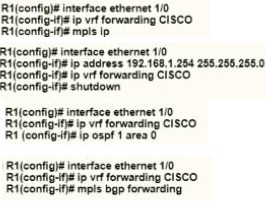
An network engineer is deploying VRF on ASBR router R1. The interface must have
connectivity over an MPLS VPN inter-AS Option AB network. Which configuration must the
engineer apply on the router to accomplish this task?
A. Option A

B. Option B

C. Option C

D. Option D

D.   Option D

Explanation

The correct answer is D.

Is scenario mein ASBR router R1 par VRF configure karni hai jo MPLS VPN Inter-AS Option AB network ke liye connectivity provide kare. Inter-AS Option AB mein ASBR routers VRF-aware hote hain aur unhe MPLS BGP forwarding enable karna hota hai taake labeled traffic VRF ke andar forward ho sake.

Option D mein sahi combination hai:

Why the Other Options Are Incorrect

A. Option A
– `ip vrf forwarding CISCO` aur `mpls ip` hai, lekin `ip address` missing hai. Interface par IP address ke bina VRF connectivity kaam nahi karegi.

B. Option B
– `ip address` aur `ip vrf forwarding CISCO` hai, lekin interface `shutdown` hai (administratively down). Ye connectivity provide nahi karega.

C. Option C
– `ip vrf forwarding CISCO` aur `ip ospf 1 area 0` hai, lekin `mpls bgp forwarding` missing hai. Inter-AS Option AB ke liye MPLS BGP forwarding zaroori hai, OSPF alone kaafi nahi.

Reference

- Cisco Press: Implementing and Operating Cisco Service Provider Network Core Technologies (SPCOR) 350-501 Official Cert Guide – Chapter on MPLS VPN Inter-AS Options (Option A, B, C, and AB). ```

Which statement about Network Services Orchestrator (NSO) is true?

A. It is used only in service provider environments

B. It can be used only with XML coding

C. It uses YANG modeling language to automate devices

D. It must use SDN as an overlay for addressing

C.   It uses YANG modeling language to automate devices

Explanation

The correct answer is C. It uses YANG modeling language to automate devices.

Cisco Network Services Orchestrator (NSO) ek automation aur orchestration platform hai jo YANG data modeling language par based hai. NSO model-driven architecture use karta hai jismein network services aur devices ko YANG models ke through represent kiya jata hai. Ye YANG models NSO ke andar device configuration, service provisioning, aur automation workflows ko define karte hain. NSO NETCONF, RESTCONF, CLI, SNMP jaise multiple southbound protocols ko support karta hai, lekin core modeling language YANG hi hai.

Why the Other Options Are Incorrect

A. It is used only in service provider environments.
– NSO sirf service provider environments tak mehdood nahi hai; ye enterprise, data center, aur cloud environments mein bhi use hota hai. Cisco NSO multi-domain automation ke liye flexible platform hai.

B. It can be used only with XML coding.
– NSO YANG models use karta hai, jo XML, JSON, ya CLI formats mein encode ho sakte hain. Ye sirf XML tak mehdood nahi hai.

D. It must use SDN as an overlay for addressing. – NSO ko SDN overlay ki zaroorat nahi hoti. Ye traditional networks, hybrid networks, aur SDN environments — sab ke saath kaam kar sakta hai.

Reference

- Cisco Press: Implementing and Operating Cisco Service Provider Network Core Technologies (SPCOR) 350-501 Official Cert Guide – Chapter on Network Services Orchestrator (NSO) and YANG-Based Automation. ```

Which utility can you use to locate MPLS faults?

A. MPLS traceroute

B. EEM

C. MPLS LSP ping

D. QoS

C.   MPLS LSP ping

Explanation

The correct answer is C. It uses YANG modeling language to automate devices.

Cisco Network Services Orchestrator (NSO) ek automation aur orchestration platform hai jo YANG data modeling language par based hai. NSO model-driven architecture use karta hai jismein network services aur devices ko YANG models ke through represent kiya jata hai. Ye YANG models NSO ke andar device configuration, service provisioning, aur automation workflows ko define karte hain. NSO NETCONF, RESTCONF, CLI, SNMP jaise multiple southbound protocols ko support karta hai, lekin core modeling language YANG hi hai.

Why the Other Options Are Incorrect

A. It is used only in service provider environments.
– NSO sirf service provider environments tak mehdood nahi hai; ye enterprise, data center, aur cloud environments mein bhi use hota hai. Cisco NSO multi-domain automation ke liye flexible platform hai.

B. It can be used only with XML coding.
– NSO YANG models use karta hai, jo XML, JSON, ya CLI formats mein encode ho sakte hain. Ye sirf XML tak mehdood nahi hai.

D. It must use SDN as an overlay for addressing.
– NSO ko SDN overlay ki zaroorat nahi hoti. Ye traditional networks, hybrid networks, aur SDN environments — sab ke saath kaam kar sakta hai.

Reference

- Cisco Press: Implementing and Operating Cisco Service Provider Network Core Technologies (SPCOR) 350-501 Official Cert Guide – Chapter on Network Services Orchestrator (NSO) and YANG-Based Automation.

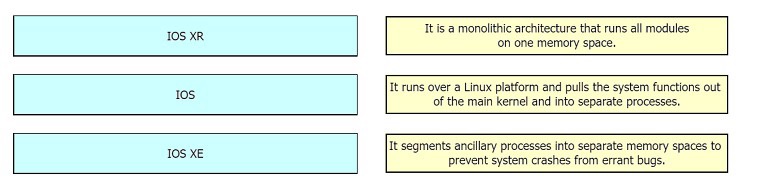
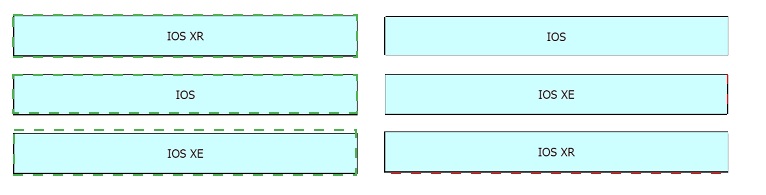
Drag and drop the OSs from the left onto the correct deceptions on the right.


Explanation

IOS XR ek microkernel-based operating system hai jo Linux platform par chalta hai. Ismein system functions (drivers, protocol stacks, etc.) ko main kernel se bahar nikaal kar separate processes mein daala jata hai. Is se ek process crash ho jaye to poora system down nahi hota — high availability milti hai, jo service provider core routers ke liye critical hai.

IOS (Classic) ek monolithic architecture hai jismein saare modules ek hi memory space mein chalte hain. Iska matlab hai ke agar koi ek module crash ho jaye to poora router crash ho sakta hai — is liye ise legacy architecture kaha jata hai.

IOS XE ek hybrid architecture hai jo classic IOS aur modern Linux-based architecture ko combine karti hai. Ismein ancillary processes (non-core functions) ko separate memory spaces mein segment kiya jata hai taake errant bugs se system crash na ho. Core IOS functions alag process mein chalte hain, aur baaki services (e.g., manageability, control plane) separate processes mein.

Reference

- Cisco Press: Implementing and Operating Cisco Service Provider Network Core Technologies (SPCOR) 350-501 Official Cert Guide – Chapter on Cisco IOS, IOS XE, and IOS XR Architecture.
How does model-driven telemetry use YANG?

A. to reset network devices that malfunction

B. to set informs and traps on clients to report back to a centralized server

C. to subscribe to data that is streamed from a device

D. to poll network devices on a 30-minute interval

C.   to subscribe to data that is streamed from a device

Explanation

The correct answer is C. to subscribe to data that is streamed from a device.

Model-Driven Telemetry (MDT) ek push-based mechanism hai jismein network devices continuously apna data stream karte hain ek telemetry collector/centralized server ki taraf. YANG models yahan data structure aur schema define karte hain — yani kaun sa data available hai, uska format kya hai, aur usse kaise access kiya jaye. MDT mein subscription ke through device ko bataya jata hai ke kaun sa YANG-modeled data stream karna hai (e.g., interface counters, CPU stats). Phir device us data ko periodically ya on-change stream karta hai. Is se real-time visibility milti hai, polling ki zaroorat nahi padti.

Why the Other Options Are Incorrect

A. to reset network devices that malfunction.
– YANG data modeling language hai, device reset karne ka tool nahi. Device reset alag commands/mechanisms se hota hai.

B. to set informs and traps on clients to report back to a centralized server.
– Informs aur traps SNMP ke concepts hain (traditional monitoring). MDT SNMP ki jagah push-based streaming use karta hai, jo zyada efficient aur scalable hai.

D. to poll network devices on a 30-minute interval.
– Polling SNMP-based monitoring ka tareeqa hai. MDT polling nahi karta — ye push-based hai jismein device khud data stream karta hai, usually seconds ke interval par. 30-minute polling bilkul MDT ke concept ke khilaf hai.

Reference

- Cisco Press: Implementing and Operating Cisco Service Provider Network Core Technologies (SPCOR) 350-501 Official Cert Guide – Chapter on Model-Driven Telemetry and YANG.


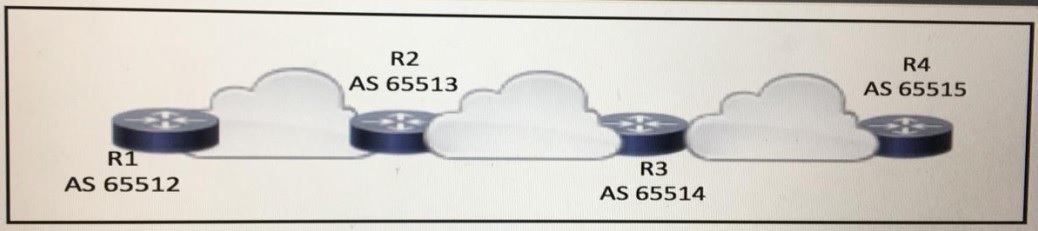
BGPsec is implemented on R1. R2. R3. and R4 BGP peering is established between
neighboring autonomous systems Which statement about implementation is true?

A. BGP updates from the eBGP peers are appended with an additional AS path value that is statically set by the domain administrator

B. BGP updates from the iBGP peers are appended with a community of local-as

C. BGP updates from the all BGP peers are appended with a community of no export

D. BGP updates from the eBGP peers are appended with a BGPsec attribute sequence that includes a public key hash and digital signature

D.   BGP updates from the eBGP peers are appended with a BGPsec attribute sequence that includes a public key hash and digital signature

Explanation

The correct answer is D. BGP updates from the eBGP peers are appended with a BGPsec attribute sequence that includes a public key hash and digital signature.

BGPsec (BGP Security) ek extension hai jo RFC 8205 mein define kiya gaya hai. Iska maqsad BGP route announcements ko cryptographically validate karna hai taake route hijacking aur prefix spoofing jaise attacks prevent ho sakein. Ismein har eBGP peer jab route advertise karta hai, to woh apne update mein ek BGPsec_PATH attribute append karta hai jismein:

- Public key hash (router ka cryptographic identity)
- Digital signature (jo update ko authenticate karta hai)

Har AS apni signature add karta hai, aur receiving router chain ko verify karta hai. Is se ye confirm hota hai ke AS path genuinely usi sequence se guzra hai. Yahi BGPsec ka core mechanism hai.

Why the Other Options Are Incorrect

A. BGP updates from the eBGP peers are appended with an additional AS path value that is statically set by the domain administrator. – AS path values normally BGP ke through dynamically add hote hain, static administrator set nahi karta. BGPsec AS path ko cryptographically sign karta hai, statically append nahi.

B. BGP updates from the iBGP peers are appended with a community of local-as. – BGPsec iBGP peers par apply nahi hota; ye sirf eBGP peering par kaam karta hai. Saath hi community attributes BGPsec ka hissa nahi hain.

C. BGP updates from the all BGP peers are appended with a community of no export. – `no-export` ek well-known BGP community hai jo route propagation control karti hai, BGPsec se iska koi taalluq nahi. Saath hi BGPsec sirf eBGP par lagta hai, "all BGP peers" par nahi.

Reference

- Cisco Press: Implementing and Operating Cisco Service Provider Network Core Technologies (SPCOR) 350-501 Official Cert Guide – Chapter on BGP Security and BGPsec.

Page 1 out of 55 Pages

Why Prepare with Our Cisco 350-501 Practice Test?


Our 350-501 practice tests are designed to closely match the real Implementing and Operating Cisco Service Provider Network Core Technologies (350-501 SPCOR) exam format and difficulty. Each question helps you understand the key concepts. With regularly updated content, detailed Implementing and Operating Cisco Service Provider Network Core Technologies (350-501 SPCOR) exam questions explanations, and a user-friendly interface, you can confidently assess your knowledge and improve your Cisco exam readiness.

Cisco 350-501 Exam Details


Exam Code: 350-501
Exam Name: Implementing and Operating Cisco Service Provider Network Core Technologies (SPCOR)
Certification Name: CCNP Service Provider
Certification Provider: Cisco
Exam Questions: 90–110 questions
Exam Time: 120 minutes
Passing Score: Variable (750-850 / 1000 Approx.)